
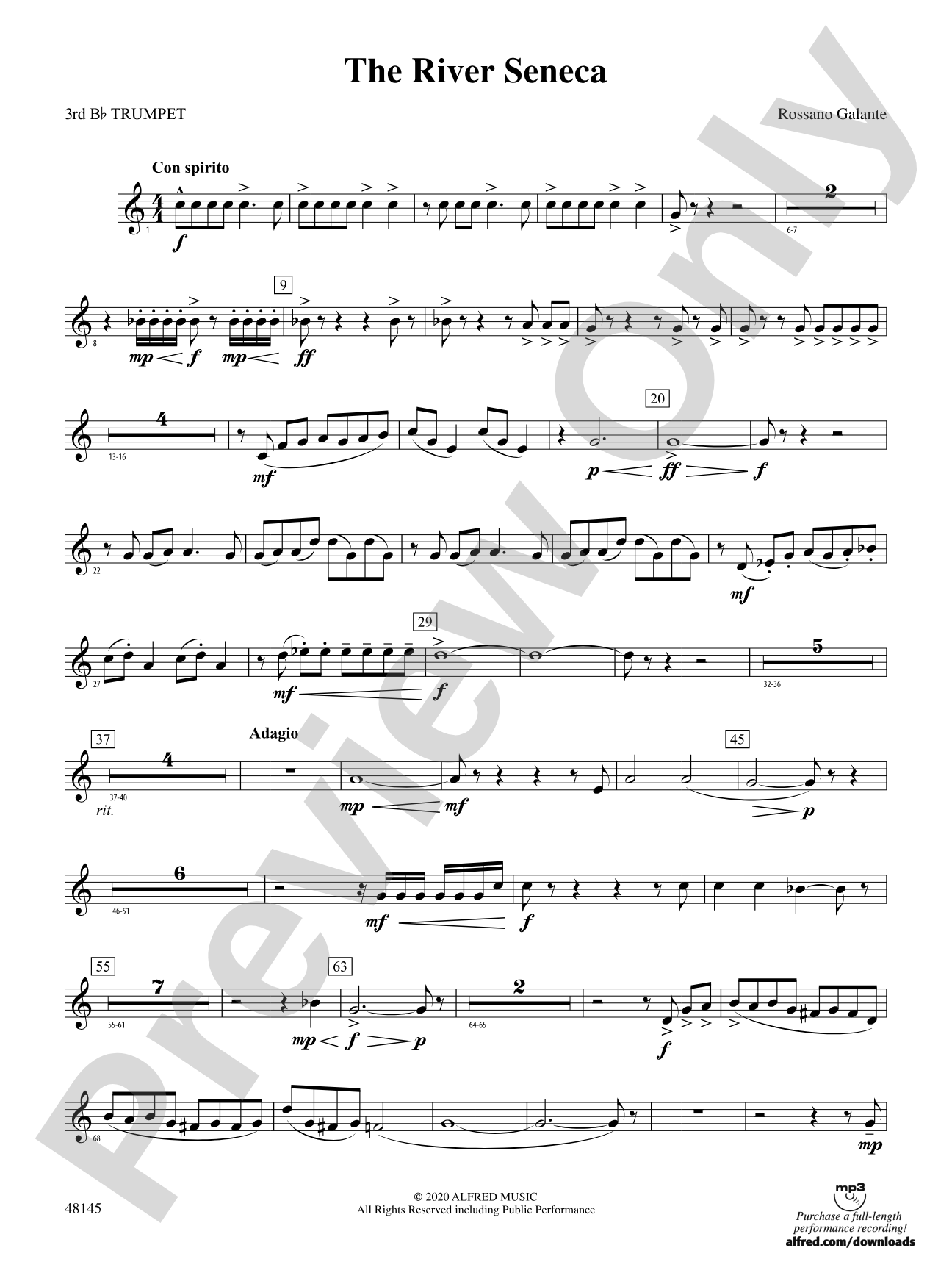

The River Seneca: 3rd B-flat Trumpet
By Rossano Galante
Grade: 4.5 (Medium Advanced)
Item: 00-PC-0018460_T3
$3.00
Pickup currently not available
Description
Capturing the proud spirit of the Salamanca community, this piece begins with powerful brass fanfares and flowing melodic woodwind lines that modulate, ebb and flow just as the Allegany River does. Lyrical themes and heroic melodies captures the strength of the Seneca Nation. (5:00) This title is available in MakeMusic Cloud.


Don't just read it, hear it, play along with it, and watch your students grow with it. In MakeMusic Cloud, The River Seneca: 3rd B-flat Trumpet comes alive with professional accompaniment, adjustable tempo, and built-in practice tools that turn solo practice into real progress.
Open in the Player
Jump straight in and assign it today.
Start Your Free Trial
Open this title and explore the full library in minutes.
Sample Audio
1
Audio File
--:--
0:00
0:00
Sample Video
Additional Details
Series:
Alfred Concert Band
Publisher:
Alfred Music
Page Count:
264
SKU:
00-PC-0018460_T3
More about this title
About the Composer: Rossano Galante

Rossano Galante grew up in Buffalo, New York and earned his Bachelor of Arts in Trumpet Performance from SUNY Buffalo in 1992. That same year, he was one of only nineteen applicants worldwide selected for the University of Southern California's Film Scoring Program, where he studied composition under the legendary Jerry Goldsmith, Academy Award winner for The Omen.
Since relocating to California in 1999, Galante has established himself as a prolific orchestrator and composer working across film, concert music, and band literature. He has orchestrated over eighty studio films including blockbusters such as The Super Mario Brothers Movie, Fast X, Venom: Let There Be Carnage, A Quiet Place, Avengers: Age of Ultron, and The Mummy, collaborating with Oscar-nominated composers including Marco Beltrami and Brian Tyler. Simultaneously, Galante maintains an active career as a concert composer, having published more than 68 compositions through Alfred, Schirmer, Hafabra, C.L. Barnhouse, and other major publishers, earning commissions from bands and orchestras worldwide.
Why we love this
Galante brings the cinematic sensibility of his film scoring background directly into the concert band idiom without sacrificing genuine musical substance. The piece moves beyond generic Americana by grounding itself in specific regional identity and the cultural significance of the Seneca Nation, making it a thoughtful programming choice that respects its subject. The musical architecture (brass fanfares anchoring lyrical woodwind passages, dynamic modulations mirroring natural movement) demonstrates the kind of sophisticated orchestration that keeps both players and audiences engaged throughout its five-minute span.
What to expect
The music captures movement and landscape through sound. Brass voices announce with nobility and strength, while the woodwinds weave lyrical passages that ebb and flow like water itself, creating moments of both grandeur and intimate beauty. The overall effect is both celebratory and reflective, honoring the pride and resilience suggested by its subject matter.
Who it's for
Directors preparing a contest or festival program at the 4.5 grade level will find a piece that balances technical demands with musical maturity. This work suits bands with solid fundamentals who are ready for music that asks them to play idiomatically across multiple moods and textures. The piece rewards both the Salamanca community (its direct subject) and any ensemble seeking substantial, regionally informed band literature with cinematic depth.
How to get the most out of it
- Balance the opening brass fanfares so they establish presence without overwhelming the subsequent woodwind themes; the piece's power comes from architectural contrast, not volume alone.
- Prepare the ensemble to navigate the modulations and dynamic ebbs with a conductor who clearly telegraphs the transitions; what flows naturally on paper requires thoughtful phrase shaping in rehearsal.
- Attend to the interaction between heroic melodic material and flowing accompaniment textures; clarity in voice leading across the sections will reveal the full scope of Galante's orchestration.
- Use the contest/festival context as motivation during sectional rehearsals to refine articulation and ensemble blend, particularly in moments where the piece shifts between bold and lyrical writing.
How to use it
Program this as a centerpiece work on a festival program or contest schedule where it can anchor a set of varied repertoire. The five-minute duration and medium-advanced difficulty make it ideal for spring concert programming when the ensemble has developed the technical security to handle modulations and dynamic nuance. Its concert band provenance and regional content also suit community-focused concert themes or programs celebrating local heritage.
Skills your students will build
- Managing dynamic and textural contrast across multiple sections simultaneously
- Executing smooth modulations while maintaining ensemble cohesion
- Balancing lyrical woodwind lines with supportive brass and low-end writing
- Responding to conductor cues for sectional entrances and transitions in flowing, less-metronomic passages
- Sustaining musical phrase shapes across longer lines without rhythmic fragmentation