
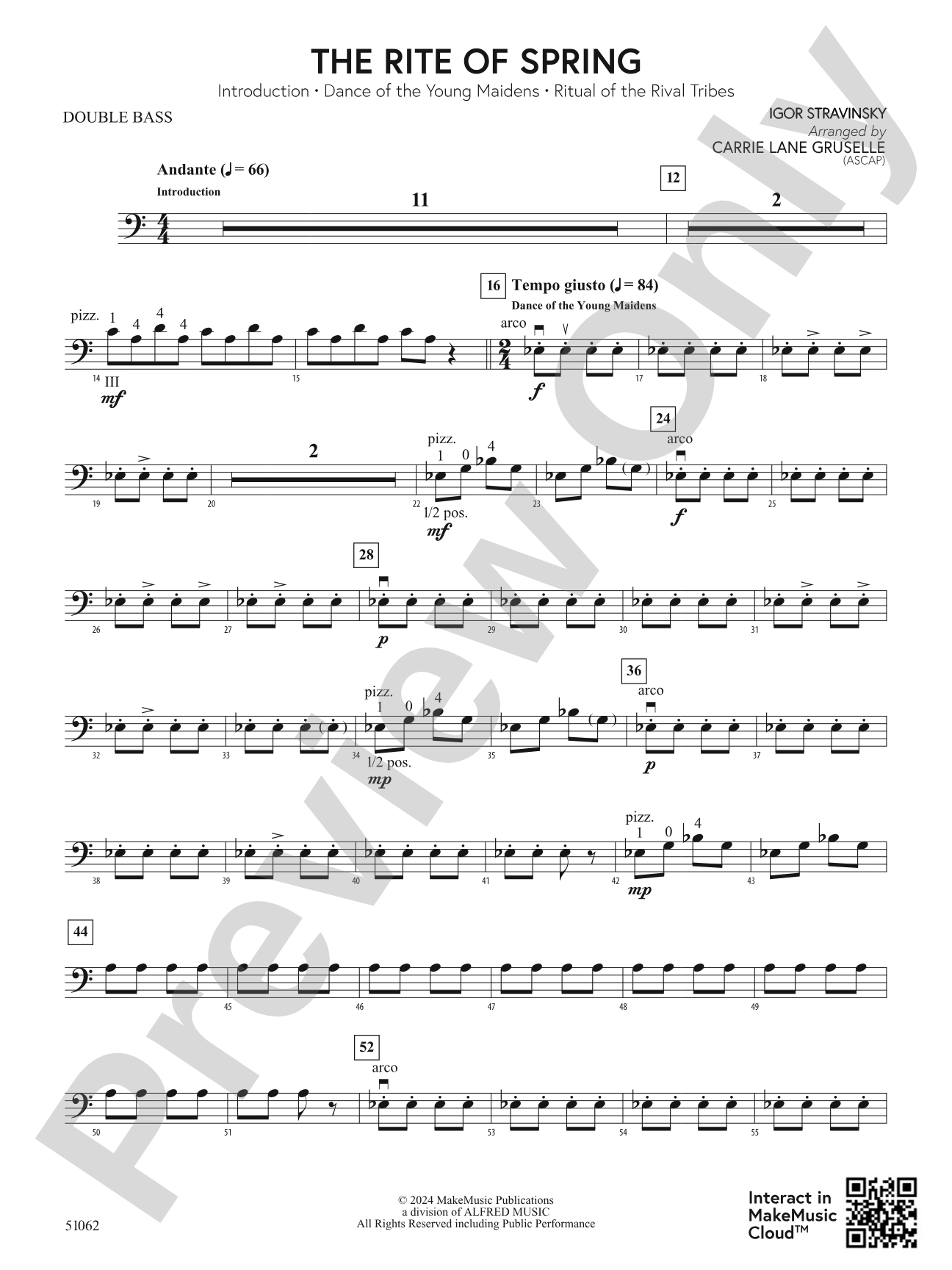

The Rite of Spring: String Bass
Featuring: Introduction / Dance of the Young Maidens / Ritual of the Rival Tribes
By Igor Stravinsky / arr. Carrie Lane Gruselle
Grade: 2.5
Item: 00-PC-0019260_SB
$3.00
Pickup currently not available
Description
Igor Stravinsky's monumental score to The Rite of Spring changed the landscape of orchestral music forever, and this landmark work is now available to younger students who want to experience the intense and raw drama of the original! Featuring music from the first act, this arrangement by Carrie Lane Gruselle is absolutely stunning yet very achievable. (3:20)


Don't just read it, hear it, play along with it, and watch your students grow with it. In MakeMusic Cloud, The Rite of Spring: String Bass comes alive with professional accompaniment, adjustable tempo, and built-in practice tools that turn solo practice into real progress.
Open in the Player
Jump straight in and assign it today.
Start Your Free Trial
Open this title and explore the full library in minutes.
Sample Audio
1
Audio File
--:--
0:00
0:00
Sample Video
Additional Details
Series:
MakeMusic Intermediate Strings
Publisher:
MakeMusic Publications
SKU:
00-PC-0019260_SB
More about this title
About the Composer: Igor Stravinsky
Igor Stravinsky (1882-1971) was a Russian-born composer whose works fundamentally reshaped twentieth-century music. His ability to synthesize folk materials, rhythmic innovation, and orchestral color made him one of the most influential composers of his era. The Rite of Spring, premiered in 1913, stands as perhaps his most consequential work, introducing harmonic and rhythmic ideas that composers are still grappling with today.
For music educators, Stravinsky's legacy extends beyond his canonical works. His approach to orchestration, his respect for the human voice and instruments, and his willingness to challenge performers and audiences alike offer invaluable lessons about artistic integrity and creative risk-taking. In the classroom, his music teaches students that innovation in music comes from deep knowledge of tradition, not rejection of it.
Why we love this
This arrangement opens one of the twentieth century's most seismic works to string orchestras at a level where students can actually absorb its power without drowning in complexity. Carrie Lane Gruselle has preserved the raw visceral impact of Stravinsky's orchestration while respecting the realities of Grade 2.5 players. Programming this signals to your students that they are capable of serious music, not just technical exercises.
What to expect
Primal and hypnotic. The music builds from insistent, almost ritualistic repetition into moments of raw intensity and sudden silence. There is a sense of something ancient and wild being summoned, then unleashed. Players will feel both the precision required to lock rhythms together and the freedom that comes from playing something genuinely theatrical and elemental.
Who it's for
String orchestras at the intermediate level who are ready to tackle a work with serious musical and historical weight. This arrangement works for students who have solid rhythmic foundation, can manage independent parts within an ensemble texture, and are hungry to play something that feels significant. It belongs in the hands of directors who want their players to experience how great music can be both challenging and deeply rewarding.
How to get the most out of it
- Treat rhythmic precision as your primary rehearsal goal. The ostinatos and layered rhythmic figures that make this piece so distinctive require absolute clarity about who plays what and when. Use a metronome in sectional rehearsals, and have players mark their parts with beat numbers early on.
- Balance the timbral contrasts deliberately. Stravinsky orchestrated this music to highlight individual instrumental colors against each other. When violas double the violins, they should blend seamlessly; when they move independently, they should cut through clearly. This requires intentional dynamic control from both sections.
- Shape phrases across the pulse rather than with it. Much of the arrangement sits in folk-derived melodic material that resists traditional phrasing. Work with your concertmaster and principal players to identify where the actual musical breath points are, then have the rest of the section follow that contour even when it conflicts with the metrical accent.
- Communicate the dramatic arc in your conducting. This music moves through distinct sections with different emotional temperatures. Your gesture should reflect the shift from ritualistic repetition to explosive climax, helping students understand they are telling a story, not just executing rhythms.
How to use it
This works powerfully as a standalone concert opener that establishes the seriousness of the evening, or as the centerpiece of a program built around twentieth-century innovation and discovery. It is equally effective as a festival selection that demonstrates your orchestra's technical maturity and interpretive ambition. The three-minute-twenty-second length makes it an ideal partner with other shorter works in a varied program.
Skills your students will build
- Reading and executing complex rhythmic figures in ensemble
- Maintaining rhythmic independence within layered textures
- Interpreting non-traditional phrasing and gesture
- Balancing individual voice clarity with ensemble blend
- Understanding harmonic and timbral color as structural elements
- Responding to dramatic shifts in intensity and articulation