
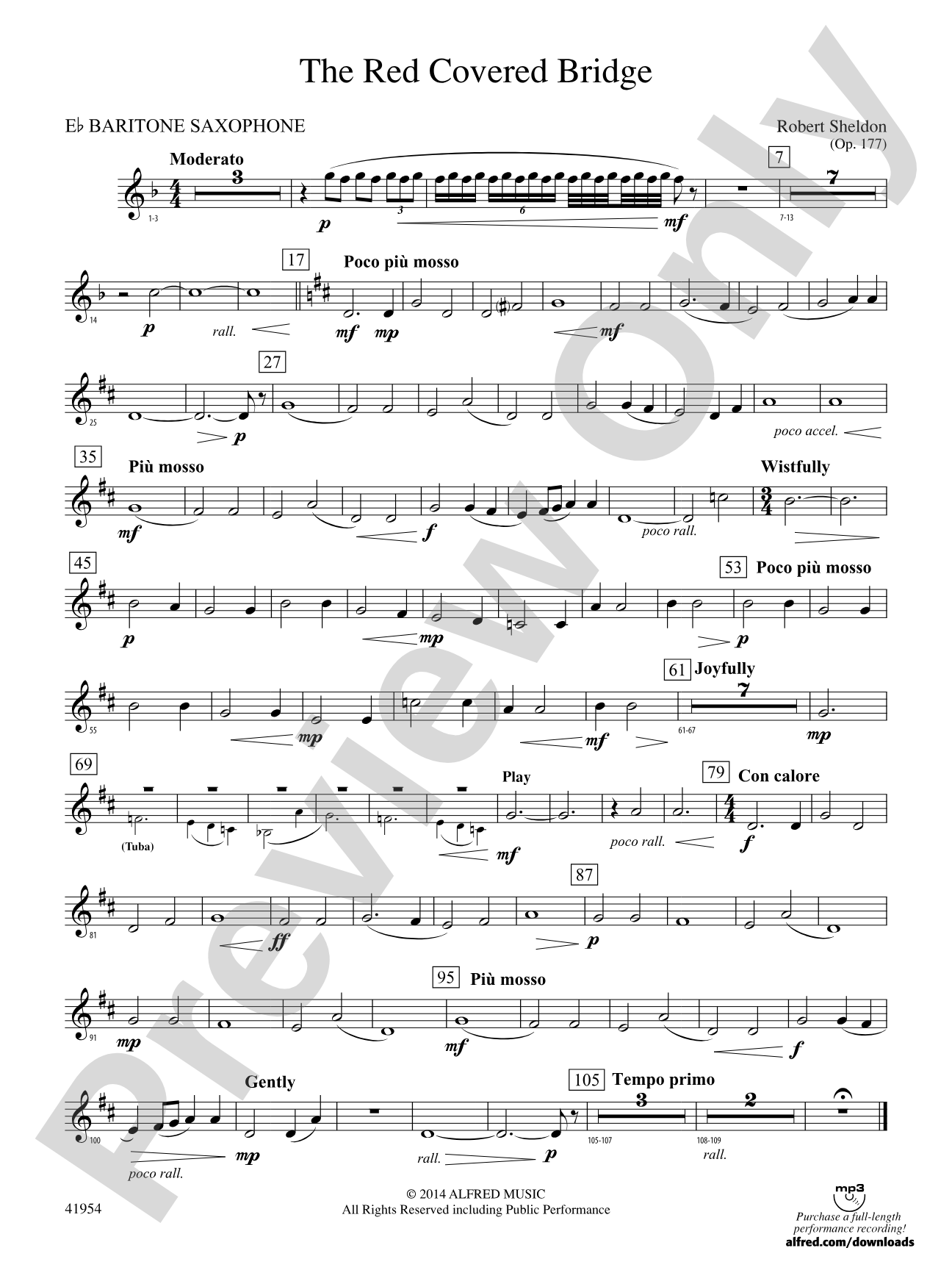

The Red Covered Bridge: E-flat Baritone Saxophone
By Robert Sheldon
Grade: 3 (Medium)
Item: 00-PC-0016436_BTX
$3.00
Pickup currently not available
Description
A red covered bridge spans the Big Bureau Creek just north of Princeton, Illinois. This local attraction has served as the inspiration for this lyrical composition. The serene setting brings to mind the many people who have crossed that bridge in simpler times, and the stories of their lives. This piece hopes to capture those moments of reflection, joy, children playing, and powerful moments of resolve. (5:00) This title is available in MakeMusic Cloud.


Don't just read it, hear it, play along with it, and watch your students grow with it. In MakeMusic Cloud, The Red Covered Bridge: E-flat Baritone Saxophone comes alive with professional accompaniment, adjustable tempo, and built-in practice tools that turn solo practice into real progress.
Open in the Player
Jump straight in and assign it today.
Start Your Free Trial
Open this title and explore the full library in minutes.
Sample Audio
1
Audio File
--:--
0:00
0:00
Sample Video
No sample videos found.
Additional Details
Series:
Alfred Concert Band
Publisher:
Alfred Music
Page Count:
166
SKU:
00-PC-0016436_BTX
More about this title
About the Composer: Robert Sheldon

Robert Sheldon stands among the most frequently performed composers of wind band literature in the world today. His works appear regularly on concert and contest programs across the United States and internationally, and his music has been performed in major venues including Carnegie Hall, the Kennedy Center, and the Sydney Opera House. Sheldon is the lead author of Sound Innovations for Concert Band, and his compositions have earned recognition from the American School Band Directors Association, Phi Beta Mu, and the American Society of Composers, Authors and Publishers.
Beyond composing, Sheldon maintains an active schedule as a guest conductor for All-State and Regional Honor Bands, and frequently serves as a clinician at universities and state music education conferences. His conducting and teaching experience spans six continents, including residencies in Japan, Canada, Italy, Germany, Australia, and China. In 2020, VanderCook College of Music awarded him an honorary doctorate in recognition of his contributions to music education.
Why we love this
The Red Covered Bridge demonstrates Sheldon's gift for writing music that sustains student interest while remaining genuinely lyrical. A Grade 3 band can execute the musical ideas convincingly, and the five-minute arc gives students a complete emotional journey without losing focus or pacing. Directors appreciate that the programmatic narrative is clear enough to engage audiences without requiring lengthy program notes.
What to expect
The Red Covered Bridge unfolds like a memory. It begins with quiet contemplation before moving through moments of lighter joy, childhood innocence, and deeper reflection. The music conveys both tenderness and quiet strength, painting scenes of people crossing a bridge at different moments in their lives without ever becoming sentimental.
Who it's for
This work suits Grade 3 bands seeking a substantial concert piece with genuine musical content and a clear sense of structure. It works equally well for concert performance and festival competition, offering directors a piece that allows their ensemble to demonstrate musicianship and emotional maturity.
How to get the most out of it
- Balance the sustained harmonic foundation in the lower voices with the primary melodic material so the piece breathes rather than sounding static.
- Attend carefully to the dynamic shapes within phrases; Sheldon often builds intensity gradually, so resist the urge to jump to louder dynamics immediately.
- Shape the sections that evoke childhood play with rhythmic clarity and lighter articulation to distinguish them from the more reflective passages.
- Consider how the "resolve" moments differ from the earlier sections in terms of tone and weight, and prepare your band to execute that shift with intention.
How to use it
Program this as a centerpiece in a concert devoted to American composers or local history themes. It pairs naturally with other Sheldon works or with lighter, more energetic pieces that can follow without jarring the audience. The five-minute duration makes it an effective anchor for a mixed program without consuming excessive rehearsal time relative to its impact.
Skills your students will build
- Sustaining long lyrical phrases with consistent tone and intonation
- Executing gradual dynamic buildup and shape within phrases
- Balancing melody and accompaniment across the full ensemble
- Interpreting programmatic intent through musical expression
- Maintaining ensemble cohesion across sectional and textural changes