
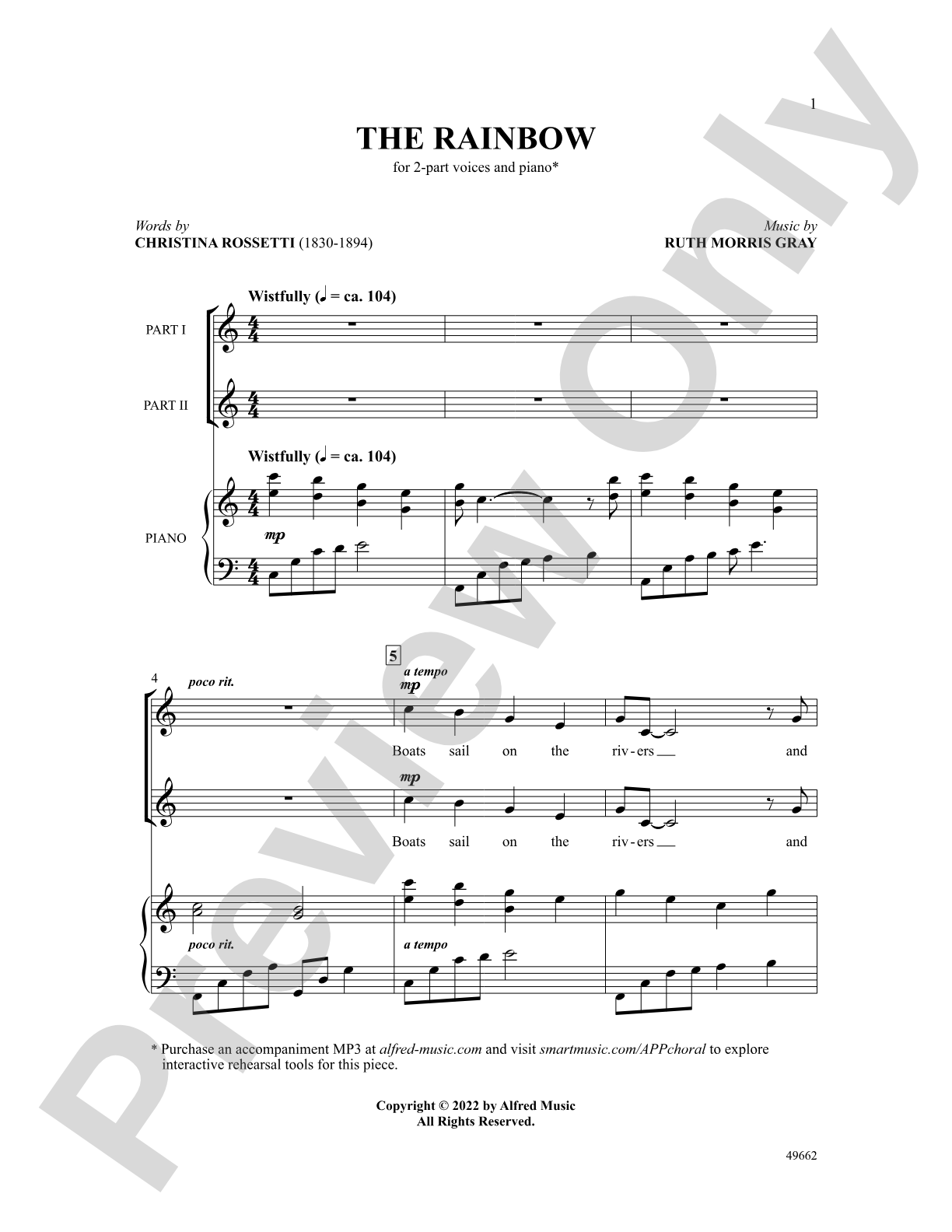

The Rainbow: 2-Part Choral Octavo
Words by Christina Rossetti, music by Ruth Morris Gray
Item: 00-PO-0006973
$2.30
Minimum order quantity: 20 copies
Pickup currently not available
Description
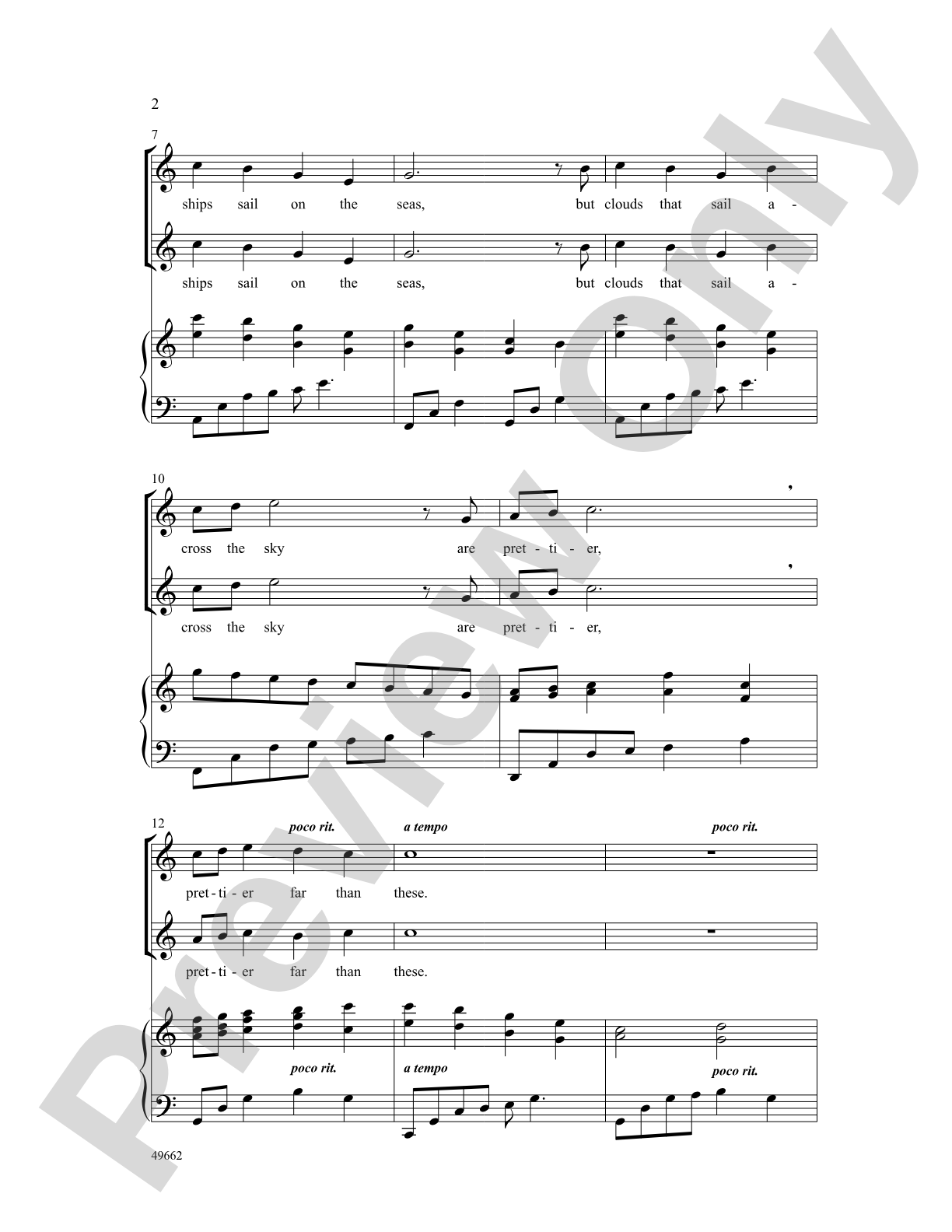
Rossetti's charming poem is set for treble voices of any age. The polyphonic choral writing is simple yet sophisticated, colorful yet clear.
The PerformancePlus+ series is an innovative addition to the ever-expanding MakeMusic Cloud interactive library. These engaging selections are presented with educational resources designed to enrich the rehearsal process and create outstanding performances. Including:


The PerformancePlus+ series is an innovative addition to the ever-expanding MakeMusic Cloud interactive library. These engaging selections are presented with educational resources designed to enrich the rehearsal process and create outstanding performances. Including:
- Assignment, recording, and assessment tools within MakeMusic Cloud
- Part-predominant and accompaniment tracks
- Printable sheet music (with a standard MakeMusic Cloud subscription)
- Correlated rehearsal guides and performance notes
- Rights to perform in a live or virtual setting
The Rainbow: 2-Part Choral Octavo isn't in MakeMusic Cloud just yet...but it could be. Let us know you'd like to see it, and you'll help shape what comes next. In the meantime, start a free trial and dive into thousands of interactive titles your students can play along with today.
Request This Title
Tell us you want it.
Start Your Free Trial
Explore everything that's ready to play right now.
Sample Audio
1
Audio File
--:--
0:00
0:00
Sample Video
Additional Details
Series:
Alfred Choral Designs
Publisher:
Alfred Music
Page Count:
12
SKU:
00-PO-0006973
More about this title
About the Composer: Ruth Morris Gray

Ruth Morris Gray has directed choirs at Rosemead High School in California since 2004, where she also teaches piano. She holds a Bachelor of Music in Piano Performance and Composition from Biola University and a Master of Arts in Music Composition from UC Santa Barbara, completed her California Single Subject Music Credential at California State University, Northridge.
With over 100 published choral compositions to her name, Gray brings both compositional sophistication and classroom experience to her work. Her output spans sacred and secular literature, consistently balancing musical depth with pedagogical clarity.
Why we love this
Gray's setting captures the luminous simplicity of Rossetti's poem while layering in genuine harmonic interest that keeps even experienced singers engaged. The polyphonic writing never feels complicated, yet it avoids the flatness that can plague easy music. It's the kind of piece that makes treble choirs sound sophisticated without requiring advanced technique.
What to expect
Bright and contemplative at once, like watching light bend through a prism. The music unfolds with a gentle curiosity that matches Rossetti's careful observation, never overshadowing the poetry yet never leaving it bare.
Who it's for
This works for developing treble choirs and experienced ensembles alike. The accessible voicing welcomes younger singers and singers new to polyphonic writing, while the sophisticated harmonic language rewards choirs ready to explore color and texture.
How to get the most out of it
- Balance the two parts so the harmonic colors emerge clearly; resist the urge to let one line dominate, even when one part has the primary text.
- Use the part-predominant tracks during early rehearsals to establish each voice independently, then blend to the full accompaniment once parts are secure.
- Shape phrases around the natural cadences in Rossetti's language rather than boxing the music into rigid measures; let the poetry guide your phrasing.
- Record yourselves during rehearsal and listen back as an ensemble; the polyphonic writing rewards awareness of blend and balance.
How to use it
Pair it with other Rossetti-inspired settings or other works exploring nature and light for a thematic program. Its moderate length and accessible difficulty make it an excellent anchor for a concert mixing shorter, feature-quality pieces with longer works. The recorded accompaniment also makes it viable for virtual performances or smaller ensembles.
Skills your students will build
- Reading two-part polyphonic writing with independent melodic lines
- Blend and balance across harmonic parts
- Shaping vocal phrases to support poetic text
- Listening for color and blend in choral sonorities