

The Race Is Run: SATB, a cappella Choral Octavo
Words and music by Jay Althouse
Item: 00-PO-0001784
$1.85
Minimum order quantity: 20 copies
Pickup currently not available
Related Items
The Race Is Run: SATB, a cappella Choral Octavo |
$1.85
|
View |
Description
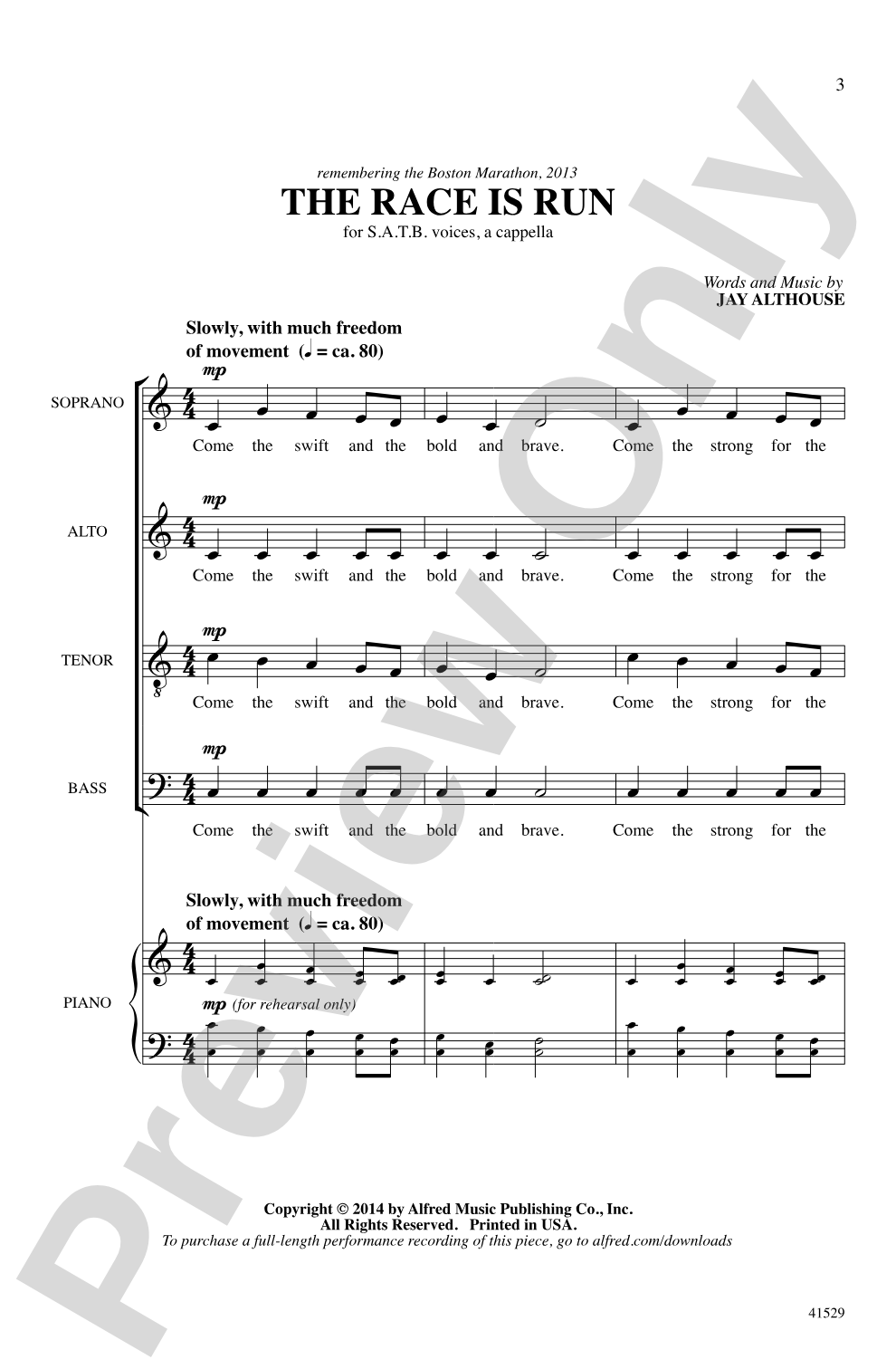
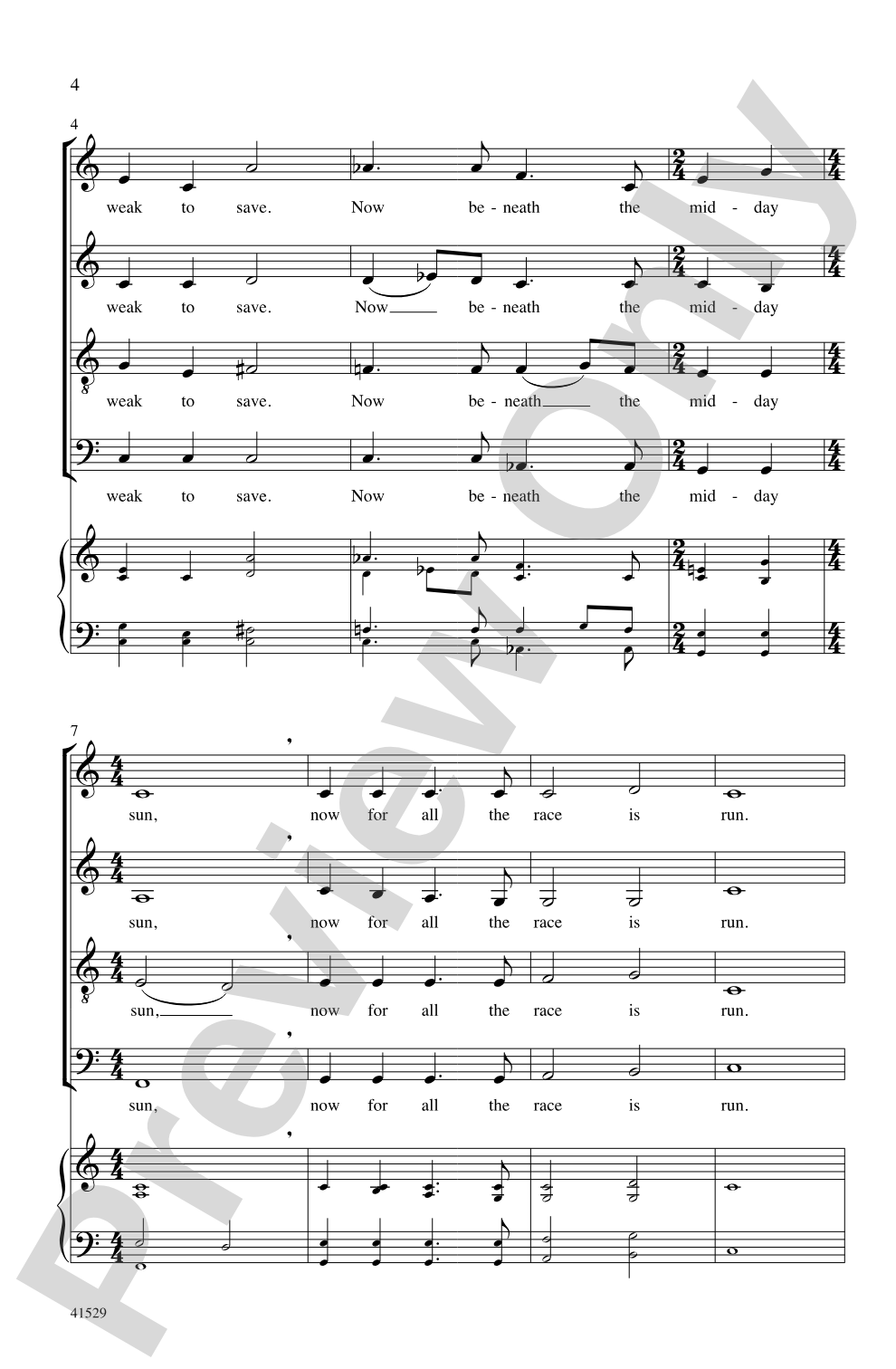
Remembering the 2013 Boston Marathon, this reverent tribute is an exceptional a cappella selection for concert groups. Throughout the brief ABA format, occasional dissonance resolves into lush choral harmony. And at the end, a final unison note symbolizes our unity.


The Race Is Run: SATB, a cappella Choral Octavo isn't in MakeMusic Cloud just yet...but it could be. Let us know you'd like to see it, and you'll help shape what comes next. In the meantime, start a free trial and dive into thousands of interactive titles your students can play along with today.
Request This Title
Tell us you want it.
Start Your Free Trial
Explore everything that's ready to play right now.
Sample Audio
1
Audio File
--:--
0:00
0:00
Sample Video
No sample videos found.
Additional Details
Series:
Alfred Choral Designs
Publisher:
Alfred Music
Page Count:
8
SKU:
00-PO-0001784
More about this title
About the Composer: Jay Althouse

Jay Althouse holds degrees in Music Education and Music from Indiana University of Pennsylvania, where he was honored as a Distinguished Alumnus. Early in his career, he spent eight years managing rights and licenses for a major educational music publisher and served on the Executive Board of the Music Publishers Association of America. His compositional output spans more than 800 choral works performed regularly across the English-speaking world.
Althouse is an ASCAP writer member and multiple recipient of the ASCAP Special Award. Beyond composing, he has co-created children's musicals with Sally K. Albrecht, curated vocal solo collections including Folk Songs for Solo Singers, and authored or co-written essential choral resources such as The Complete Choral Warm-up Book and Accent on Composers. His educational publications for the classroom include Ready to Read Music, Sixty Music Quizzes, and One-Page Composer Bios. He resides in North Carolina and serves on the National Advisory Board of the Folk Art Society of America.
Why we love this
Althouse captures the emotional weight of a national tragedy without resorting to sentimentality. The harmonic language feels both contemporary and deeply musical, with strategic dissonance that earns its resolution and creates genuine emotional momentum. The closing unison is structurally brilliant and symbolically powerful, giving your singers a moment of profound simplicity after intricate writing.
What to expect
The music moves with quiet dignity, building from sparse textures into moments of lush, interlocking harmony. There's a contemplative quality throughout, but never mournful; instead, the harmonic language feels meditative and hopeful, ultimately affirming human resilience.
Who it's for
This work suits concert choirs with secure four-part blend and the maturity to approach reverent texts with authenticity. The piece works for groups already comfortable with a cappella singing and those ready to deepen their control of intonation and harmony without instrumental support.
How to get the most out of it
- Shape the occasional dissonant moments with intention. These aren't accidents; they're deliberate emotional inflection points. Your singers should understand where tension lives in the harmony so they can execute those passages with clarity and purpose.
- The a cappella texture demands rhythmic precision without a rhythm section to anchor you. Lock your tempo during rehearsal and consider using a silent pulse or light pulse work to keep ensemble unity tight, especially across phrase boundaries.
- Balance the ABA structure by allowing the contrasting section genuine musical space. This isn't a brief departure but a meaningful shift; let it breathe and land distinctly before returning to familiar material.
- The final unison note needs silent focus. Conductor and singers should agree on how long that moment holds and what it means emotionally. A slight ritardando into it can enhance the symbolic weight without feeling contrived.
How to use it
Pair this with other contemporary a cappella selections to create a concert section exploring how modern composers approach reverent themes. It also sits naturally in a program addressing community, solidarity, or remembrance, whether for graduation, a memorial observance, or a concert themed around national resilience.
Skills your students will build
- Intonation control in a cappella SATB voicing
- Harmonic listening and blend across dissonant passages
- Maintaining rhythmic integrity without instrumental support
- Interpreting contemporary choral language with emotional authenticity
- Sustaining longer phrases with ensemble unity