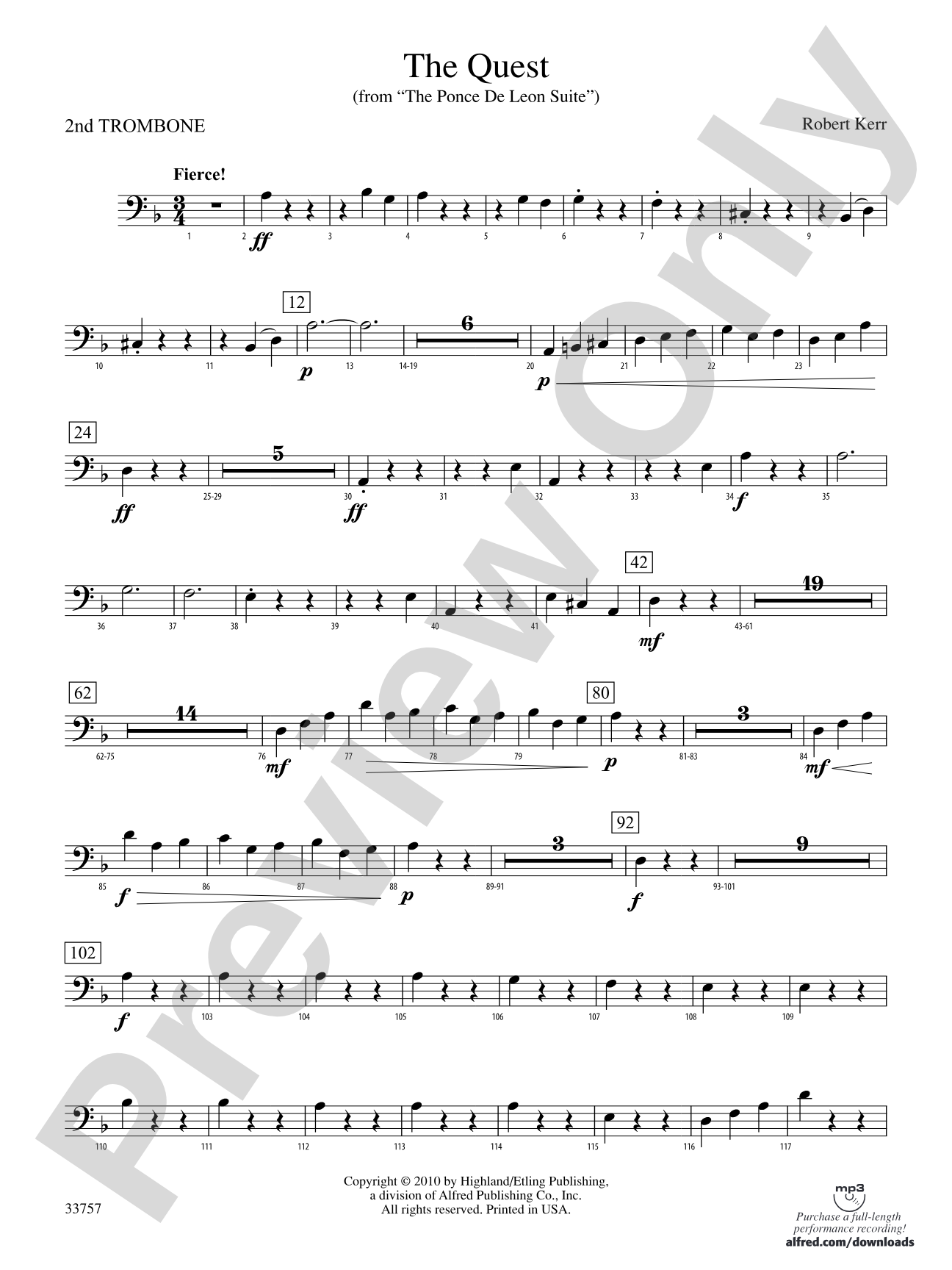
The Quest: 2nd Trombone Sheet Music Preview

The Quest: 2nd Trombone

(From The Ponce De Leon Suite)

By Robert Kerr

Grade: 3.5

Item: 00-PC-0014541_TN2

Digital Download
$3.00
Description
This exciting and fanciful symphonic movement depicts the eager enthusiasm and hopeful optimism felt by Ponce De Leon and his crew in the early days of that famous quest through Florida's uncharted wetlands, swamp regions, and coasts, to find the legendary "Fountain of Youth" and the "Seven Cities of Gold"! The familiar and exotic Spanish harmonies and rhythms help to evoke the romantic image of this epic journey.

Don't just read it, hear it, play along with it, and watch your students grow with it. In MakeMusic Cloud, The Quest: 2nd Trombone comes alive with professional accompaniment, adjustable tempo, and built-in practice tools that turn solo practice into real progress.

Sample Audio
0:00
0:00
Sample Video
Additional Details
Series: Highland/Etling Full Orchestra
Publisher: Alfred Music
Page Count: 200
SKU: 00-PC-0014541_TN2

More about this title

Why we love this

Kerr captures the swashbuckling spirit of exploration without resorting to bombast, letting Spanish harmonies and rhythmic vitality carry the narrative weight. The Grade 3.5 scoring keeps the writing transparent and idiomatic across the section, so players at this level can genuinely feel the forward momentum rather than just reading notes.

What to expect

Swashbuckling optimism tinged with romantic adventure. The music carries the eager restlessness of explorers setting out into unknown territory, buoyed by Spanish melodic warmth and rhythmic color that evokes both the New World setting and the Old World aspirations of its seekers.

Who it's for

Orchestras working at the solid Grade 3.5 level who want a concert or festival piece with genuine programmatic content and character. Conductors seeking a closer that energizes audiences without demanding virtuosic playing from the ensemble.

How to get the most out of it

  • Establish the Spanish rhythmic character early in sectional rehearsals by isolating the percussion and lower strings; once that foundation is secure, the melody lines will sit naturally on top of it.
  • Shape the dynamic arc across entire phrases rather than bar by bar. The optimism of the quest lives in sustained forward motion, not in isolated peaks.
  • Balance the exotic harmonic color by ensuring the inner voices remain transparent. Woodwind doublings and string divisi need clear articulation so the Spanish flavor registers without muddiness.

How to use it

Program this as a concert or festival closer to showcase your orchestra's ability to blend programmatic storytelling with orchestral color. It pairs well alongside lighter classical or contemporary works, or stand alone as a compelling finale that leaves audiences with a sense of adventure and triumph.

Skills your students will build

  • Balancing melodic line against rhythmic accompaniment figures
  • Playing Spanish-influenced harmonic progressions and rhythmic patterns idiomatically
  • Conducting and performing through sustained dynamic arcs and phrase architecture
  • Maintaining ensemble cohesion across transparent orchestration with active inner voices

You May Also Like