

The Puzzle: 2-Part Choral Octavo
Words and music by Andy Beck
Item: 00-PO-0006690
$2.05
Minimum order quantity: 20 copies
Pickup currently not available
Description
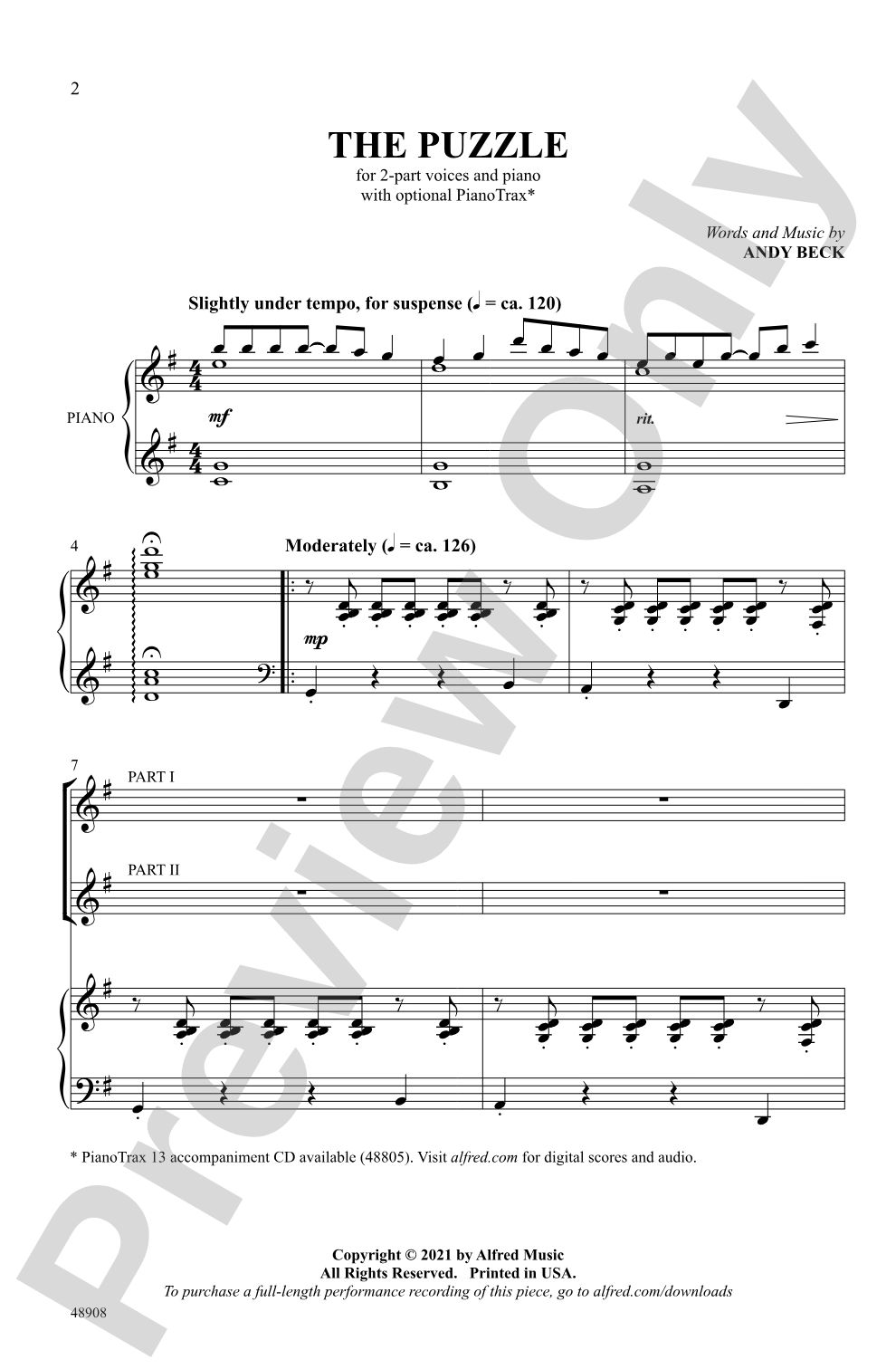
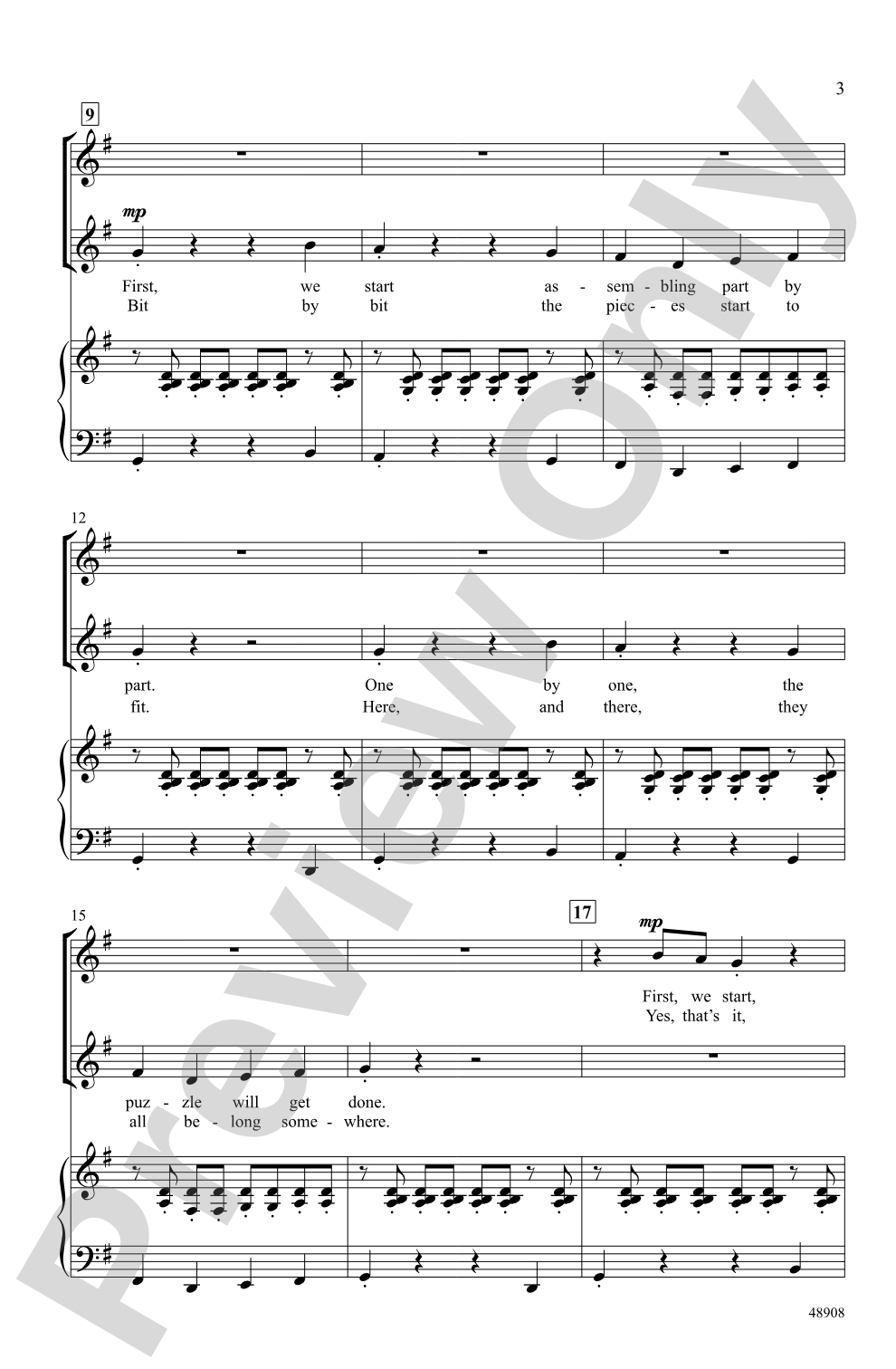
This darling little charmer reads like step-by-step instructions for assembling a jigsaw puzzle. Andy's writing provides the perfect lesson plan to teach part-singing: Part II sings an eight-bar melody, Part I sings their complementary eight bars, the two combine, we add some simple parallel harmony on the refrain, and voilà! Teachers will thoroughly appreciate the easy-to-play piano part and compact vocal ranges (no one sings higher or lower than a D). In a surprise, not-so-hidden message, the lyrics explain that "the pieces are scattered, not broken, and though they have come apart, when they fit back together, we'll have a wonderful work of art." It's a double metaphor about points of view, or voice parts, coming together.


The Puzzle: 2-Part Choral Octavo isn't in MakeMusic Cloud just yet...but it could be. Let us know you'd like to see it, and you'll help shape what comes next. In the meantime, start a free trial and dive into thousands of interactive titles your students can play along with today.
Request This Title
Tell us you want it.
Start Your Free Trial
Explore everything that's ready to play right now.
Sample Audio
1
Audio File
--:--
0:00
0:00
Sample Video
1 / 2
Additional Details
Series:
Alfred Choral Designs
Publisher:
Alfred Music
Page Count:
8
SKU:
00-PO-0006690
More about this title
About the Composer: Andy Beck

Andy Beck directs choral publications at Alfred Music and has composed and arranged over 450 works for choral ensembles, vocal classes, and children's theater. His pedagogical resources, including Sing at First Sight and Vocalize! 45 Vocal Warm-Ups That Teach Technique, have shaped how singers across the country learn music literacy and vocal technique. His compositions are performed regularly by choirs worldwide, and his work as a guest conductor, adjudicator, and clinician has made him a familiar voice in honor choirs and all-state programs throughout the Southeast and beyond.
Beck holds a Bachelor's degree in Music Education from Ithaca College and a Master's degree in Music Education from Northwest Missouri State University. A tenor himself, he performs with the North Carolina Master Chorale Chamber Choir and has been a studio singer for Alfred Music since 1992. His dual commitment to choral artistry and music literacy runs through every piece he creates and every publication he shepherds through Alfred's catalog.
Why we love this
Beck demonstrates real pedagogical insight here: this piece functions as an actual part-singing lesson plan, not just a charming song. The structural elegance (one part sings eight bars, the other responds with eight bars, then they interlock) teaches listening and voice independence in real time, and the metaphor about scattered pieces fitting together transforms a simple arrangement into something meaningful for young singers.
What to expect
Clever and uplifting. The puzzle metaphor unfolds gradually as voices enter and blend, creating a satisfying sense of assembly and wholeness. There's humor in the literalism of the lyrics paired with the structural elegance of the music, and the final message about broken pieces and wonderful art lands with genuine warmth.
Who it's for
Middle school and early high school choirs working on part-singing fundamentals, as well as any ensemble eager to program something with genuine pedagogical bones alongside audience appeal. The compact vocal range (no notes beyond a D) and eight-page length make it accessible to newer singers without sacrificing musical interest.
How to get the most out of it
- Let Part I and Part II rehearse their sections independently first. Once each part owns their melody, run them together to highlight how the two lines complement each other.
- Keep the parallel harmony on the refrain relaxed and natural; avoid over-singing the homophonic sections. The contrast with the canonic opening will feel sharper if you don't push.
- Use the recorded accompaniment to build confidence in singers who are still developing rhythmic independence, then gradually transition to live piano.
How to use it
Open a concert with this piece to set an optimistic, collaborative tone, or slot it into a spring program where it pairs well with other thematic repertoire about unity or growth. Its brevity and straightforward charm also make it an excellent choice for festival appearances or informal community performances where you want to showcase developing singers without overextending rehearsal time.
Skills your students will build
- Part-singing through sequential entry (responding melody technique)
- Listening to a different melodic line while singing their own
- Parallel harmony singing and voice blending
- Reading and performing within a limited vocal range
- Understanding structural canons and call-and-response forms