The Promise Of Living (from The Tender Land) Sheet Music Preview

The Promise Of Living (from The Tender Land): Concert Band Conductor Score & Parts

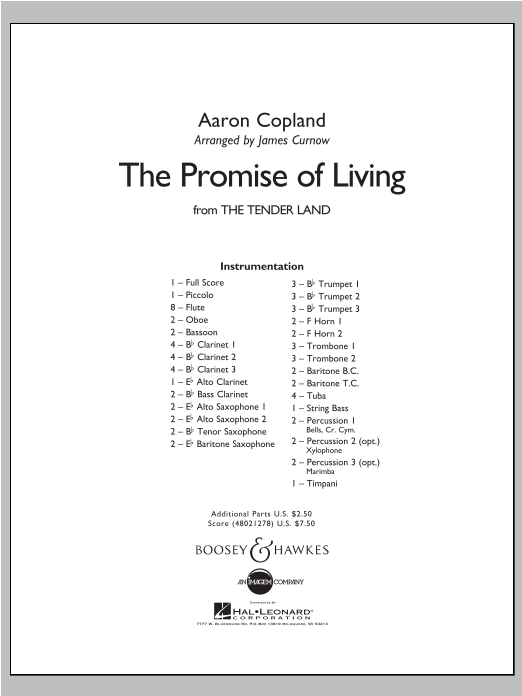
As performed by Aaron Copland / Arranged by James Curnow

Grade: 3

Item: 35-PK00246667

Digital Download
$70.00

Buy Extra Parts (Digital PDF Download)

Product Price Quantity
The Promise Of Living (from The Tender Land) - Conductor Score (Full Score) $10.00
The Promise Of Living (from The Tender Land) - Piccolo $6.00
The Promise Of Living (from The Tender Land) - Flute $6.00
The Promise Of Living (from The Tender Land) - Oboe $6.00
The Promise Of Living (from The Tender Land) - Bassoon $6.00
The Promise Of Living (from The Tender Land) - Bb Clarinet 1 $6.00
The Promise Of Living (from The Tender Land) - Bb Clarinet 2 $6.00
The Promise Of Living (from The Tender Land) - Bb Clarinet 3 $6.00
The Promise Of Living (from The Tender Land) - Eb Alto Clarinet $6.00
The Promise Of Living (from The Tender Land) - Bb Bass Clarinet $6.00
The Promise Of Living (from The Tender Land) - Eb Alto Saxophone 1 $6.00
The Promise Of Living (from The Tender Land) - Eb Alto Saxophone 2 $6.00
The Promise Of Living (from The Tender Land) - Bb Tenor Saxophone $6.00
The Promise Of Living (from The Tender Land) - Eb Baritone Saxophone $6.00
The Promise Of Living (from The Tender Land) - Bb Trumpet 1 $6.00
The Promise Of Living (from The Tender Land) - Bb Trumpet 2 $6.00
The Promise Of Living (from The Tender Land) - Bb Trumpet 3 $6.00
The Promise Of Living (from The Tender Land) - F Horn 1 $6.00
The Promise Of Living (from The Tender Land) - F Horn 2 $6.00
The Promise Of Living (from The Tender Land) - Trombone 1 $6.00
The Promise Of Living (from The Tender Land) - Trombone 2 $6.00
The Promise Of Living (from The Tender Land) - Baritone B.C. $6.00
The Promise Of Living (from The Tender Land) - Baritone T.C. $6.00
The Promise Of Living (from The Tender Land) - Tuba $6.00
The Promise Of Living (from The Tender Land) - String Bass $6.00
The Promise Of Living (from The Tender Land) - Percussion 1 $6.00
The Promise Of Living (from The Tender Land) - Percussion 2 $6.00
The Promise Of Living (from The Tender Land) - Percussion 3 $6.00
The Promise Of Living (from The Tender Land) - Timpani $6.00

Parts Added to Cart!

Description
James Curnow has skillfully adapted this classic Copland work for younger players while maintaining the transparency and integrity of the original. Solo lines and chamber-like playing is beautifully offset with rich, full ensemble passages. A marvelous addition to the repertoire of classic adaptations for young bands. Dur: 4:30

The Promise Of Living (from The Tender Land): Concert Band Conductor Score & Parts isn't in MakeMusic Cloud just yet...but it could be. Let us know you'd like to see it, and you'll help shape what comes next. In the meantime, start a free trial and dive into thousands of interactive titles your students can play along with today.

Sample Audio
No sample audio found.
Sample Video
Additional Details
Publisher: Hal Leonard
SKU: 35-PK00246667

More about this title

About the Artist: Aaron Copland

Aaron Copland stands as one of America's most distinctive compositional voices, known for weaving folk melodies and open harmonies into works that feel both intimate and expansive. His genius lay in making concert music accessible without sacrificing sophistication, a quality that made him an essential figure in 20th-century American classical music and a natural fit for music education.

Copland's balancing act between populist appeal and artistic substance makes his works invaluable teaching tools. The Tender Land, his only full-length opera, captures this philosophy perfectly, offering students entry into a compositional approach that prizes clarity, singability, and emotional directness.

Why we love this

Curnow's adaptation respects Copland's architectural vision while genuinely serving younger ensembles; the transparency of the orchestration means every section gets moments to shine without drowning in overly complex counterpoint. Programming this invites audiences into authentic Americana without compromise, and the four-and-a-half-minute duration fits naturally into concerts where pacing matters.

What to expect

Warm and optimistic, with an open-air quality that evokes American landscapes and human connection. The solo passages carry an intimate, almost folk-like quality, while the ensemble moments swell with genuine grandeur without becoming bombastic.

Who it's for

Directors programming Grade 3 ensembles who want substantial classical material that builds musicianship without requiring virtuoso technique. Students benefit from encountering Copland's compositional voice in an arrangement that lets them experience the full expressive range of the original.

How to get the most out of it

  • Maintain the lyrical quality of solo lines by encouraging players to shape phrases rather than merely hit notes. The melody should feel as vocal as possible, even when it passes through different instruments.
  • Balance the chamber-like passages carefully; these moments expose intonation issues and individual tone quality, making sectional rehearsals focused on blend essential.
  • Let the full ensemble passages breathe. Resist the urge to rush, especially as the texture thickens. Copland's harmonies create their own momentum when given space.
  • Pay attention to dynamic contours within the piece rather than playing entire sections at a single volume. The emotional arc depends on subtle shifts that prevent the music from feeling static.

How to use it

Feature this as a centerpiece in a concert exploring American composers, where it naturally pairs with other Copland works or contemporary classics at similar levels. Its duration and emotional arc make it ideal as a bridge piece between lighter openers and more demanding works, or as the emotional climax of a program that values accessibility.

Skills your students will build

  • Sustaining lyrical phrasing across longer melodic lines
  • Balancing solo and ensemble textures within a single work
  • Reading and executing dynamic shadings that serve musical architecture
  • Understanding transparent orchestration and how fewer notes can mean greater impact
  • Maintaining intonation in chamber-like settings with exposed harmony

You May Also Like