
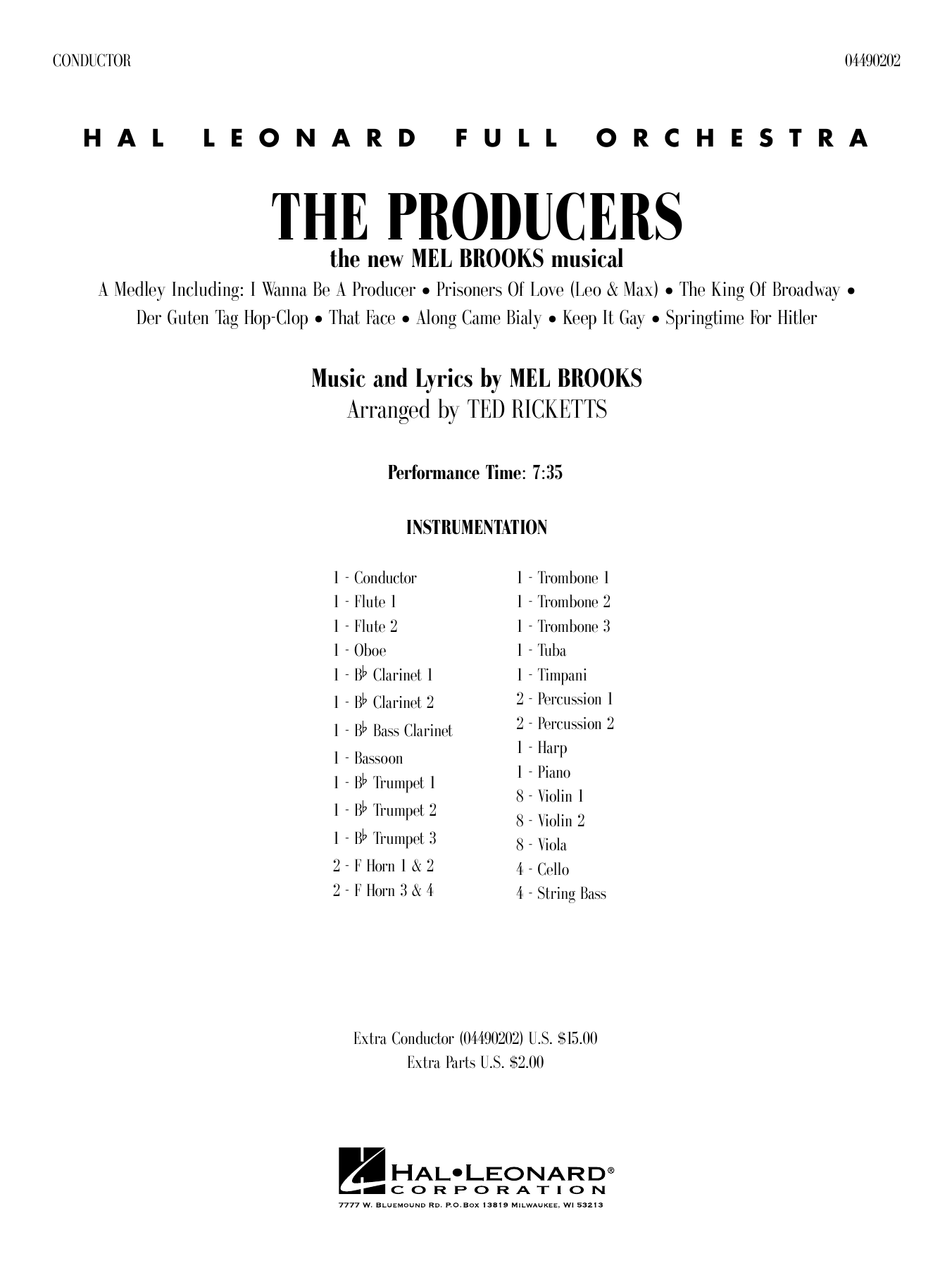

The Producers (arr. Ted Ricketts): Full Orchestra Conductor Score & Parts
By Mel Brooks / Arranged by Ted Ricketts
Grade: 3-4
Item: 35-PK01412421
$80.00
Pickup currently not available
Buy Extra Parts (Digital PDF Download)
Parts Added to Cart!
Description
"I grew up with all the great shows. And that's what you're going to get here...an old-fashioned traditional musical comedy." -Mel Brooks. This Tony Award winner has become an entertainment phenomenon - the hardest ticket to get on Broadway. Ted Ricketts' spectacular medley includes: "Along Came Bialy, Der Guten Tag Hop-Clop, I Wanna Be a Producer, Keep It Gay, The King of Broadway, Prisoners of Love, That Face," and "Springtime for Hitler."


The Producers (arr. Ted Ricketts): Full Orchestra Conductor Score & Parts isn't in MakeMusic Cloud just yet...but it could be. Let us know you'd like to see it, and you'll help shape what comes next. In the meantime, start a free trial and dive into thousands of interactive titles your students can play along with today.
Request This Title
Tell us you want it.
Start Your Free Trial
Explore everything that's ready to play right now.
Sample Audio
No sample audio found.
Sample Video
No sample videos found.
Additional Details
Publisher:
Hal Leonard
SKU:
35-PK01412421
More about this title
About the Composer: Mel Brooks
Mel Brooks is a satirist and storyteller who has shaped American comedy across film, theater, and television for seven decades. His theatrical works, particularly The Producers, demonstrate his gift for layering comedy with genuine musicality; he understood that the jokes land harder when the music swings and the orchestrations sparkle.
Brooks' approach to musical theater composition breaks the fourth wall between performer and audience, inviting everyone into the joke. For music educators, his work offers a masterclass in how comedic timing, harmonic surprise, and rhythmic precision work together to create entertainment that feels both irreverent and deeply crafted.
Why we love this
Ted Ricketts has distilled the most infectious moments from The Producers into a medley that captures the show's anarchic energy without overwhelming your ensemble. Conductors gravitate toward this arrangement because it balances accessibility with genuine orchestral fun; your students get to execute real musical gestures while delivering laughs that audiences remember.
What to expect
Vaudeville energy crashing into Broadway sophistication. The music careens between styles with infectious, almost reckless joy, full of orchestral winks and harmonic surprises that keep listeners grinning. Your ensemble gets to be in on every joke.
Who it's for
Directors programming a full orchestra concert who want a showstopper with genuine musical substance. This works equally well for ensembles with strong performers and those still developing their chops; the arrangement scales with what your students can deliver.
How to get the most out of it
- Nail the comedic timing by treating rhythmic precision as your primary tool. Brooks' humor depends on hitting exactly what's written; any rhythmic sloppiness deflates the gag.
- Lean into the stylistic contrasts between numbers. The shift from the polka swagger of 'Der Guten Tag Hop-Clop' to the Broadway glamour of 'Keep It Gay' should feel intentional and clean.
- Let the percussion section carry more of the comedic weight than you might expect. The orchestration likely uses rhythmic punctuation and orchestral hits to land jokes, so balance your dynamics accordingly.
- Schedule extra rehearsal time for the full ensemble sections where multiple themes overlap or collide. Medleys like this often layer material that requires precision to sound intentional rather than chaotic.
How to use it
Position this as a closer on a pops concert, or pair it with other Broadway arrangements to create a full theater-music set. The medley format works beautifully when you want something substantial that doesn't require staging, giving your orchestra the chance to shine comedically without leaving them tethered to a script.
Skills your students will build
- Executing rhythmic precision across changing time signatures and syncopated passages
- Responding to conductor gestural changes with split-second timing
- Balancing articulation and dynamics to serve comedic intent
- Maintaining ensemble cohesion when material shifts stylistically between medley segments
- Reading and performing cross-cued orchestral arrangements with multiple instrumental doublings