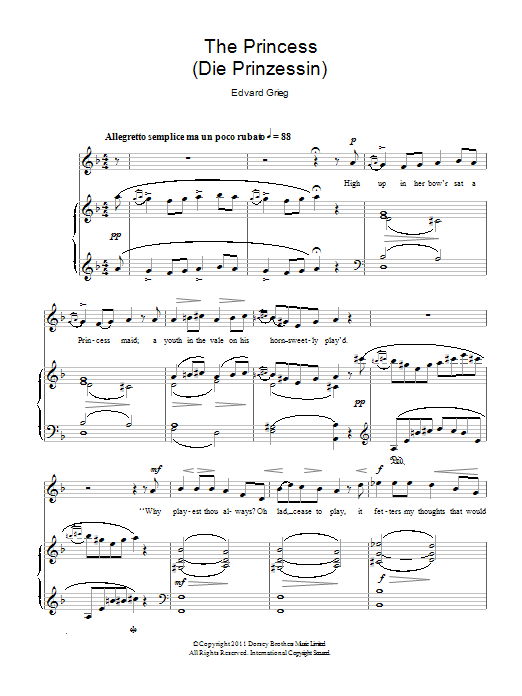
The Princess (Die Prinzessin) Sheet Music Preview

The Princess (Die Prinzessin): Piano Vocal

As performed by Edvard Grieg

Item: 35-DS00205508

Digital Download
$5.99
Description

The Princess (Die Prinzessin): Piano Vocal isn't in MakeMusic Cloud just yet...but it could be. Let us know you'd like to see it, and you'll help shape what comes next. In the meantime, start a free trial and dive into thousands of interactive titles your students can play along with today.

Sample Audio
No sample audio found.
Sample Video
Additional Details
Publisher: Hal Leonard
Page Count: 4
SKU: 35-DS00205508

More about this title

About the Artist: Edvard Grieg

Edvard Grieg (1843-1907) shaped Romantic music through his unwavering commitment to Norwegian identity and folk idiom. His gift for melody, harmonic innovation, and orchestral color made him one of the era's most performed composers, yet he remained deeply rooted in his homeland rather than chasing international fame from a European capital.

For music educators, Grieg's vocal writing stands as a masterclass in text setting and emotional directness. His songs reward singers who understand how musical gesture can illuminate a single poetic moment, and they've become essential repertoire for developing expressive interpretation at every level.

Why we love this

Grieg's gift for crafting memorable, singable lines combined with elegant piano writing makes this song accessible to intermediate singers without sacrificing artistic substance. The four-page score feels substantial enough for a recital slot yet remains manageable for singers building their art song foundation.

What to expect

The song unfolds with the intimate, reflective character typical of Grieg's Scandinavian sensibility. Lyrical warmth meets subtle harmonic shifts that suggest emotional complexity beneath a serene surface, inviting singers to find depth within apparent simplicity.

Who it's for

Intermediate and advanced vocalists developing their song recital repertoire, particularly those comfortable with languages and seeking material beyond standard beginner Lied collections. Accompanists will find the piano writing idiomatically rewarding without excessive technical demands.

How to get the most out of it

  • Explore the piano part as a full character in dialogue with the voice rather than accompaniment; Grieg shapes emotional arcs through harmonic color and figurative patterns that deserve independent voice.
  • Shape the text naturally without overemphasizing syllables; Grieg's melodic contours already carry the emotional weight, so resist the urge to add interpretive layers that obscure the line's elegance.
  • Balance any rubato between voice and piano so they move as a single unit; recorded accompaniments can help establish this coordination before rehearsals with an accompanist.

How to use it

This works beautifully as a standalone recital piece or paired with other Grieg songs to create a focused set within a larger program. Consider programming it alongside Romantic art song from other Northern European composers to highlight Grieg's distinctive voice within the tradition.

Skills your students will build

  • Sustaining lyrical vocal lines with clarity and warmth
  • Interpreting Romantic-era text setting and word painting
  • Coordinating with piano accompaniment through harmonic changes
  • Building expressive awareness through economical musical means

You May Also Like