
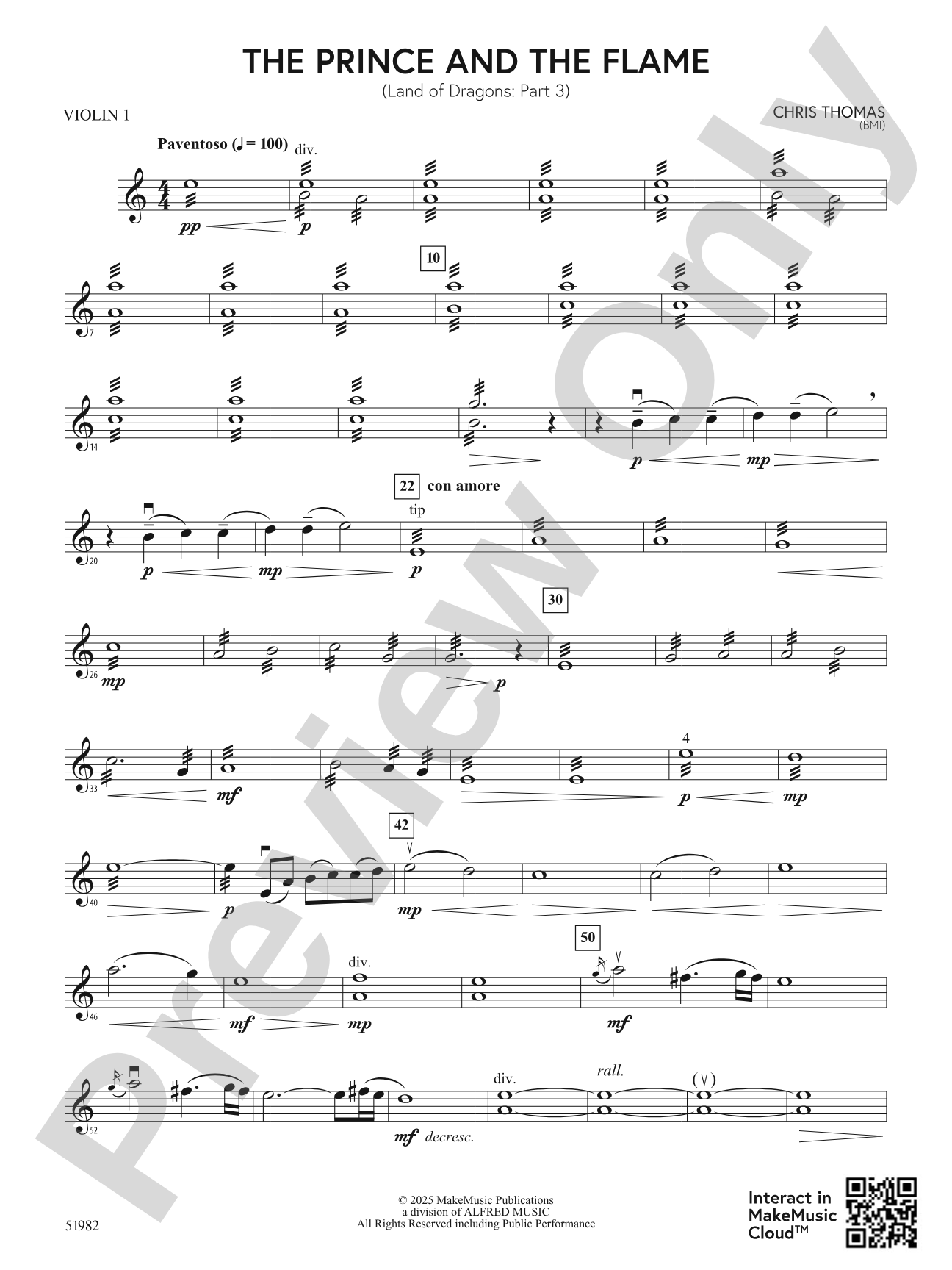

The Prince and the Flame: 1st Violin
(Land of Dragons: Part 3)
By Chris Thomas
Grade: 3-4
Item: 00-PC-0019459_VN1
$3.00
Pickup currently not available
Description
The Prince and the Flame is the latest chapter of the "Land of Dragons" series by Chris Thomas. The piece opens with a sense of trepidation as dark forces gather. A restrained, yet powerful theme hints at both courage and vulnerability. Listeners then embark on a sweeping journey featuring solo violin, cello, and optional ocarina to tell this cinematic tale. (4:30)


The Prince and the Flame: 1st Violin isn't in MakeMusic Cloud just yet...but it could be. Let us know you'd like to see it, and you'll help shape what comes next. In the meantime, start a free trial and dive into thousands of interactive titles your students can play along with today.
Request This Title
Tell us you want it.
Start Your Free Trial
Explore everything that's ready to play right now.
Sample Audio
1
Audio File
--:--
0:00
0:00
Sample Video
Additional Details
Series:
MakeMusic Symphony Strings
Publisher:
MakeMusic Publications
SKU:
00-PC-0019459_VN1
More about this title
About the Composer: Chris Thomas

Chris Thomas composes for film, television, theme parks, and concert stages across multiple media. His accolades include a Hollywood Music in Media Award, two second-place finishes in the American Prize for Composition, a Global Music Award, and the Gold Medal at the Park City Film Music Festival. He has received nominations for Film & TV Music Awards and the International Sound & Film Music Crystal Pine Award. His scores accompany Emmy-nominated films and The Woman Rebel, which was shortlisted for Academy Award consideration.
In television production, Thomas works as composer, orchestrator, and conductor for major studios including Sony, ABC, FOX, CBS, and HBO. His concert works have been performed at Carnegie Hall, the Sydney Opera House, and the Hollywood Bowl. His orchestral compositions appear in theme parks worldwide, from Evermore Adventure Park to Knott's Berry Farm and international venues like Dreamland Theme Park in the UK. His Symphony No. 1 (the Malheur Symphony) was featured in his 2019 TED Talk. Learn more at www.christhomasmusic.com.
Why we love this
Thomas brings film scoring sophistication to school string orchestra without sacrificing accessibility. The cinematic arc and vivid orchestration capture student musicians' attention while remaining performable at Grade 3-4, and the optional ocarina adds a distinctive color that gives students something genuinely fresh to play. Programming this piece signals that your ensemble engages serious musical storytelling.
What to expect
The piece unfolds like a film score for an intimate adventure. It opens in shadow and uncertainty, with sparse textures and restrained harmonies building an atmosphere of quiet dread. The journey broadens into expansive, soaring passages that balance both heroism and doubt, carried by solo voices that feel like characters in dialogue.
Who it's for
String orchestra conductors seeking Grade 3-4 repertoire with narrative depth and film-inspired orchestration. Young musicians who thrive with programmatic context will respond to this storytelling approach, and competitive ensembles will find strong festival material here.
How to get the most out of it
- Balance the opening's dark atmosphere by keeping dynamics restrained in the lower strings; let the tension build gradually rather than stating the theme at full volume.
- Bring out the solo violin and cello passages with clear phrasing and warm tone; these moments carry the narrative weight of the piece.
- If using the optional ocarina, rehearse its entrance carefully so the timbre registers without overwhelming the string texture.
- Shape the sweeping middle section with long-line awareness; treat it as one sustained gesture rather than a series of separate phrases.
How to use it
Program this as the centerpiece of a concert exploring narrative in instrumental music, pairing it with other programmatic works or film score arrangements. Its 4:30 runtime makes it substantial enough to anchor a set without dominating it. The piece works equally well in concert or festival competition settings.
Skills your students will build
- Sustained legato playing and long-line phrasing across multiple phrases
- Balance and blend in passages featuring solo instruments against full ensemble
- Dynamic control and terraced dynamics in programmatic contexts
- Stylistic awareness of film music orchestration and cinematic pacing
- Ensemble synchronization in sweeping, lyrical passages with changing textures