
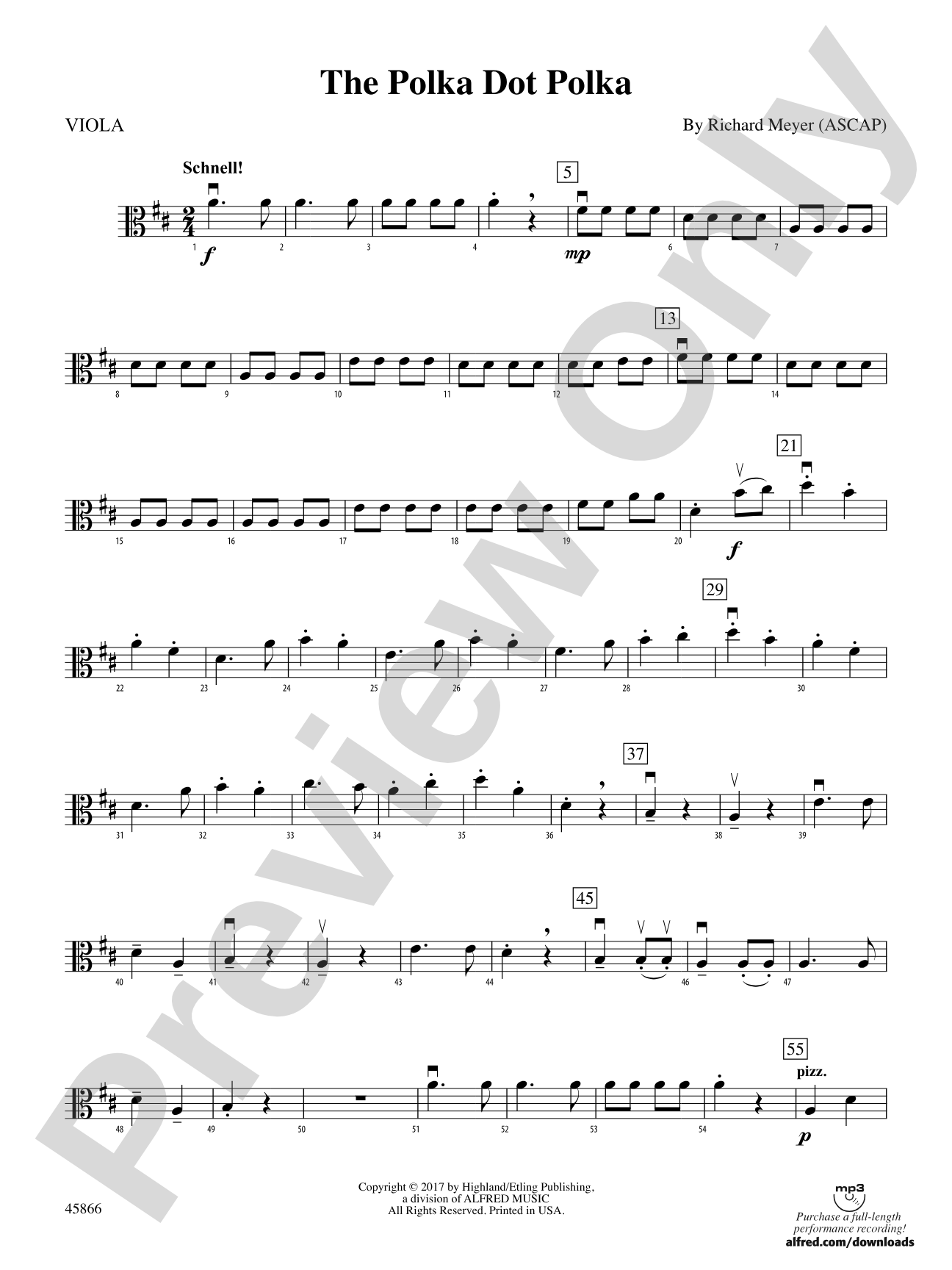

The Polka Dot Polka: Viola
By Richard Meyer
Grade: 1.5
Item: 00-PC-0017665_VA1
$5.99
Pickup currently not available
Description
As the title suggests, this nod to the fleet-footed dance of the 1800s, The Polka Dot Polka, is all about dots---dots over, under, and after notes! Written as an etude to enhance your young orchestra's understanding of dotted quarter note rhythms and staccato bow strokes, this selection---in true Richard Meyer style---is sure to challenge all of your students and get your audience dancing in the aisles! For extra fun, "push" the tempo a bit (or even a lot!)---the faster the better! (2:30). This title is available in MakeMusic Cloud.


Don't just read it, hear it, play along with it, and watch your students grow with it. In MakeMusic Cloud, The Polka Dot Polka: Viola comes alive with professional accompaniment, adjustable tempo, and built-in practice tools that turn solo practice into real progress.
Open in the Player
Jump straight in and assign it today.
Start Your Free Trial
Open this title and explore the full library in minutes.
Sample Audio
1
Audio File
--:--
0:00
0:00
Sample Video
Additional Details
Series:
Highland/Etling String Explorer
Publisher:
Alfred Music
Page Count:
140
SKU:
00-PC-0017665_VA1
More about this title
About the Composer: Richard Meyer

Richard Meyer spent 35 years teaching string students across elementary, middle, and high school levels in public schools. At Oak Avenue Intermediate School in Temple City, California, he directed orchestras for 22 years, transforming the program from 29 students to 200 while also overseeing the district's elementary string curriculum. He led the Pasadena Youth Symphony Orchestra for 16 years, taking ensembles on international tours to Vienna, Australia, Canada, New York, and Washington D.C.
Beyond the classroom, Meyer has established himself as a prolific composer with over 190 published works and arrangements. He served as string editor for Alfred Publishing Company for 16 years and co-authored the String Explorer Series and Sight-read It for Strings. His "Giving Bach" program, launched in 2009, uses interactive concerts to reach special needs and underserved students across Southern California. Meyer remains an active guest conductor and clinician, presenting at the A.S.T.A. National Conference, regional orchestral conferences, and university string workshops.
Why we love this
Meyer designs this piece as a teaching tool that never feels like a drill. The rhythmic focus on dotted quarters and staccato articulation emerges naturally through the polka's infectious energy, so students sharpen their technique while playing something genuinely fun. The tempo instruction to push the pace transforms a technical study into an audience crowd-pleaser—give your ensemble permission to play it faster and watch both musicians and listeners light up.
What to expect
Bright, bouncy, and propulsive—the polka's characteristic rhythmic swagger comes through in every measure. Dotted notes dance across the texture, punctuated by crisp staccato strokes that give the whole piece a snappy, light-footed quality. There's a playful mischief here, as if the dots are winking at the audience between phrases.
Who it's for
Grade 1.5 string orchestras ready to tackle rhythmic specificity in a high-energy context. This piece speaks directly to young ensembles developing staccato articulation and dotted rhythmic patterns; it works equally well as a pedagogical stepping stone and a concert selection that audiences genuinely enjoy.
How to get the most out of it
- Isolate the dotted quarter figures in sectional rehearsals using just the rhythm, then layer in the bow strokes once the articulation feels secure.
- Communicate clearly about your target tempo before ensemble rehearsal begins; having that number in mind helps students understand how the technical demands scale with speed.
- Exaggerate the staccato articulation in early run-throughs, then gradually relax it slightly as confidence builds; young players often need permission to lighten up once they've internalized the rhythm.
- Record a quick rehearsal excerpt and listen back together, focusing on ensemble unity in the dotted rhythms rather than individual precision—this builds accountability without requiring formal performance.
How to use it
Position this as your closer on a concert that needs an energy boost, or program it alongside heavier teaching pieces to show off your orchestra's rhythmic precision and personality. It pairs well with other light concert fare for a family-friendly opening or transitions nicely from baroque to contemporary repertoire on a mixed program.
Skills your students will build
- Dotted quarter note rhythm execution
- Staccato bow articulation control
- Rhythmic unity across the ensemble
- Tempo flexibility and control under increased speed
- Coordination of rhythmic figures with multiple bow attacks