
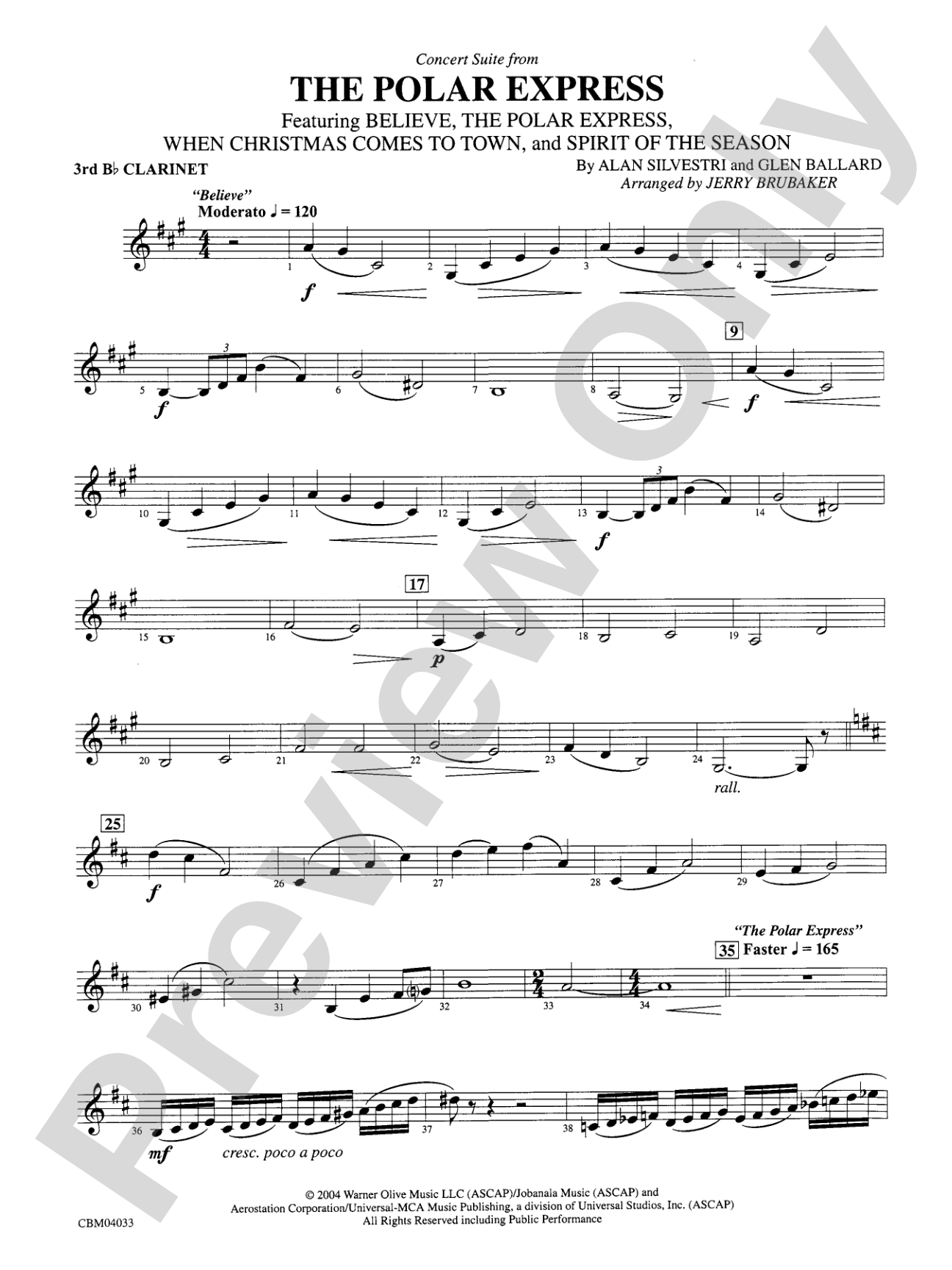

The Polar Express, Concert Suite from: 3rd B-flat Clarinet
Featuring: Believe / The Polar Express / When Christmas Comes to Town / Spirit of the Season
By Glen Ballard and Alan Silvestri / arr. Jerry Brubaker
Grade: 4 (Medium)
Item: 00-PC-0016088_C3
$3.00
Pickup currently not available
Description
This blockbuster Alan Silvestri and Glen Ballard film score has been masterfully scored for symphonic band. The medley includes "Believe," "The Polar Express," "When Christmas Comes to Town," and "Spirit of the Season." Wonderful film music---let the children come out for the holiday season! (6:30)


Don't just read it, hear it, play along with it, and watch your students grow with it. In MakeMusic Cloud, The Polar Express, Concert Suite from: 3rd B-flat Clarinet comes alive with professional accompaniment, adjustable tempo, and built-in practice tools that turn solo practice into real progress.
Open in the Player
Jump straight in and assign it today.
Start Your Free Trial
Open this title and explore the full library in minutes.
Sample Audio
1
Audio File
--:--
0:00
0:00
Sample Video
Additional Details
Series:
Pop Symphonic Band
Publisher:
Alfred Music
Page Count:
354
SKU:
00-PC-0016088_C3
More about this title
About the Composer: Glen Ballard
Glen Ballard is a Grammy Award-winning composer and producer whose work spans film, television, and popular music. He has collaborated with major studios on blockbuster scores and is known for writing music that balances emotional depth with broad accessibility, making his compositions equally effective in concert settings and in their original contexts.
Why we love this
Jerry Brubaker's arrangement preserves the soaring melodies and emotional arc of the original film score while crafting idiomatic writing that lies beautifully for band instruments. The medley structure gives you four contrasting moments in one piece, perfect for holiday concerts that need emotional resonance without requiring your ensemble to tackle overly technical passages. Grade 4 accessibility means solid players across your section can execute the writing cleanly, leaving rehearsal time for shaping and interpretation rather than mechanics.
What to expect
Warm, nostalgic, and genuinely festive without veering into saccharine territory. The suite unfolds like a cinematic journey through winter wonder, moving from the hopeful drive of the title theme through reflective moments and building toward joyful celebration. Each song retains its character from the film while sounding fresh within the band context.
Who it's for
Band directors programming holiday concerts who want substantive, singable music that audiences recognize and your students genuinely enjoy performing. This suite works well for groups with intermediate technical facility but strong musicianship and willingness to shape longer phrases. High school and upper middle school bands will find the arrangement rewarding without requiring advanced skill or extensive rehearsal time.
How to get the most out of it
- Balance the melody across your woodwind and brass sections as it travels between them; mark who has the lead in each phrase so no one undershoots their role during run-throughs.
- Use the recorded accompaniment to lock in the ensemble pulse, especially during the faster sections where rhythmic precision shapes the energy.
- Shape the softer, introspective moments with genuine restraint; resist the urge to push dynamics too hard, since the emotional power comes from contrast.
- Work the sectional releases and cutoffs deliberately in rehearsal; film scores often depend on crisp releases to maintain the cinematic pacing Brubaker built into the arrangement.
How to use it
Open your second half with this as a complete standalone work, or use individual movements as connective tissue between other holiday selections. The six-and-a-half-minute duration makes it substantial enough to anchor a program without consuming the full concert. This pairs naturally with traditional holiday repertoire or other contemporary film-inspired concert band music.
Skills your students will build
- Sustaining longer musical phrases across changes in orchestration and harmonic context
- Balancing melody and accompaniment when the primary voice shifts between sections
- Responding to dynamic layering and textural contrast within a single work
- Maintaining ensemble cohesion during key and tempo shifts within medley format