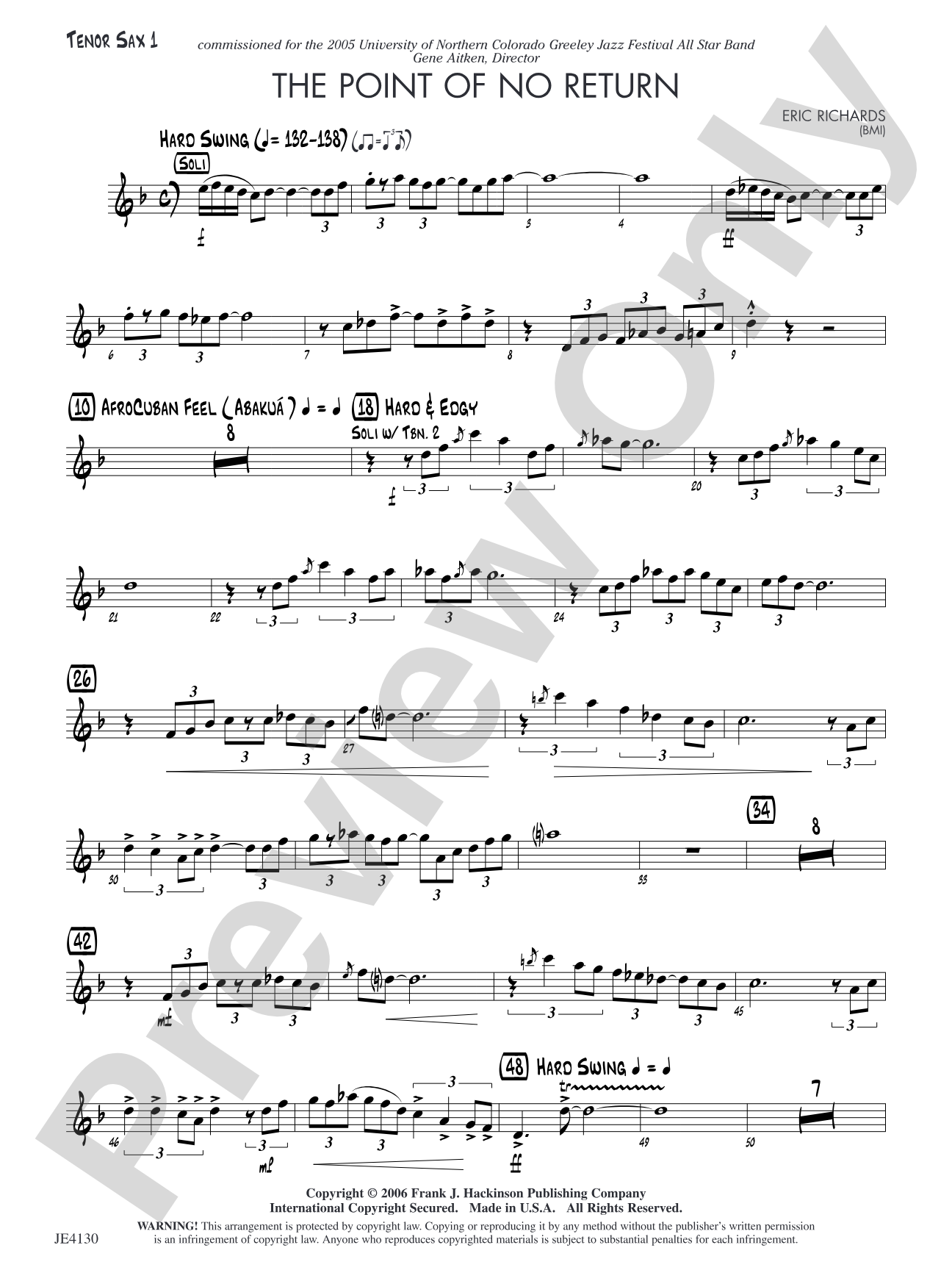
The Point of No Return: Tenor Sax 1 (Jazz) Sheet Music Preview

The Point of No Return: Tenor Sax 1 (Jazz)

By Eric Richards

Grade: 5

Item: 98-PC-DJE4130_TX1

Digital Download
$7.00
Description
Take your group to the next level with this innovative chart that alternates between a hard swing and an Afro-Cuban abakuá. Featuring trombone and tenor, this chart has it all-section features, optional soprano sax, great ensemble writing, shout choruses, and a final dogfight between bones and tenor (with plenty of solo drum fills). Sure to bring down the house!

The Point of No Return: Tenor Sax 1 (Jazz) isn't in MakeMusic Cloud just yet...but it could be. Let us know you'd like to see it, and you'll help shape what comes next. In the meantime, start a free trial and dive into thousands of interactive titles your students can play along with today.

Sample Audio
0:00
0:00
Sample Video
Additional Details
Series: FJH Advanced Jazz Ensemble
Publisher: The FJH Music Company, Inc.
SKU: 98-PC-DJE4130_TX1

More about this title

About the Composer: Eric Richards

Eric Richards

Eric Richards brings decades of experience across composition, arranging, conducting, and performance to his work at the University of Nebraska-Lincoln School of Music, where he holds a faculty position in composition. His music has premiered in major concert halls worldwide, including Carnegie Hall and prestigious jazz festivals in Montreux, Nice, and North Sea, performed by ensembles ranging from the US Army Field Band to the National Symphony Orchestra and the USAF Airmen of Note.

Richards spent two decades (1984-2004) as composer and arranger for the US Army Field Band, where he developed the craft of writing for large ensembles across multiple styles and idioms. That foundation in ensemble writing for professional musicians directly informs his approach to jazz composition and arrangement.

Why we love this

Richards writes with real knowledge of what makes a jazz ensemble come alive. The alternation between hard swing and Afro-Cuban feels genuine, not grafted on, and the section spotlights (trombone, tenor, soprano) give your players meaningful moments without overshadowing the ensemble writing. That final trombone versus tenor dogfight gives you a genuine show-stopper that audiences remember.

What to expect

The piece swings hard and grooves deep, then pivots into the warmth and complexity of Afro-Cuban rhythms without losing energy. The shout choruses build momentum naturally, and the final battle between the bones and tenor crackles with competitive chemistry and rhythmic fire.

Who it's for

Grade 5 jazz ensembles ready to tackle stylistic contrast and sophisticated section writing. Your group needs solid readers who can execute both swing and Latin feels cleanly, plus confident soloists who can drive the featured passages.

How to get the most out of it

  • Lock the pocket during the swing sections first. Once your rhythm section has the groove locked, the reeds and bones can layer their lines with confidence.
  • Balance the abakuá rhythm carefully. The clave pattern needs to sit just under the surface; don't let it overwhelm the melody or the ensemble harmony.
  • Give your soloists real space in the tenor and trombone features. Richards writes strong lines, and they'll sing best when not rushed or crowded by the section.
  • Prepare your drummer for those fills. The final dogfight section lives and dies by the drum conversation with the bones and tenor, so isolate and rehearse that section early.

How to use it

This lands perfectly as a concert closer or the centerpiece of a jazz-focused program. It works equally well as a festival selection where you want to show off your ensemble's range and your soloists' individual voices.

Skills your students will build

  • Playing with conviction in two distinct groove styles (hard swing and Afro-Cuban rhythmic feel)
  • Balancing ensemble section writing with featured solo passages
  • Reading and executing clave-based Latin rhythms with accuracy
  • Responding to and supporting drummer-led rhythmic conversations
  • Trading figures and call-and-response patterns between sections

You May Also Like