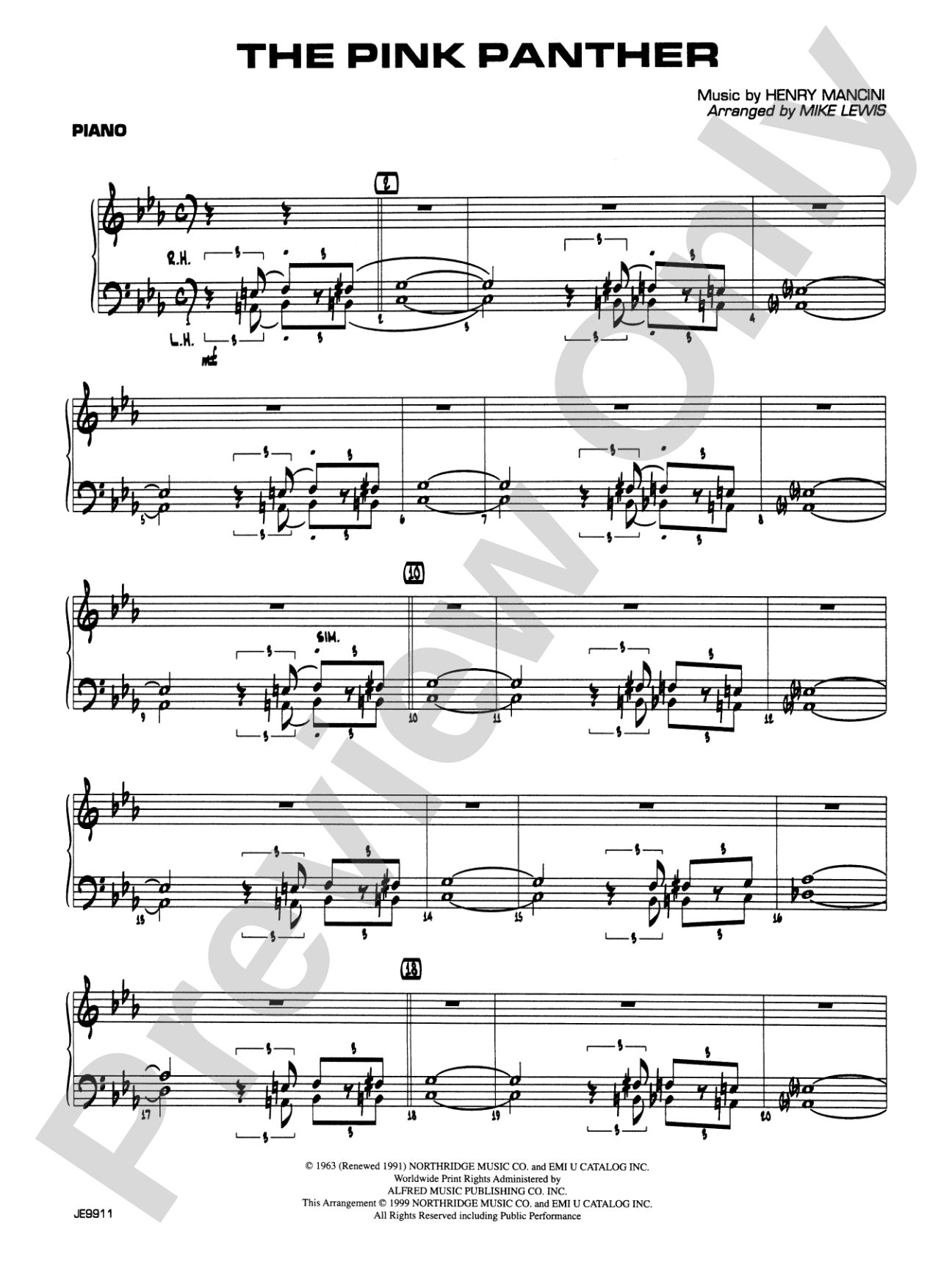
The Pink Panther: Piano Accompaniment Sheet Music Preview

The Pink Panther: Piano Accompaniment

By Henry Mancini / arr. Mike Lewis

Grade: 1 (Easy)

Item: 00-PC-0017268_K

Digital Download
$3.00
Description
Some tunes just live forever, and students always love to play them. PINK PANTHER is a perfect example. Arranger Mike Lewis gives the less experienced jazz groups an opportunity to play this all-time favorite. A few triplet and swing figures, along with a lot of unison scoring, make this a natural for young jazz ensembles. Give this chart a look! Very Easy (3:04)

Don't just read it, hear it, play along with it, and watch your students grow with it. In MakeMusic Cloud, The Pink Panther: Piano Accompaniment comes alive with professional accompaniment, adjustable tempo, and built-in practice tools that turn solo practice into real progress.

Sample Audio
No sample audio found.
Sample Video
Additional Details
Series: First Year Charts for Jazz Ensemble
Publisher: Alfred Music
Page Count: 74
SKU: 00-PC-0017268_K

More about this title

About the Composer: Henry Mancini

Henry Mancini (1924–1994) shaped the sound of American film and television through his gift for melody and orchestration. His work earned 20 Grammy Awards and four Academy Awards, and his scores became the soundtrack to postwar popular culture. For music educators, Mancini represents the golden age of accessible, singable composition—work that connects immediately with students while maintaining genuine musical sophistication.

Why we love this

This arrangement captures what makes the Pink Panther theme iconic without overwhelming young jazz musicians. Mike Lewis keeps the harmonic and rhythmic language straightforward—unison passages dominate, swing figures are manageable, and there's nothing here that demands years of jazz experience. It's the rare chart that teaches jazz fundamentals while delivering a piece students genuinely want to play.

What to expect

Smooth, cool, and instantly recognizable. The Pink Panther theme has an inherent sophistication that comes from its melodic simplicity and harmonic elegance. Young musicians feel immediately like they're playing real jazz, not exercises.

Who it's for

First-year jazz ensembles and middle school jazz programs looking for a piece that builds fundamentals without feeling remedial. Any group in their first or second year of jazz study will find the swing figures and unison scoring accessible while the familiar melody keeps everyone engaged.

How to get the most out of it

  • Lock the rhythm section into the swing feel from the opening. Triplet subdivision on the drums and walking bass lines give the chart its groove; if those two elements are solid, the horns will follow naturally.
  • Lean into the unison sax and trumpet passages. They're written this way to strengthen ensemble blend and intonation, so treat them as opportunities to hear the collective voice rather than individual voices.
  • Shape the melody with rubato in the head. This tune has inherent swagger; let the lead trumpet breathe and phrase like they're singing, not just hitting the notes on time.

How to use it

Program this early in a concert to grab the audience's attention with a tune everyone knows, then use it as a confidence builder before moving into more challenging repertoire. It also works beautifully as a feature piece for young jazz groups performing at pep rallies, assemblies, or informal performances where you want maximum impact from minimal rehearsal investment.

Skills your students will build

  • Swing feel and triplet subdivision
  • Leading and following in unison passages
  • Phrasing and articulation for jazz melody
  • Basic jazz ensemble balance and blend
  • Listening to bass lines and drums for rhythmic grounding

You May Also Like