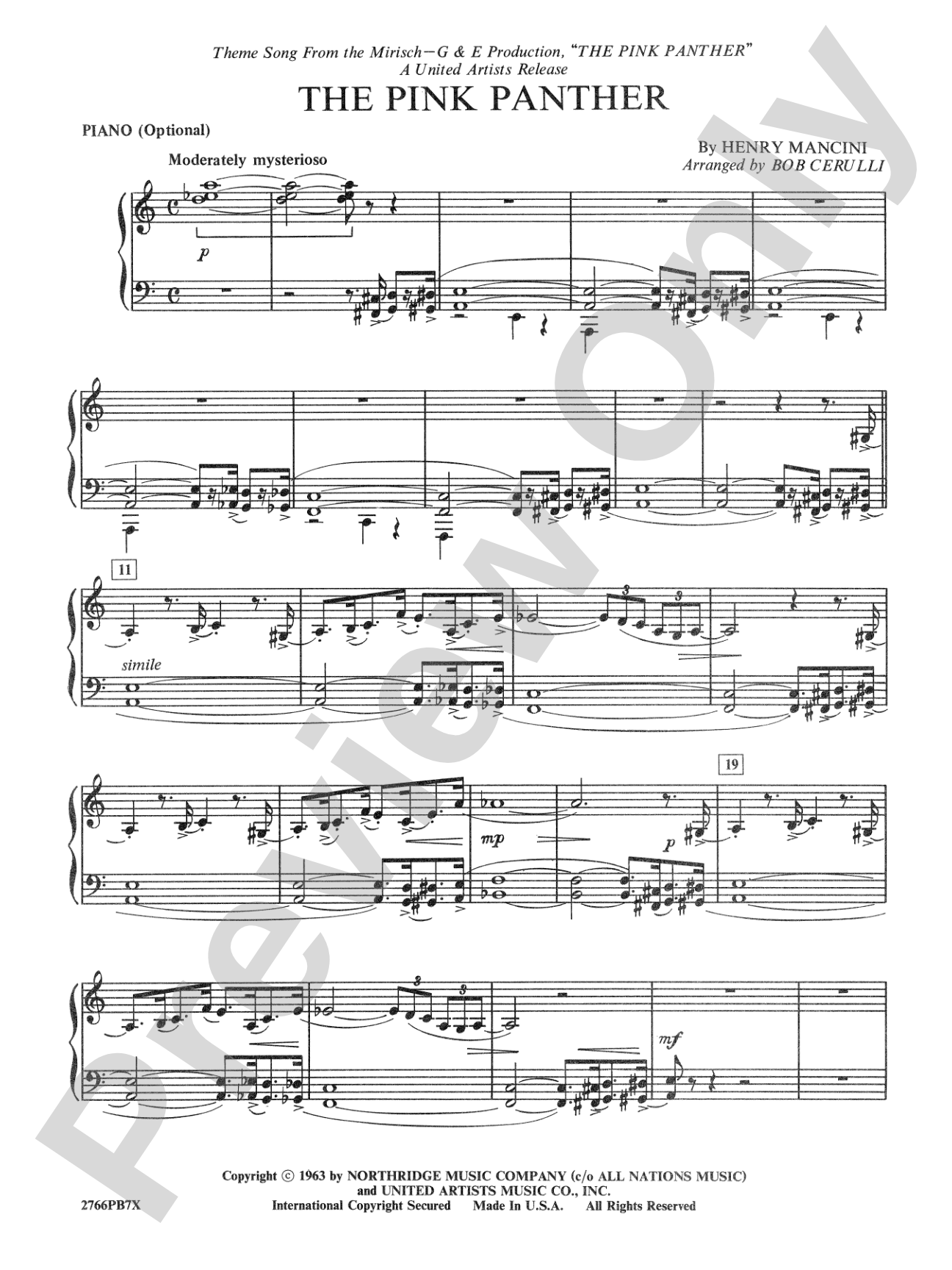
The Pink Panther: Piano Accompaniment Sheet Music Preview

The Pink Panther: Piano Accompaniment

By Henry Mancini / arr. Bob Cerulli

Grade: 2.5

Item: 00-PC-0001321_K

Digital Download
$3.00
Description
Who doesn't know this theme by the great Henry Mancini? Now in an easy arrangement for school groups by Bob Cerulli. Good for any concert. Use as a change of pace or even encore material!

Don't just read it, hear it, play along with it, and watch your students grow with it. In MakeMusic Cloud, The Pink Panther: Piano Accompaniment comes alive with professional accompaniment, adjustable tempo, and built-in practice tools that turn solo practice into real progress.

Sample Audio
No sample audio found.
Sample Video
Additional Details
Series: Pop Intermediate Full Orchestra
Publisher: Alfred Music
Page Count: 140
SKU: 00-PC-0001321_K

More about this title

About the Composer: Henry Mancini

Henry Mancini (1924-1994) composed some of the most instantly recognizable themes in film and television history. His gift for melody and orchestration made him a dominant force in Hollywood during the 1950s and 1960s, earning four Academy Awards and eighteen Grammy Awards over his career. Mancini's music education background and sophisticated harmonic sense allowed him to write themes that work equally well in concert halls and classrooms, making his catalog invaluable for music educators looking to engage students with repertoire they actually know.

Why we love this

This arrangement captures the suave, comedic energy of one of cinema's most famous themes without overwhelming young musicians. Bob Cerulli's Grade 2.5 scoring lets every section shine while keeping parts manageable, so students focus on character and articulation rather than wrestling with the notes. It's the kind of piece that generates genuine excitement in rehearsal because everyone in the audience will recognize it instantly.

What to expect

Sly and sophisticated, with a hint of humor around every corner. The melody glides with an almost film noir elegance, accompanied by warm orchestral colors that feel both retro and timeless. There's a subtle comedic timing built into the phrasing—this music doesn't take itself too seriously, but it takes the craft seriously.

Who it's for

Any full orchestra program that needs a crowd-pleasing concert or encore piece at an intermediate level. Middle school and high school orchestras will find themselves playing a legitimate Hollywood theme rather than a simplified novelty, building confidence and musicianship alongside fun. Directors programming pops concerts, spring concerts, or community events will appreciate having a piece this recognizable that still requires genuine musical attention.

How to get the most out of it

  • Shape the opening melody with a light, sophisticated articulation. The Pink Panther stalks; it doesn't march. Clean detaché attacks with a slight taper at each note phrase.
  • Balance the muted trumpet or saxophone carrying the theme against the supporting orchestration. The solo voice must float above the texture without drowning in accompanimental detail.
  • Use the written dynamics as a roadmap for building tension and releasing it. This arrangement relies on subtle dynamic waves rather than dramatic contrasts, so discipline the crescendos and diminuendos.
  • Lock the rhythmic foundation in the rhythm section early. Once bass and percussion establish the groove's relaxed swing feel, the rest of the orchestra settles in naturally.

How to use it

Pair it with classical or contemporary pieces to demonstrate how great melody works across genres. It works beautifully as an encore after a more serious concert program, or as the centerpiece of a pops concert alongside other accessible orchestral favorites. The 140-page full score and parts give you flexibility to program it virtually any time of year without worrying about thematic constraints.

Skills your students will build

  • Articulation control and character playing (distinguishing between detaché, legato, and staccato within a single melodic line)
  • Ensemble balance and relative dynamic awareness (supporting a featured melody without overplaying the accompaniment)
  • Rhythmic precision in a swing-influenced idiom
  • Phrasing and rubato with style (knowing when to hold back and when to push slightly forward)
  • Reading a full orchestra score coordinated with individual parts

You May Also Like