
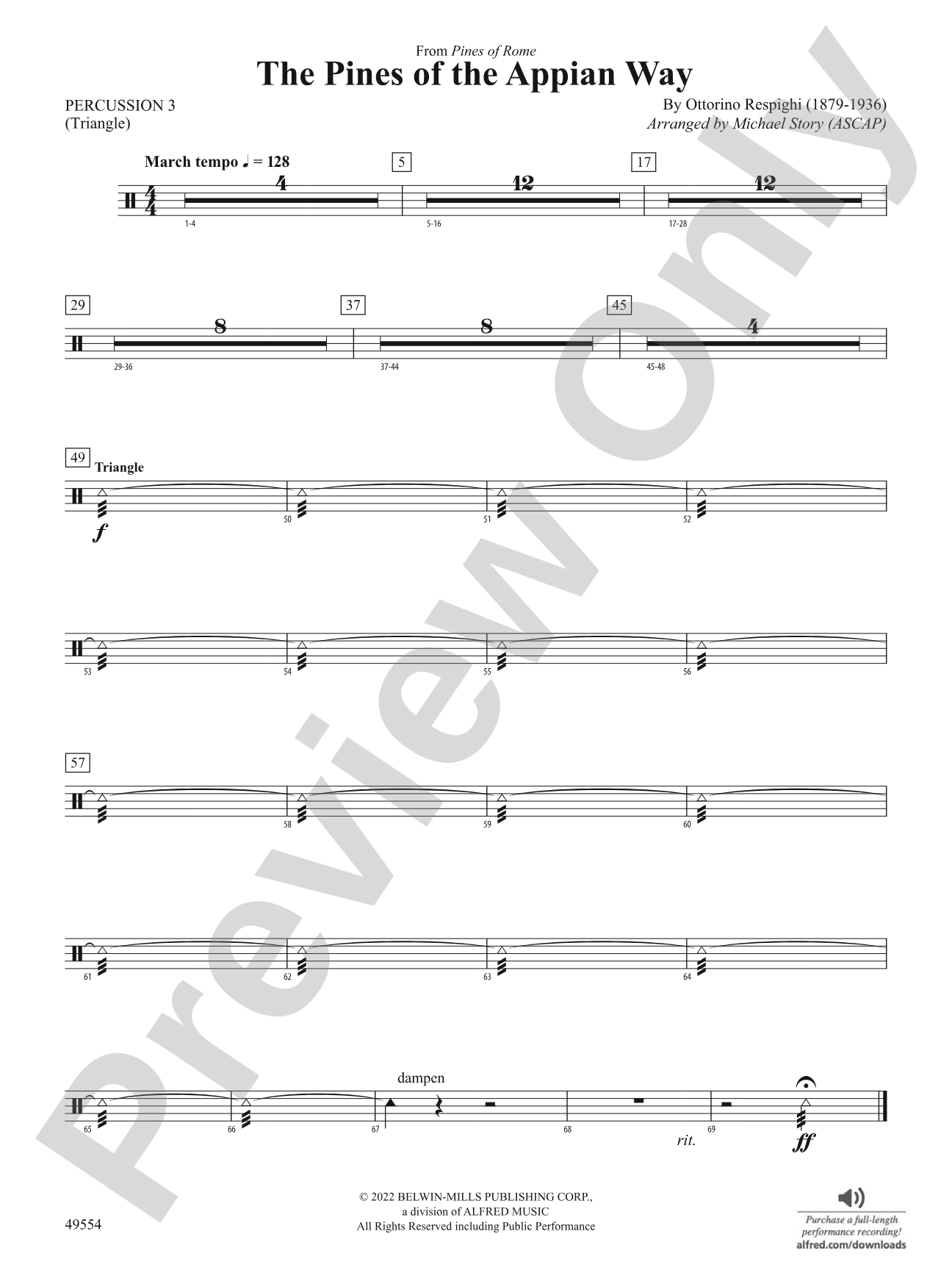

The Pines of the Appian Way: 3rd Percussion
From Pines of Rome
By Ottorino Respighi (1879-1936) / arr. Michael Story
Grade: 2.5
Item: 00-PC-0018827_PC3
$3.00
Pickup currently not available
Description
Completed in 1924 Respighi's masterwork consists of four contrasting movements. The final movement, "The Pines of the Appian Way," depicts the advancement of the Roman Legion as it gradually marches towards the listener. It is one of the most glorious and stunning orchestral crescendos in all of classical music. Perfectly arranged for young band by Michael Story! (2:29) This title is available in MakeMusic Cloud.


Don't just read it, hear it, play along with it, and watch your students grow with it. In MakeMusic Cloud, The Pines of the Appian Way: 3rd Percussion comes alive with professional accompaniment, adjustable tempo, and built-in practice tools that turn solo practice into real progress.
Open in the Player
Jump straight in and assign it today.
Start Your Free Trial
Open this title and explore the full library in minutes.
Sample Audio
1
Audio File
--:--
0:00
0:00
Sample Video
No sample videos found.
Additional Details
Series:
Belwin Young Band
Publisher:
Alfred Music
SKU:
00-PC-0018827_PC3
More about this title
About the Composer: Ottorino Respighi
Ottorino Respighi (1879–1936) was an Italian composer and conductor whose orchestral works defined early twentieth-century nationalism in concert music. He studied composition in Bologna and later in Russia under Nikolai Rimsky-Korsakov, absorbing techniques in color and orchestration that would become his hallmark. His four symphonic poems collectively titled "The Pines of Rome" secured his international reputation and remain staples of the wind band and orchestra repertoire.
Respighi's gift was transforming evocative imagery into precise musical architecture. He sketched Rome's landmarks and history with orchestration of remarkable clarity, writing music that sounds effortless yet demands sophisticated ensemble control. His works have inspired generations of young musicians to listen closely to how composers use instrumental color to tell a story.
Why we love this
Michael Story's arrangement captures the architectural grandeur of Respighi's original without overwhelming a young band. The final movement's legendary crescendo remains the emotional centerpiece, yet the ensemble writing ensures every section contributes meaningfully. At Grade 2.5, this gives developing bands access to a legitimate masterwork that sounds and feels far more sophisticated than its technical demands.
What to expect
Imagine the echo of marching footsteps growing louder, more purposeful, and more overwhelming as thousands of soldiers approach. Respighi's orchestration builds from a distant procession into a thunderous, almost terrifying declaration of power, leaving the listener awestruck by sheer sonic force and forward momentum.
Who it's for
Concert bands at the Grade 2.5 level who want to program a masterwork arrangement that sounds impressive without requiring advanced technique or maturity. This arrangement works for bands preparing for festival or contest, or for any director seeking a finale that leaves an audience genuinely moved.
How to get the most out of it
- Build the opening march with steady, unyielding pulse from the bass line. The Roman Legion advances at a relentless pace, so resist the temptation to pull back between phrase statements.
- Balance the melodic layers throughout the crescendo. As more voices enter, ensure soloists (particularly in the upper woodwinds) remain audible beneath the growing sonority rather than drowning in it.
- Shape the final climax with dynamic control across eight to ten bars. The effect depends on a graduated acceleration of volume, not a sudden arrival. Subdivide internally and cue ensemble entrances so the last measures feel inevitable rather than forced.
- Use the recorded accompaniment in rehearsal to establish tempo and phrasing before conducting live. This piece's majesty lives in its momentum, and the recording model provides a clear reference for ensemble balance.
How to use it
Program this as a concert finale or festival encore. It pairs naturally after lighter character pieces or educational works, offering a dramatic payoff that sends the audience out energized. Many contest programs benefit from closing with this movement, as its emotional impact elevates the entire performance.
Skills your students will build
- Sustaining ensemble balance across a lengthy crescendo
- Maintaining pulse and rhythmic integrity under dynamic expansion
- Blending multiple melodic lines while preserving clarity
- Responding to precise conducting cues during accelerating harmonic and orchestral density
- Identifying and executing dynamic shaping across an entire section rather than individual phrases