
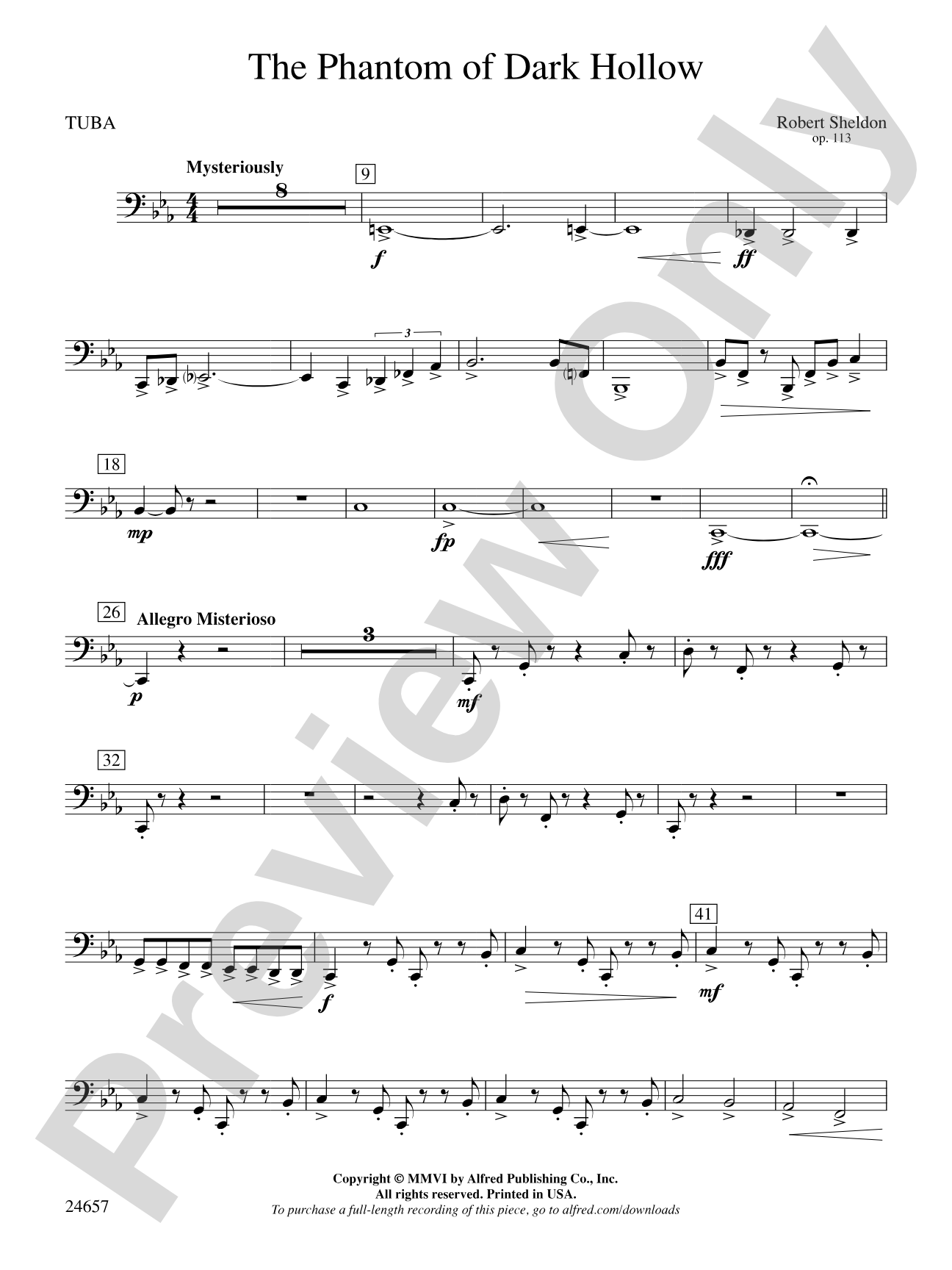

The Phantom of Dark Hollow: Tuba
By Robert Sheldon
Grade: 2.5 (Medium Easy)
Item: 00-PC-0000825_TB1
$3.00
Pickup currently not available
Description
"The Phantom of Dark Hollow" was commissioned by the Indiana Bandmasters Association for the 2005 Indiana All-District Honor Bands. The piece was inspired by the weird and gruesome legend told about Robeson's Hills, just across the Wabash River from Vincennes, Indiana. In the midst of these hills is a deep, dark ravine, where the rays of the sun never penetrate. This place is known as "Dark Hollow."


Don't just read it, hear it, play along with it, and watch your students grow with it. In MakeMusic Cloud, The Phantom of Dark Hollow: Tuba comes alive with professional accompaniment, adjustable tempo, and built-in practice tools that turn solo practice into real progress.
Open in the Player
Jump straight in and assign it today.
Start Your Free Trial
Open this title and explore the full library in minutes.
Sample Audio
1
Audio File
--:--
0:00
0:00
Sample Video
Additional Details
Series:
Young Symphonic
Publisher:
Alfred Music
Page Count:
230
SKU:
00-PC-0000825_TB1
More about this title
About the Composer: Robert Sheldon

Robert Sheldon's compositions have become staples in concert band repertoire worldwide, performed by ensembles from school bands to professional orchestras. His work has earned recognition from the American School Band Director's Association, Phi Beta Mu, and ASCAP, and he has conducted his music in venues ranging from Carnegie Hall to the Sydney Opera House.
Beyond composition, Sheldon is a prolific clinician and guest conductor for All-State and Regional Honor Bands across the United States and internationally in Japan, Canada, Italy, Germany, Australia, and China. He served as lead author of Sound Innovations for Concert Band and continues to accept commissions while maintaining an active publication schedule. In 2020, VanderCook College of Music honored him with a doctorate for his contributions to music education.
Why we love this
Sheldon captures the atmospheric tension of a local legend without sacrificing accessibility; Grade 2.5 bands get to play genuinely engaging programmatic music that builds ensemble skill while telling a story. The orchestration sits comfortably in young players' hands while delivering the dramatic color and narrative arc that keeps rehearsals focused and performances memorable.
What to expect
Sheldon paints a musical landscape of mystery and shadow, where the deep ravine becomes palpable through color and tension rather than technical complexity. The piece breathes with the eerie quality of local folklore while remaining approachable enough for young ensembles to express genuine musicality.
Who it's for
Concert bands at the Grade 2 to 2.5 level looking for programmatic repertoire that engages without overwhelming. Directors seeking accessible Halloween programming or fall concert material that builds student confidence in atmospheric ensemble playing.
How to get the most out of it
- Shape the darker passages with deliberate dynamic control; the absence of bright sunlight in Dark Hollow demands restraint in the upper register to create authentic atmosphere rather than simply playing softly.
- Lock in rhythmic precision during transitions between sections; the programmatic structure depends on clean ensemble attacks to signal shifts in the narrative and maintain momentum.
- Balance the bass and woodwind lines carefully in ensemble passages to ensure both the harmonic foundation and melodic storytelling remain audible from the audience's perspective.
- Use the full range of articulation available to your ensemble to distinguish between the legend's ominous elements and any moments of release or resolution within the piece.
How to use it
Program this as a thematic centerpiece for a fall or Halloween concert, pairing it with contrasting brighter works to highlight its atmospheric qualities. It also works well as an ensemble builder earlier in the season, offering meaningful musical content while developing sight-reading and interpretive skills before more demanding winter repertoire.
Skills your students will build
- Dynamic control and maintaining ensemble balance in soft passages
- Responding to programmatic cues and narrative structure in concert band writing
- Precision in rhythmic transitions between contrasting sections
- Tone quality and sustained playing across full phrase lengths
- Sectional independence within ensemble texture