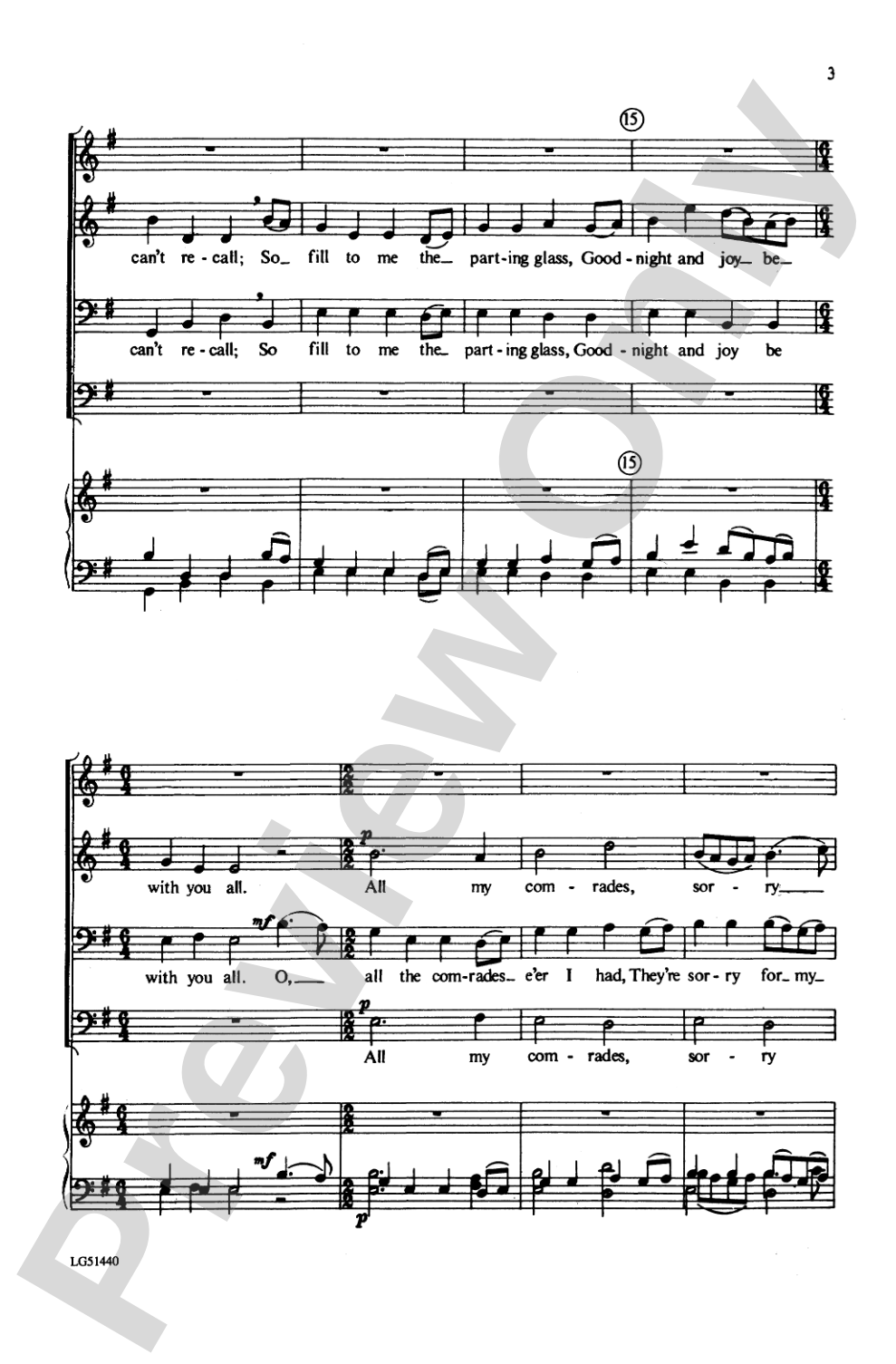
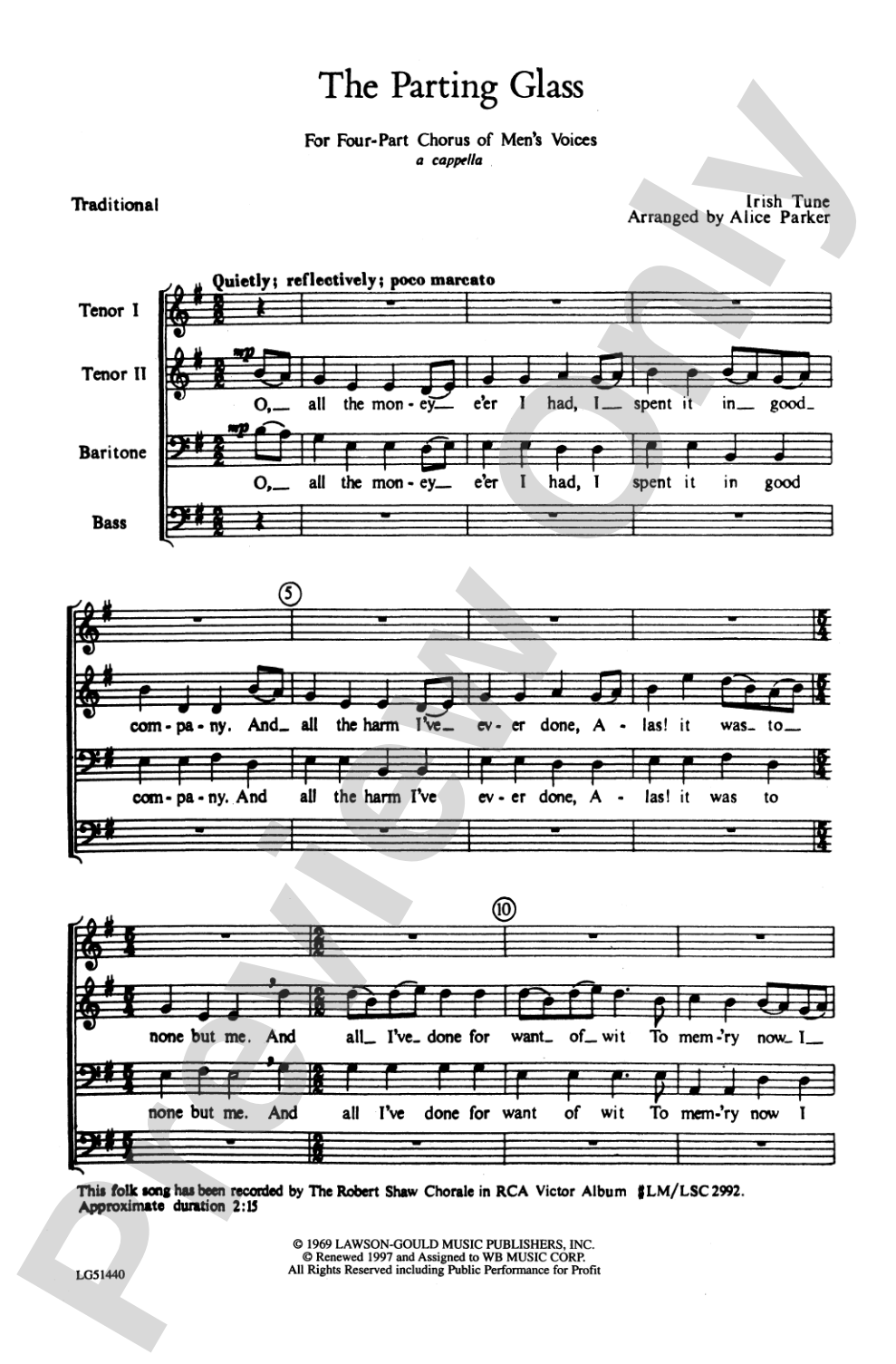
The Parting Glass Sheet Music Preview

The Parting Glass: TTBB Choral Octavo

Arr. Alice Parker

Item: 00-PO-0002661

Digital Download
$2.25

Minimum order quantity: 20 copies

Description

The Parting Glass: TTBB Choral Octavo isn't in MakeMusic Cloud just yet...but it could be. Let us know you'd like to see it, and you'll help shape what comes next. In the meantime, start a free trial and dive into thousands of interactive titles your students can play along with today.

Sample Audio
No sample audio found.
Sample Video
Additional Details
Series: Alfred Archive Edition: Lawson-Gould Music Publishers
Publisher: Alfred Music
Page Count: 8
SKU: 00-PO-0002661

More about this title

About the Arranger: Alice Parker

Alice Parker

Alice Parker brought the folk tradition into the concert hall through meticulous, singable arrangements that honor both melody and text. A student of composition and conducting at Smith College and Juilliard, she spent decades collaborating with Robert Shaw on settings of American folksongs, hymns, and spirituals that have become repertoire standards in choirs everywhere. Her catalog spans over five hundred published works, from operas and cantatas to individual anthems, all grounded in her belief that melody is the heart of vocal music.

Parker founded MELODIOUS ACCORD, INC. in 1985 to deepen her work with song leading and congregational singing. She published influential books on melodic style and choral improvisation, and her 2010 hymnal brought together folk hymn arrangements alongside her own settings of contemporary poetry. Among many honors, she received the Robert Shaw Award from the American Choral Directors Association in 2013, six honorary doctorates, and recognition as Distinguished Composer of the Year by the American Guild of Organists.

Why we love this

Parker's arrangement captures what makes this Irish farewell so enduring: a melody that sits naturally in men's voices and text that carries genuine emotion without sentimentality. The flexible voicing (TB/TTB/TBB/TTBB) means you can program this whether your tenor section is strong or your baritones outnumber tenors, and the eight-page score gives enough substance for a meaningful rehearsal without drowning a concert program.

What to expect

A moment of reflection that feels both intimate and universal. The melody unfolds with the directness of a folk tune, but Parker's harmonic language gives it depth; the text (a farewell blessing) lands with quiet gravity. There is no sentimentality here, only honest craftsmanship and the kind of warm melancholy that makes audiences listen.

Who it's for

Men's choirs and TTBB ensembles looking for repertoire that is both musically substantial and genuinely enjoyable to sing. Directors who want a folk arrangement that feels earned rather than gimmicky, and who value pieces that anchor an all-male program with emotional intelligence.

How to get the most out of it

  • Honor the lyrical contour of the melody. Even in a four-part arrangement, the tune should sing through with warmth and legibility.
  • Balance the harmony to support rather than obscure the text. Parker's voice-leading rewards clear diction over thick chordal blend.
  • Let the lower voices anchor the harmonic rhythm without dragging. A flowing tempo that matches the natural speech rhythm of the words will keep the piece from feeling static.
  • Consider whether your ensemble needs the accompaniment or can sustain this arrangement a cappella. Either choice works; the determining factor is ensemble blend and comfort with intonation.

How to use it

Program this in a concert that mixes folk tradition with art song, or pair it with other Parker arrangements to showcase her distinctive approach to American repertoire. It works equally well as a concert closer (a fitting sendoff) or as a bridge between secular and sacred music if your program includes hymns or spirituals.

Skills your students will build

  • Singing folk melody with musical line and intention
  • Balancing ensemble blend across flexible TTBB voicings
  • Maintaining intonation in four-part harmony
  • Connecting text to phrasing and dynamic shape

You May Also Like