
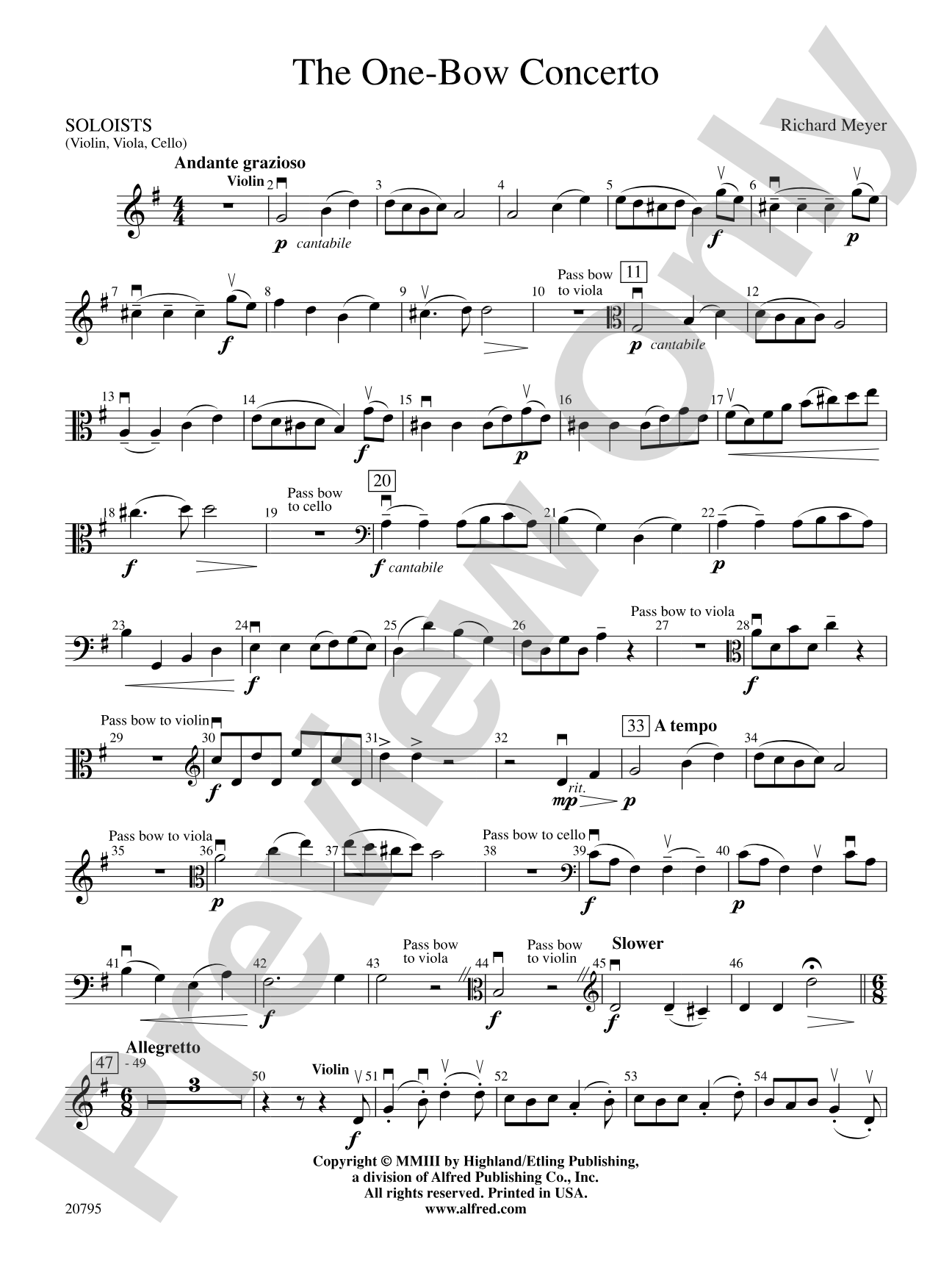

The One-Bow Concerto: Solo
By Richard Meyer
Grade: 2
Item: 00-PC-0000461_SOLO
$5.99
Pickup currently not available
Description
This original piece features three soloists and the use of only one bow throughout! Your audience will be captivated as they watch the violin, viola, and cello soloists pass a bow amongst themselves while the rest of the string orchestra accompanies pizzicato. The concerto begins with a slow Mozart-like opening section followed by a lively 6/8 section that allows the soloists to show off. By the end, the bow ends up in the conductor's hand, used as a baton to bring this crowd-pleaser to a rousing conclusion. Very playable by less experienced groups but a joy for all groups to play, hear and watch! This title is available in MakeMusic Cloud.


Don't just read it, hear it, play along with it, and watch your students grow with it. In MakeMusic Cloud, The One-Bow Concerto: Solo comes alive with professional accompaniment, adjustable tempo, and built-in practice tools that turn solo practice into real progress.
Open in the Player
Jump straight in and assign it today.
Start Your Free Trial
Open this title and explore the full library in minutes.
Sample Audio
1
Audio File
--:--
0:00
0:00
Sample Video
No sample videos found.
Additional Details
Series:
Highland/Etling String Orchestra
Publisher:
Alfred Music
Page Count:
136
SKU:
00-PC-0000461_SOLO
More about this title
About the Composer: Richard Meyer

Richard Meyer brings three decades of string education experience to his work as a composer and conductor. He transformed the orchestra program at Oak Avenue Intermediate School in Temple City, California, growing it from 29 students to 200 over 22 years, and directed the Pasadena Youth Symphony Orchestra for 16 years, taking them on international tours to Vienna, Australia, and Canada. He also founded the nationally recognized "Giving Bach" program, which uses interactive concerts to serve special needs and underserved students across Southern California.
Meyer's compositional output reflects his deep understanding of what works in the rehearsal room and on stage. With nearly 200 published works and arrangements in print, he has also served as string editor for Alfred Publishing Company and co-authored the String Explorer Series and Sight-read It for Strings. He has been a featured clinician at the A.S.T.A. National Conference, Texas Orchestra Directors' Association Conference, and state All-State honor orchestras.
Why we love this
Meyer has engineered a piece that works on multiple levels: it's visually compelling enough to hold an audience's attention, musically satisfying for student performers, and surprisingly elegant in its concept. The theatrical device of passing a single bow among three soloists transforms what could be a gimmick into a genuine musical challenge that requires careful listening, ensemble awareness, and rhythmic precision from the entire orchestra. Grade 2 groups rarely get this kind of sophisticated programming opportunity.
What to expect
The opening unfolds with classical elegance in the manner of Mozart, establishing a contemplative mood before the piece shifts into a buoyant 6/8 section full of rhythmic energy. The visual spectacle of watching three soloists trade a single bow creates genuine suspense, while the pizzicato strings provide a rhythmic foundation that anchors the soloists' improvisatory feel.
Who it's for
String orchestras at the Grade 2 level who want a piece that entertains without sacrificing musicality. The work suits groups preparing for festivals or spring concerts, especially those looking for something that demonstrates both technical competence and theatrical presence.
How to get the most out of it
- Establish clear sightlines between the three soloists before rehearsing. They must see the bow exchange happen, so position them in a triangle or row where they can visually confirm transitions without relying solely on the conductor.
- Work the pizzicato sections separately from the solo passages. The accompaniment needs rhythmic solidity and consistent dynamic control to support the soloists' transitions without drawing focus.
- Mark the moment the conductor takes possession of the bow as a distinct character change. Rehearse the final section so the orchestra understands it's following the conductor's baton, not a traditional soloist.
How to use it
Feature this on a festival or concert program where your ensemble needs a centerpiece that showcases both musicianship and showmanship. The piece works equally well as a spring concert highlight or a festival entry that stands out from traditional concerto repertoire. Consider programming it alongside contrasting works to emphasize its novelty without overloading the concert with theatrical pieces.
Skills your students will build
- Precise ensemble rhythmic coordination while accommodating solo passage work
- Sustained pizzicato playing with consistent tone and intonation
- Listening and visual communication between soloists during bow exchanges
- Following both independent soloist lines and a unified conductor during structural transitions
- Reading and executing the Mozart-like baroque counterpoint in the opening section and the rhythmic complexity of 6/8 meter