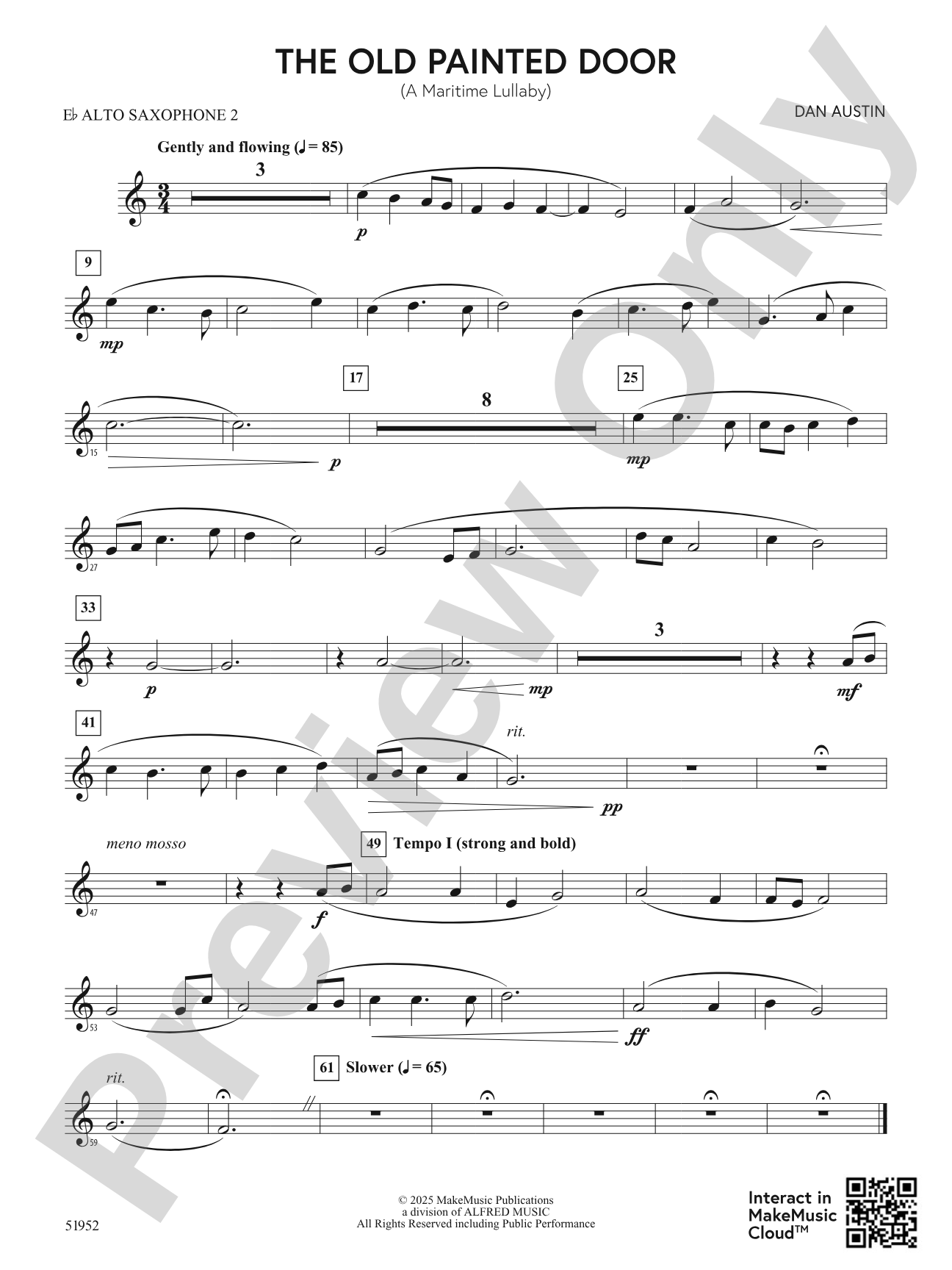
The Old Painted Door: 2nd E-flat Alto Saxophone Sheet Music Preview

The Old Painted Door: 2nd E-flat Alto Saxophone

(A Maritime Lullaby)

By Dan Austin

Grade: 3

Item: 00-PC-0019441_AX2

Digital Download
$3.00
Description
This endearing lyrical work was inspired by an artist's magnificent painting on an old wooden door. Reflecting the beautiful scenery of the Maritime Provinces in Canada, The Old Painted Door by Canadian composer Dan Austin has a sincere, heartfelt melody that is both contemplative and powerful. Stunning music that is also very approachable. (3:00)

The Old Painted Door: 2nd E-flat Alto Saxophone isn't in MakeMusic Cloud just yet...but it could be. Let us know you'd like to see it, and you'll help shape what comes next. In the meantime, start a free trial and dive into thousands of interactive titles your students can play along with today.

Sample Audio
0:00
0:00
Sample Video
Additional Details
Series: MakeMusic Young Band
Publisher: MakeMusic Publications
SKU: 00-PC-0019441_AX2

More about this title

About the Composer: Dan Austin

Dan Austin

Dan Austin brings two decades of instrumental music teaching experience to his compositional work, currently serving as Band Director and Instrumental Music Teacher at Guelph Collegiate Vocational Institute in Guelph, Ontario. His contributions to music education extend beyond the classroom: he has led clinics at the Ontario Music Educators Association conference, guest lectured at the University of Toronto, McMaster University, and York University, and regularly publishes in Canadian and Ontario music education journals. Recognition for his work includes the 2022 Keith Mann Outstanding Band Directors Award from Musicfest Canada and the Canadian National Arts Centre, as well as the inaugural 2020 Beckwith Award from the Canadian Music Centre. Austin holds a degree from York University's Jazz Music Program in Toronto.

Why we love this

Austin crafts a piece that respects your students' musicality without compromising accessibility. The lyrical writing invites genuine expression rather than technical scrambling, and the programmatic connection to a specific place gives your band something concrete to rehearse toward. At Grade 3, it proves that sincere, emotionally resonant music doesn't require flashy difficulty.

What to expect

Contemplative yet substantial, like stepping into a gallery and finding yourself moved by something simple and honest. The writing reflects the quiet dignity of the Maritime landscape that inspired it, with moments of genuine warmth breaking through a reflective, thoughtful atmosphere.

Who it's for

Concert band directors seeking repertoire that challenges students musically without overwhelming them technically. It works equally well for high school ensembles building their expressive skills and mature middle school bands ready to engage with programmatic storytelling.

How to get the most out of it

  • Shape the main melody with a long-line approach rather than phrase-by-phrase punctuation; let the heartfelt character sustain through the sections.
  • Balance the harmonic colors by having players listen inward to blend with their section and outward to support the melodic line, regardless of which part carries it.
  • Allow the contemplative sections to breathe; resist the impulse to rush when the texture thins or the dynamics drop.
  • Use the three-minute duration to build a clear arc; mark your score where energy builds and where it recedes so every entrance and release serves the overall narrative.

How to use it

Position this as a centerpiece on a concert exploring regional or cultural themes, or pair it with other Canadian composers to spotlight that tradition. Its three-minute runtime and emotional maturity make it an excellent choice for festival programs where you want to showcase musicianship and artistry rather than technical display.

Skills your students will build

  • Sustaining long melodic lines with consistent tone and direction
  • Balancing sectional blend with support for the primary melody
  • Creating dynamic shape through expressive listening and ensemble awareness
  • Responding to programmatic context to inform interpretive choices
  • Managing ensemble sound in contrasting textures and dynamics

You May Also Like