
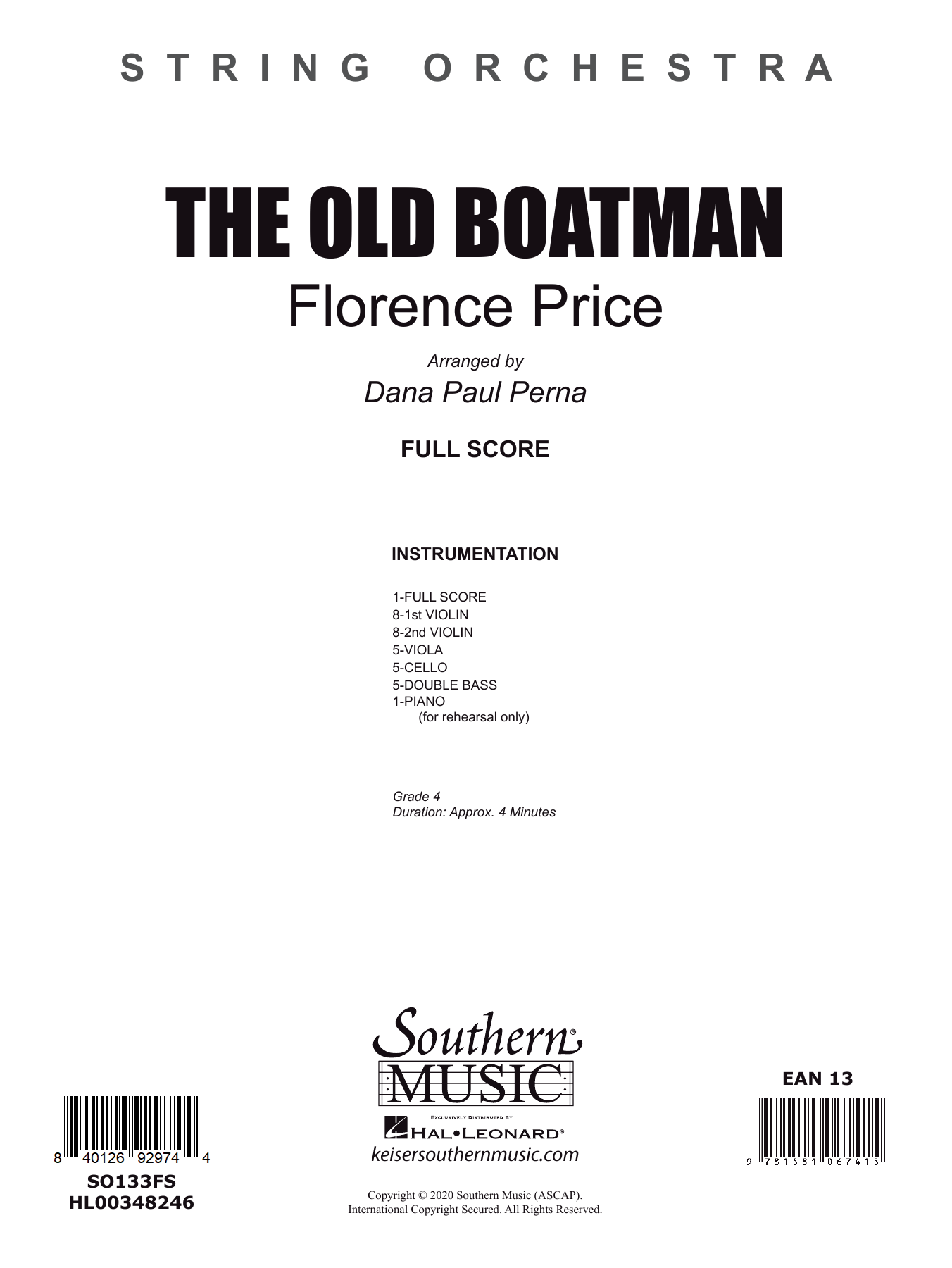

The Old Boatman: String Orchestra Conductor Score & Parts
By Florence Price / Arranged by Dana Perna
Grade: 4
Item: 35-PK01467231
$40.00
Pickup currently not available
Buy Extra Parts (Digital PDF Download)
| Product | Price | Quantity |
|---|---|---|
| The Old Boatman - Full Score | $7.00 | |
| The Old Boatman - 1st Violin | $2.50 | |
| The Old Boatman - 2nd Violin | $2.50 | |
| The Old Boatman - Viola | $2.50 | |
| The Old Boatman - Cello | $2.50 | |
| The Old Boatman - Double Bass | $2.50 | |
| The Old Boatman - Piano | $2.50 |
Parts Added to Cart!
Description
Originally for piano, this lyric work is a shining presentation of Prices signature style. The first statement is in G Major, then modulates to A major. Although short, the piece requires mature musicality, secure shifting and vibrato from your ensemble, with delicate dynamics and rubato. There are brief solos for violin and cello.


The Old Boatman: String Orchestra Conductor Score & Parts isn't in MakeMusic Cloud just yet...but it could be. Let us know you'd like to see it, and you'll help shape what comes next. In the meantime, start a free trial and dive into thousands of interactive titles your students can play along with today.
Request This Title
Tell us you want it.
Start Your Free Trial
Explore everything that's ready to play right now.
Sample Audio
No sample audio found.
Sample Video
No sample videos found.
Additional Details
Publisher:
Hal Leonard
SKU:
35-PK01467231
More about this title
About the Composer: Florence Price
Florence Price (1887-1953) was the first African American woman to have a symphony performed by a major American orchestra. A pianist and composer of remarkable gifts, she wrote across genres with fluency and sophistication, drawing on spirituals, folk idioms, and classical forms to create music of enduring lyricism. Her chamber works and orchestral pieces remain essential additions to the concert repertoire, offering students and audiences alike access to a distinctly American musical voice.
Price's compositions are marked by melodic generosity and harmonic richness. She understood orchestral color with precision and wrote idiomatically for every instrument, whether in large symphonic works or intimate pieces like this one. Her music rewards careful interpretation and reveals new layers with each rehearsal.
Why we love this
Price's original piano work translates beautifully to strings, where the lyric melody sings naturally across the ensemble. The modulation from G Major to A Major creates a gentle lift without artifice, and the brief solo passages for violin and cello offer your strongest players moments of genuine musicality rather than technical display. Programming this piece signals to your audience that classical music education includes Black composers from the canon.
What to expect
A gentle journey by water, unhurried and reflective. The opening melody floats with an almost conversational ease, as if the boatman is singing to himself. When the key lifts to A Major, the light seems to shift across the water, warmer and more inviting, though the contemplative mood never fully lifts.
Who it's for
High school orchestras and advanced middle school groups ready to balance technical demands with interpretive maturity. Your ensemble should have secure shifting and vibrato in the first violin section and solid intonation across all parts before tackling this work.
How to get the most out of it
- Balance the first statement in G Major so the principal first violin carries the melody while inner voices provide transparent harmonic support; the rubato should emerge from phrase shape, not arbitrary tempo shifts.
- Shape the modulation to A Major as an arrival rather than a sudden key change; the transition rewards a slight broadening before settling into the new key.
- Rehearse the violin and cello solos separately with the full ensemble before combining them, so other players learn to listen and support rather than compete.
- Treat the delicate dynamics as structural markers; a well-managed diminuendo often communicates more musicality than a pushed forte ever could.
How to use it
This compact work functions beautifully as a bridge between heavier repertoire on a concert. Pair it with a contemporary piece or a Baroque arrangement to create a thematic arc around lyricism and simplicity. It also serves well as a study in rubato and dynamic control in rehearsals preparing for more complex romantic literature.
Skills your students will build
- Secure shifting in exposed positions, particularly in the first violin part
- Vibrato with musical intent rather than automatic application
- Controlling and shaping delicate dynamics from pianissimo to mezzo-piano
- Responding to rubato and flexible tempo within a single ensemble
- Accompanying a soloists confidently while maintaining ensemble cohesion