
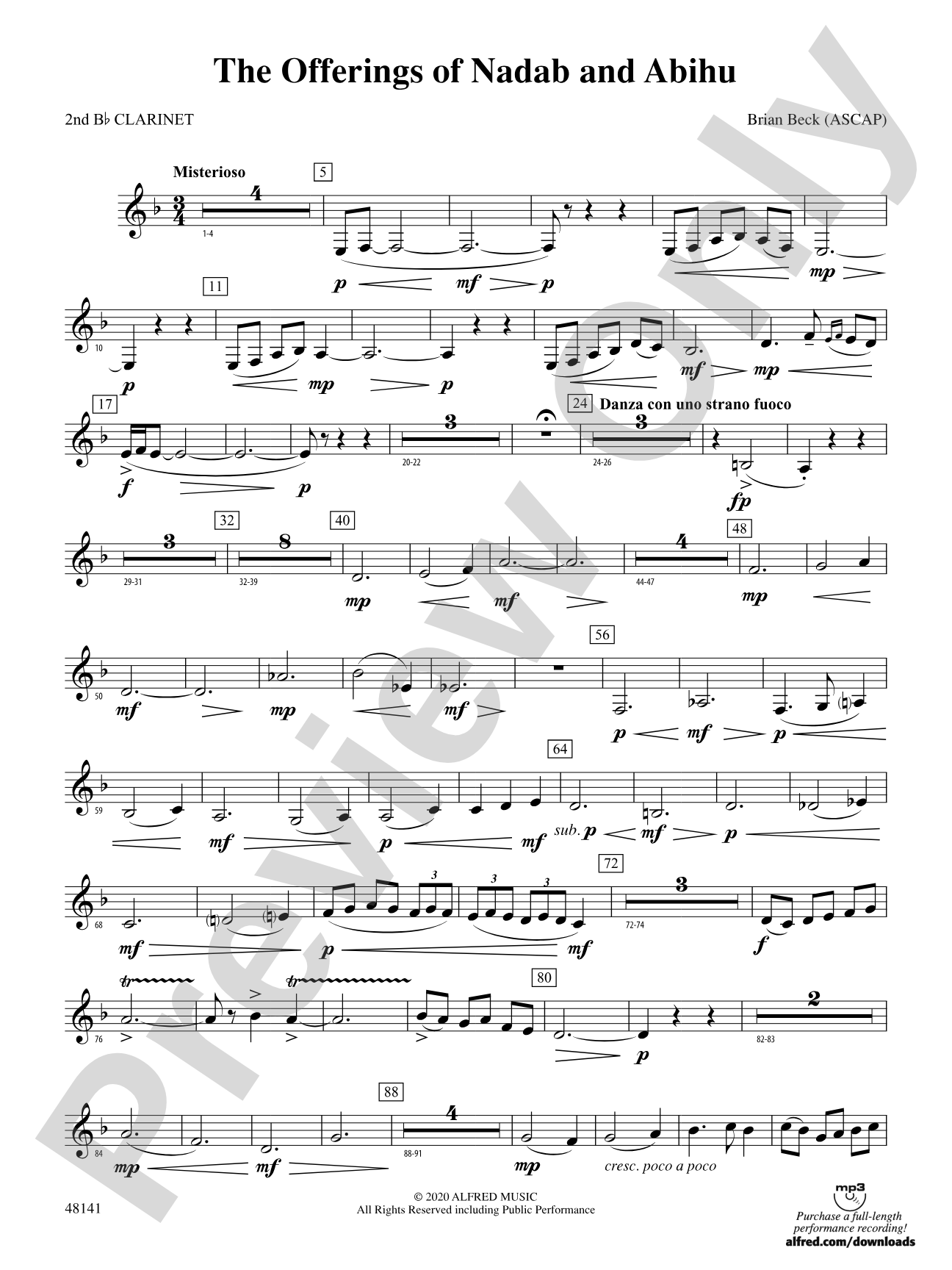

The Offerings of Nadab and Abihu: 2nd B-flat Clarinet
By Brian Beck
Grade: 3 (Medium)
Item: 00-PC-0018570_C2
$5.99
Pickup currently not available
Description
Something is not right . . . a growing sense of danger is in the air. Dark colors, minor chords, shifting tonalities, and eerie melodic lines warn us of the consequences of playing with fire. (4:00)


Don't just read it, hear it, play along with it, and watch your students grow with it. In MakeMusic Cloud, The Offerings of Nadab and Abihu: 2nd B-flat Clarinet comes alive with professional accompaniment, adjustable tempo, and built-in practice tools that turn solo practice into real progress.
Open in the Player
Jump straight in and assign it today.
Start Your Free Trial
Open this title and explore the full library in minutes.
Sample Audio
1
Audio File
--:--
0:00
0:00
Sample Video
Additional Details
Series:
Young Symphonic
Publisher:
Alfred Music
Page Count:
280
SKU:
00-PC-0018570_C2
More about this title
About the Composer: Brian Beck

Brian Beck is a composer and arranger whose works span concert band, instrumental ensembles, and vocal groups. His pieces have earned recognition including "Reviewer's Choice" from The Instrumentalist and "Best New Concert Band Music" from Tom Lee Music, and several appear on state prescribed music lists across Texas, Ohio, Florida, and the Pacific Northwest. His compositions have been featured at TMEA Honor Band concerts, UIL state competitions, Midwest Band and Orchestra Clinic performances, and in the GIA Publications series Teaching Music Through Performance In Band.
Beck has directed bands at both middle and high school levels in Texas, earning a "Teacher of the Year" nomination and consistently achieving Superior ratings at UIL contests. He holds degrees in Music Education from Texas A&M University-Commerce (Bachelor's) and the University of Houston (Master's), and was himself a member of the TMEA All-State Band as a student.
Why we love this
Beck crafts a genuinely unsettling narrative arc here, using harmonic ambiguity and orchestral color to build dread without relying on bombast. At Grade 3, the piece respects student musicians' ability to execute meaningful musical storytelling; the difficulty serves the piece's dramatic intent rather than difficulty for its own sake. Contests and festival judges consistently respond to work that balances accessibility with compositional sophistication, and this title delivers both.
What to expect
The piece unfolds like a warning you can't quite ignore. Dark, minor-inflected harmonies and an unsettled melodic language create an atmosphere of creeping dread, as though the ensemble is playing a story about consequences rather than a traditional concert piece. The shifting tonalities mean the ground never feels quite solid beneath the listener's feet.
Who it's for
Band directors preparing intermediate ensembles for festival or contest performances who want repertoire with genuine musical substance. Students in this grade range are ready to execute expressive playing and respond to narrative direction, making Beck's atmospheric writing both playable and dramatically engaging.
How to get the most out of it
- Establish the tonal instability early. Minor chords and shifting harmonic centers are the piece's vocabulary for unease; resist the urge to lock into a single tonal center even when the ensemble craves stability.
- Shape the eerie melodic lines with dynamic subtlety. Let softer dynamics and careful articulation convey dread; you don't need aggressive playing to create tension.
- Balance clarity in the upper voices against the foundation of the harmonic movement. Students will track the unsettling quality better when they can hear both the warning melody and the shifting ground beneath it.
- Use the four-minute duration to let the psychological journey unfold. Resist rushing through darker passages; the effectiveness depends on the listener staying immersed in the unease.
How to use it
This works powerfully as a festival or contest selection where the dramatic arc and compositional craft will impress adjudicators. Consider programming it alongside contrasting material (something brighter or more grounded) to let audiences experience the full emotional range of your ensemble's capabilities.
Skills your students will build
- Executing minor tonalities and chromatic harmonic shifts with rhythmic precision
- Shaping melodic lines that convey emotional character rather than relying on volume
- Balancing ensemble color across changing harmonic contexts
- Reading and responding to dynamic and expressive markings that drive narrative intent
- Maintaining rhythmic integrity while navigating shifting tonal centers