The Ocean Deep (for right hand or left hand alone) - Piano Solo Sheet Music Preview

The Ocean Deep (for right hand or left hand alone) - Piano Solo: Piano

By Kathleen Massoud

Level: Elementary

Item: 00-PB-0000750

Digital Download
$3.50
Description
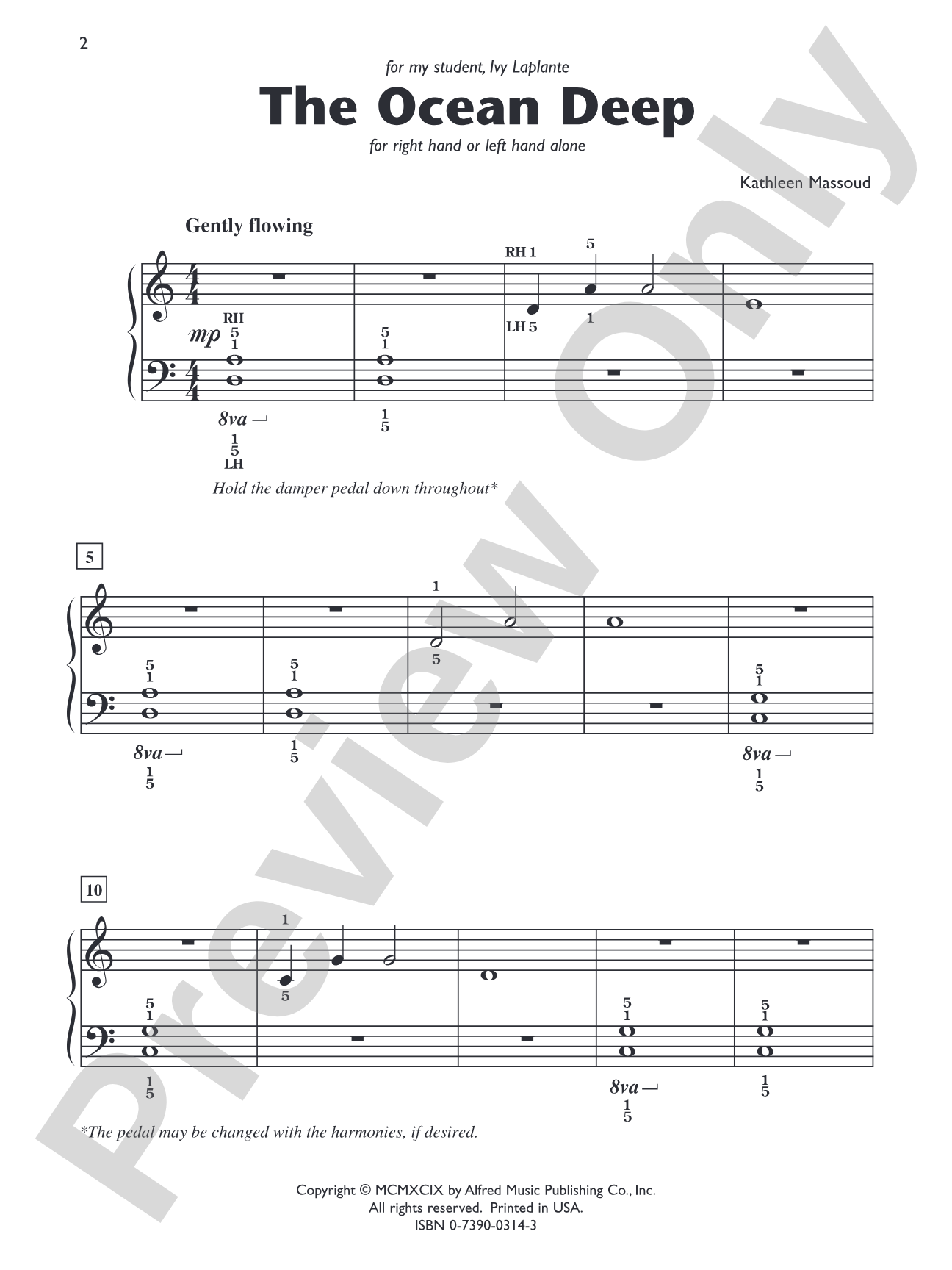
This elementary piano solo for right hand or left hand alone makes liberal use of the damper pedal for an underwater effect. Simple whole note, half note, and quarter note rhythms are used throughout the two-page piece, which ends on the lowest D on the piano. Fingerings for both hands are provided. A Federation Festivals 2016-2020 selection. A Federation Festivals 2020-2024 selection.

The Ocean Deep (for right hand or left hand alone) - Piano Solo: Piano isn't in MakeMusic Cloud just yet...but it could be. Let us know you'd like to see it, and you'll help shape what comes next. In the meantime, start a free trial and dive into thousands of interactive titles your students can play along with today.

Sample Audio
No sample audio found.
Sample Video
Additional Details
Series: Signature Series
Publisher: Alfred Music
Page Count: 4
SKU: 00-PB-0000750

More about this title

About the Composer: Kathleen Massoud

Kathleen Massoud

Kathleen Massoud studied piano performance at Hartt College of Music in Hartford, Connecticut and Longy School of Music in Cambridge, Massachusetts, establishing a foundation in both classical training and pedagogical expertise. Since opening the Massoud Piano Studio in New Bedford, Massachusetts in 1980 with her husband, she has maintained an independent teaching studio for over two decades while serving as an active member of the National Guild of Piano Teachers and former president of the Southeastern Chapter of the Massachusetts Music Teachers Association.

Beyond her work at the piano, Massoud pursues music and the written word in her personal life, singing in her church choir and writing poetry. Her compositions reflect her deep understanding of how young pianists learn, always grounded in her classroom experience.

Why we love this

The damper pedal becomes an expressive tool rather than an afterthought in this piece, teaching elementary pianists how sound itself can paint a picture. Massoud's choice to offer both right-hand and left-hand versions makes this accessible to students at the same level regardless of hand position preference, and the Federation Festivals selections signal solid pedagogical merit built on real classroom teaching.

What to expect

Serene and spacious, with moments of low, resonant depth. The sustained whole notes and careful pedal work create a floating sensation, while the journey to the lowest D on the keyboard feels like descending into darker, quieter waters.

Who it's for

Elementary-level piano students ready to explore whole note, half note, and quarter note rhythms in a musical context that rewards careful listening. This piece especially suits students who need confidence with pedal technique or who respond well to programmatic music that connects sound to imagery.

How to get the most out of it

  • Experiment with the timing of pedal changes to blur the harmonic colors; younger students often worry about precision here, but underwater effect demands some cloudiness
  • Let whole notes breathe fully before lifting the pedal; resist the urge to rush through silence
  • The lowest D on the piano is a dramatic moment—prepare students for how far their hand must travel and how resonant that register will sound
  • Practice hand position and finger numberings separately before combining them with pedal work

How to use it

Slot this into a spring or end-of-year recital as a palette cleanser between more rhythmically active pieces, or pair it with other descriptive solos to create a thematic concert. The manageable two-page length makes it suitable for festival performance or as a solo for a student recital spotlight.

Skills your students will build

  • Pedal technique and listening for harmonic blur
  • Sustaining whole notes and half notes without tension
  • Reading fingerings for both right hand and left hand independently
  • Coordinating hand movement across multiple octaves of the keyboard
  • Understanding how silence and space contribute to musical expression

You May Also Like