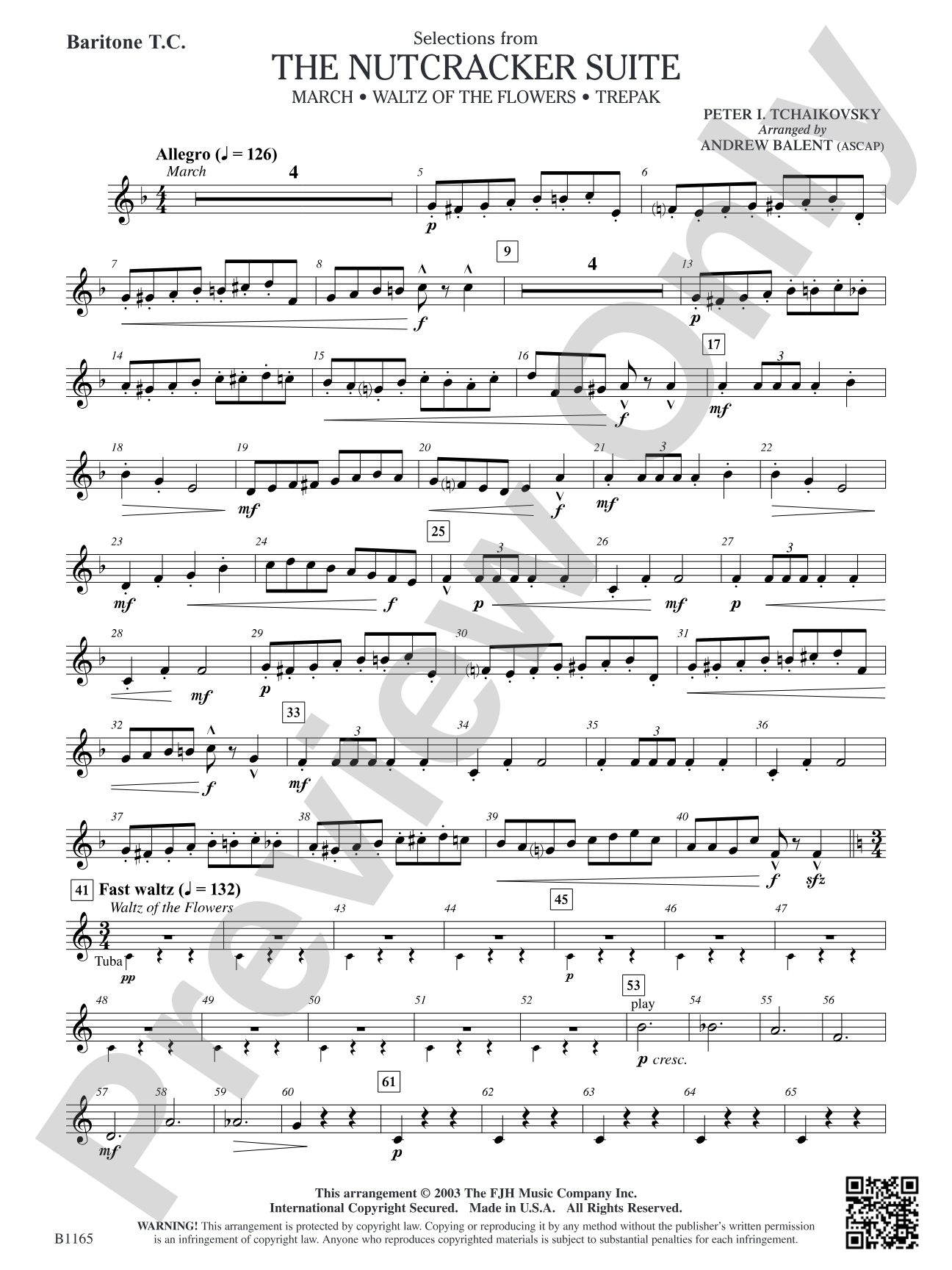
The Nutcracker Suite (Selections from): Baritone T.C. Sheet Music Preview

The Nutcracker Suite (Selections from): Baritone T.C.

Selections from

By Peter Ilyich Tchaikovsky / arr. Andrew Balent

Grade: 2.5

Item: 98-PC-DB1165_BTC1

Digital Download
$7.00
Description
This substantial arrangement for young band features the March, Waltz of the Flowers, and Trepak. Andrew Balent has done a superb job keeping this well within the abilities of young musicians while retaining the character and quality of the original. The Nutcracker has become a tradition during the holidays - now you can bring it right into your own concert hall. Highly recommended!

The Nutcracker Suite (Selections from): Baritone T.C. isn't in MakeMusic Cloud just yet...but it could be. Let us know you'd like to see it, and you'll help shape what comes next. In the meantime, start a free trial and dive into thousands of interactive titles your students can play along with today.

Sample Audio
0:00
0:00
Sample Video
Additional Details
Series: FJH Young Band
Publisher: The FJH Music Company, Inc.
SKU: 98-PC-DB1165_BTC1

More about this title

About the Composer: Peter Ilyich Tchaikovsky

Tchaikovsky stands as one of the 19th century's most gifted melodists, and his gift for writing music that connects immediately with listeners defines his legacy. His ballets, Swan Lake, The Sleeping Beauty, and The Nutcracker, remain cornerstones of classical music because they blend accessible beauty with genuine compositional craft, making them ideal models for young musicians learning how masterworks are constructed.

Composed in 1892, The Nutcracker emerged from Tchaikovsky's mastery of orchestral color and rhythmic vitality. The suite's movements showcase his ability to build character through orchestration and melody, qualities that make these selections endlessly rewarding for band students to perform and audiences to hear.

Why we love this

Balent's arrangement respects Tchaikovsky's orchestral imagination while trusting young musicians to handle real musical substance. The Grade 2.5 level keeps technical demands reasonable, but the voicing and part writing demand genuine musicianship, students aren't just playing notes, they're performing a recognized masterpiece with authentic color and phrasing.

What to expect

The March steps forward with bright, processional energy. Waltz of the Flowers blooms with lyrical grace and flowing melodic lines that invite singing musicality. Trepak explodes with joy, propelled by rhythmic vitality and the infectious spirit of Russian folk celebration.

Who it's for

Holiday concert programs that want substance alongside seasonal appeal. Young bands ready to tackle a recognized classical work with genuine orchestral character rather than simplified holiday arrangements.

How to get the most out of it

  • Balance the inner voices in the March so the harmonic progression stays clear; the melody will carry itself if the foundation is solid.
  • Shape each phrase in Waltz of the Flowers with a gentle swell rather than forcing dynamics; let the lyrical character emerge naturally.
  • Lock the tempo in Trepak before rehearsal and maintain it with precision; this Russian dance thrives on rhythmic drive and ensemble cohesion.
  • Record a full run-through early in preparation so students hear the arc of all three movements together and understand how they connect as a suite.

How to use it

Program these selections as the centerpiece of a holiday concert, framing them between lighter pops arrangements or traditional carols to show the range of your ensemble's abilities. The three movements work equally well as a complete suite or separated across different concert halves, and they're recognizable enough that audiences arrive with goodwill but engaged enough to hold serious attention.

Skills your students will build

  • Phrasing and musical architecture across multi-movement works
  • Maintaining rhythmic precision in dance forms (March and Trepak)
  • Balance and blend in exposed inner voice writing
  • Expressive rubato and dynamic shaping in lyrical passages
  • Reading and performing from a full conductor score context

You May Also Like