
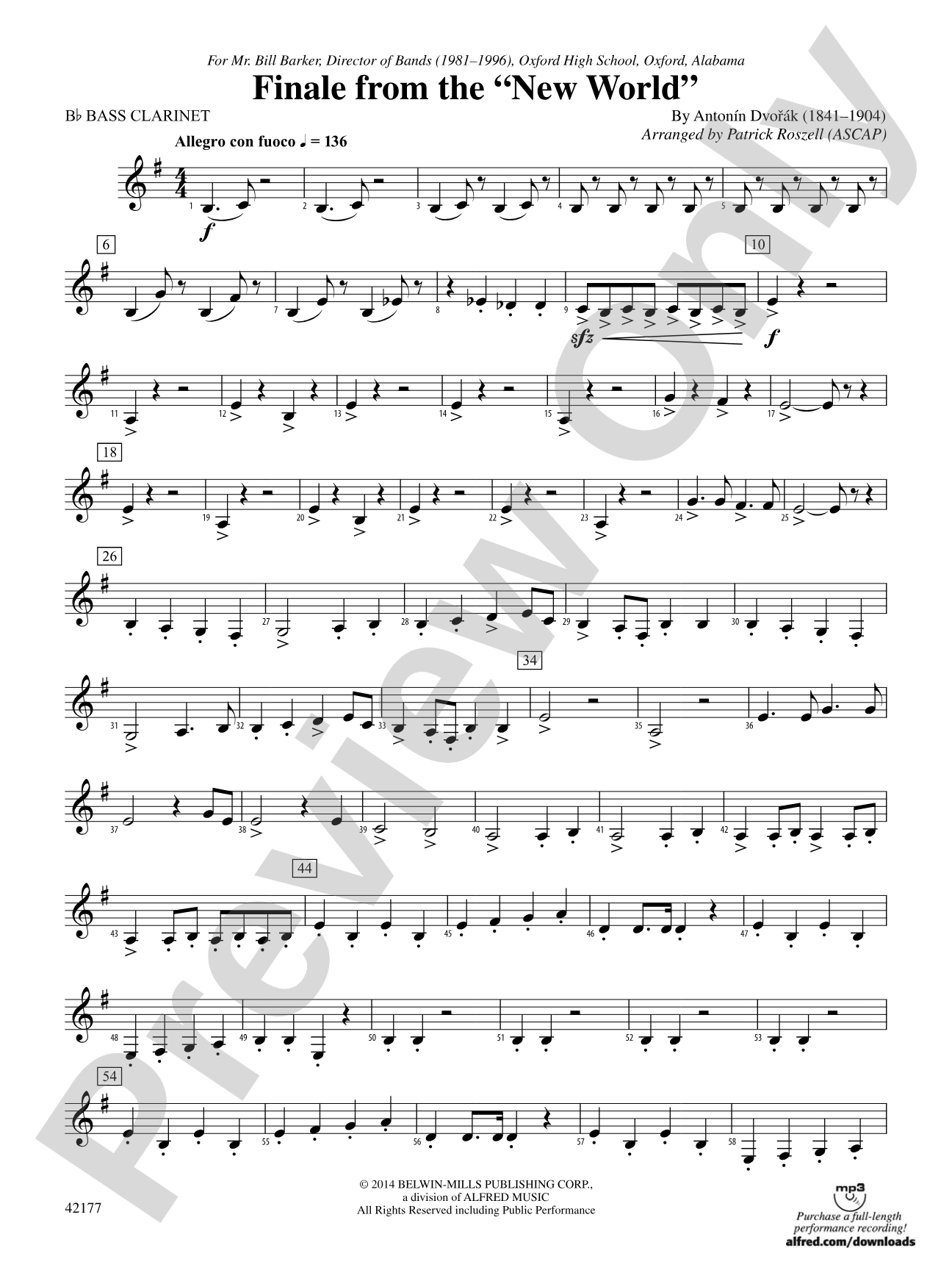

"The New World," Finale from: B-flat Bass Clarinet
By Antonín Dvorák / arr. Patrick Roszell
Grade: 2 (Easy)
Item: 00-PC-0016549_BC
$3.00
Pickup currently not available
Description
Expose your students to one of the great symphonies of the 19th century. Numerous teaching opportunities are present for articulation, phrasing, and the clarinet register key. A great contest or concert piece exploring the music of Dvorák! (4:30) This title is available in MakeMusic Cloud.


Don't just read it, hear it, play along with it, and watch your students grow with it. In MakeMusic Cloud, "The New World," Finale from: B-flat Bass Clarinet comes alive with professional accompaniment, adjustable tempo, and built-in practice tools that turn solo practice into real progress.
Open in the Player
Jump straight in and assign it today.
Start Your Free Trial
Open this title and explore the full library in minutes.
Sample Audio
1
Audio File
--:--
0:00
0:00
Sample Video
No sample videos found.
Additional Details
Series:
Belwin Young Band
Publisher:
Alfred Music
Page Count:
234
SKU:
00-PC-0016549_BC
More about this title
About the Composer: Antonín Dvorák
Antonín Dvorák (1841-1904) stands among the most performed composers of the Romantic era, and for good reason: his music combines symphonic architecture with direct emotional appeal and folk-influenced melody. A Czech nationalist who spent time as director of the National Conservatory in New York, Dvorák drew inspiration from both European classical tradition and American musical idioms, creating works that speak across cultures and skill levels.
His "New World" Symphony remains one of the most beloved symphonies in the repertoire, performed countless times in concert halls worldwide. For young musicians, Dvorák's writing rewards careful attention to phrasing and orchestration while remaining fundamentally approachable; his melodies sing naturally, and his harmonic language, though sophisticated, feels inevitable and clear.
Why we love this
This arrangement opens the door to genuine symphonic literature at a level your ensemble can actually execute, without sacrificing the music's substance or beauty. The finale of the "New World" carries real dramatic weight; students feel they are playing something that matters, and the pedagogical payoffs (articulation clarity, register navigation on clarinet, long-line phrasing) emerge from musical necessity rather than exercise.
What to expect
The finale radiates Romantic optimism and forward motion; bright, singing themes emerge from flowing accompaniment figures, and the sense of arrival and resolution feels earned rather than imposed. There's both jubilation and tenderness in this movement, and students will experience the full emotional range of symphonic writing.
Who it's for
This is ideal for Grade 2 bands ready to tackle repertoire with real musical substance. You'll need solid fundamentals in your section leadership, reliable clarinet players comfortable with register work, and an ensemble that can maintain ensemble cohesion across longer phrases, but you don't need exceptional soloists or an unusually large instrumentation.
How to get the most out of it
- Balance the opening thematic material between the lower reeds and the woodwind choir; Dvorák's orchestration depends on clarity of line, so listen carefully during soli passages and trim volume in accompanying voices.
- Work the clarinet register key transitions deliberately in section rehearsal. This piece exposes any rushed or careless fingering, so isolate the moments where students move between registers and establish them as landmarks.
- Shape the phrases with intentional rubato in the lyrical sections; Romantic-era style demands elasticity and breathing room, not metronomic precision.
- Attend to the articulation markings as character indicators, not mere notation. Staccato passages feel purposeful and energetic when executed with precision; legato lines need genuine air support and phrase direction.
How to use it
Program this as a concert centerpiece or contest selection that demonstrates your ensemble's growth and musical maturity. It pairs well alongside lighter concert fare because the substantive musical content commands respect without exhausting young players; the 4:30 duration is manageable for a full rehearsal cycle without dominating your preparation calendar.
Skills your students will build
- Clarinet register key technique and intonation management
- Articulation clarity and style (staccato vs. legato as expressive choice)
- Long-line phrasing and phrase shaping across extended melodies
- Balance and blend in mixed woodwind and reed textures
- Reading full score context (understanding their line in relation to the full band)