
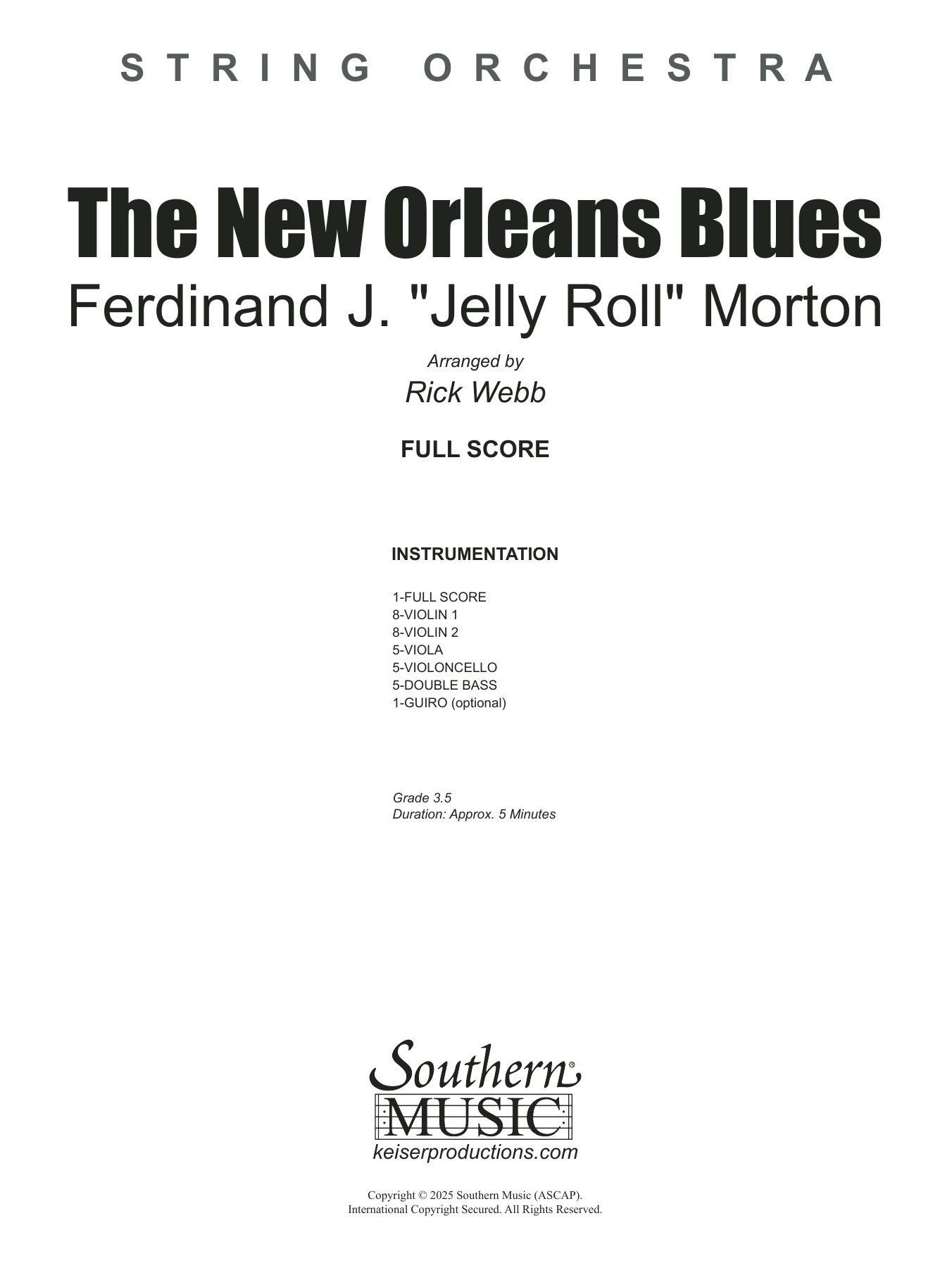

The New Orleans Blues (arr. Richard Webb): String Orchestra Conductor Score & Parts
By Jelly Roll Morton / Arranged by Richard Webb
Grade: 3.5
Item: 35-PK01726399
$60.00
Pickup currently not available
Buy Extra Parts (Digital PDF Download)
Parts Added to Cart!
Description
Ferdinand Joseph LeMonthe (c. 1890-1941), better known by his pen name "Jelly Roll" Morton, was a New Orleans-born ragtime pianist, composer, and band leader. One of the first musicians to play the New Orleans music that would come to be known as jazz, he was also one of the first artists to notate his jazz compositions on paper. He would claim, years later, that he had invented jazz, something historians dispute. His popular works include Dead Mans Blues, King Porter Stomp, Alabama Bound, and the Tiger Rag. His 1920s recordings by his hand-picked band The Red Hot Peppers are considered classics in the early jazz idiom. Mortons The New Orleans Blues appears to have been composed between 1900-1910, when the composer was touring the United States.


The New Orleans Blues (arr. Richard Webb): String Orchestra Conductor Score & Parts isn't in MakeMusic Cloud just yet...but it could be. Let us know you'd like to see it, and you'll help shape what comes next. In the meantime, start a free trial and dive into thousands of interactive titles your students can play along with today.
Request This Title
Tell us you want it.
Start Your Free Trial
Explore everything that's ready to play right now.
Sample Audio
No sample audio found.
Sample Video
No sample videos found.
Additional Details
Publisher:
Hal Leonard
SKU:
35-PK01726399
More about this title
About the Composer: Jelly Roll Morton
Jelly Roll Morton (Ferdinand Joseph LeMonthe, c. 1890-1941) stands as one of jazz's foundational figures. Born in New Orleans, he was among the first musicians to commit jazz improvisation to written notation, creating a bridge between ragtime tradition and the emerging jazz language. His 1920s recordings with his ensemble The Red Hot Peppers remain essential listening for understanding early jazz idiom.
Morton's compositional legacy extends far beyond his claims of inventing jazz. Works like King Porter Stomp, Dead Man's Blues, and Alabama Bound showcase his gift for melody and structural clarity. These pieces reveal how a trained musician could harness the spontaneity of New Orleans music while preserving it on the page for future musicians to study and perform.
Why we love this
String arrangements of early jazz standards occupy rare territory in the orchestra repertoire. This Webb arrangement makes Morton's compositional voice accessible to developing ensembles while preserving the harmonic language and blues sensibility that made his original work vital. Your students encounter authentic jazz history not as museum piece but as living music they can actually perform.
What to expect
The blues permeate every phrase. You hear New Orleans in the bent pitches, the syncopation, the particular way melody and harmony collide and resolve. This is ragtime's sophisticated cousin, written by someone who lived the music rather than studying it from afar.
Who it's for
String orchestras at the 3.5 level looking to expand beyond standard European concert repertoire. Directors seeking historically significant works that engage students with American musical roots while remaining technically accessible. Advanced middle school or early high school ensembles ready to tackle jazz vocabulary within a classical framework.
How to get the most out of it
- Honor the blues tonality throughout. The raised and lowered scale degrees that give this piece its character require sensitive intonation from both melody and harmonic voices.
- Balance the dialogue between sections. Morton's writing often passes thematic material between instruments; clarity in these conversations matters more than volume.
- Let rhythmic flexibility breathe in the blues passages without losing ensemble cohesion. Slight rubato feels natural here, but the pulse must remain steady underneath.
How to use it
Pair this with other American composers on a concert celebrating early 20th century roots music, or use it to bridge a unit on jazz history with concert performance. The piece works equally well as a second half opener that shifts the mood from classical repertoire or as a closing selection that leaves audiences remembering where American music came from.
Skills your students will build
- Reading and performing blues harmony and tonality
- Playing with jazz articulation and swing feel in a classical context
- Balancing sectional dialogue and thematic clarity
- Intonation sensitivity in non-traditional harmonic environments
- Understanding historical context and cultural significance of early jazz composition