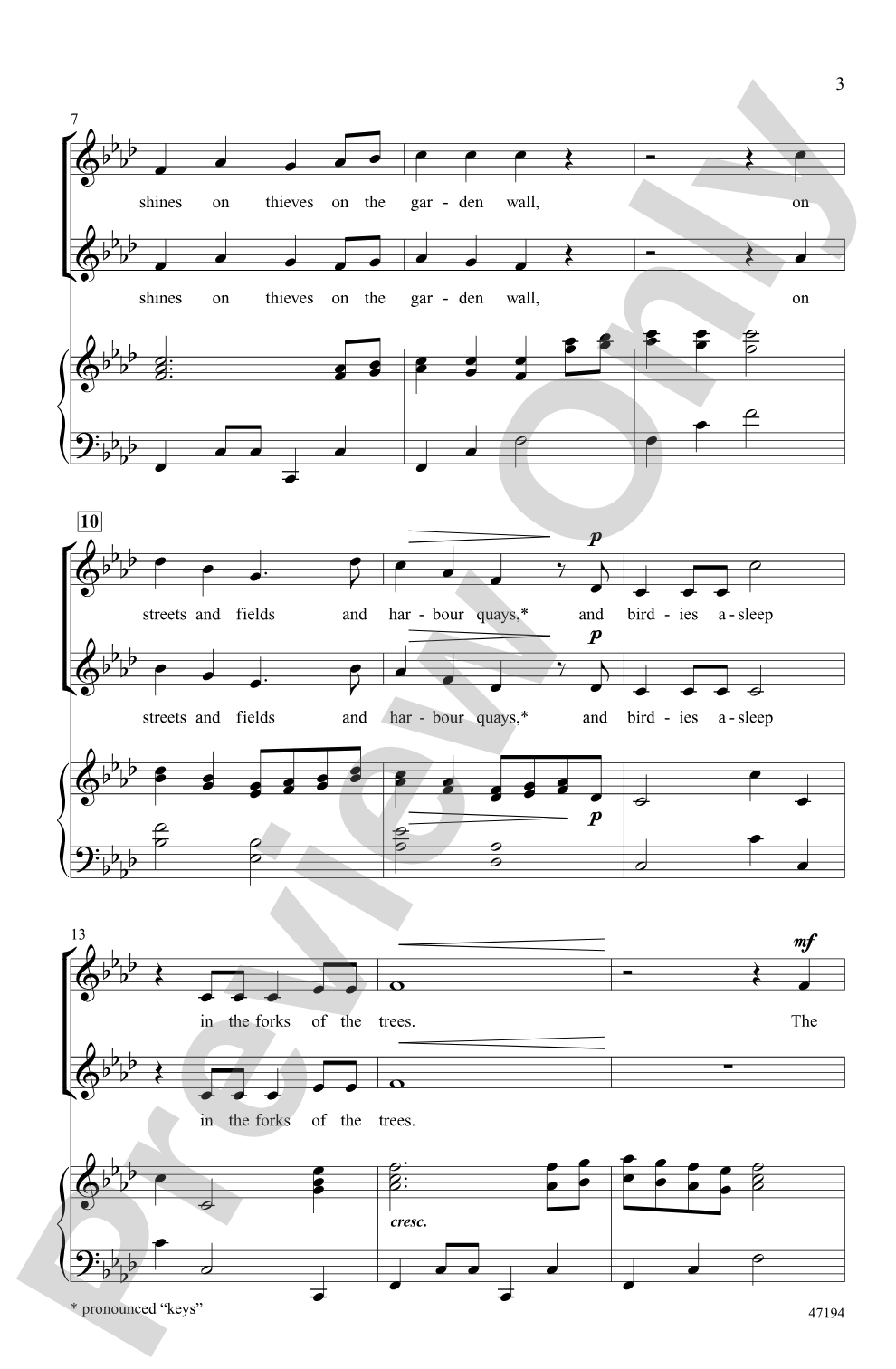
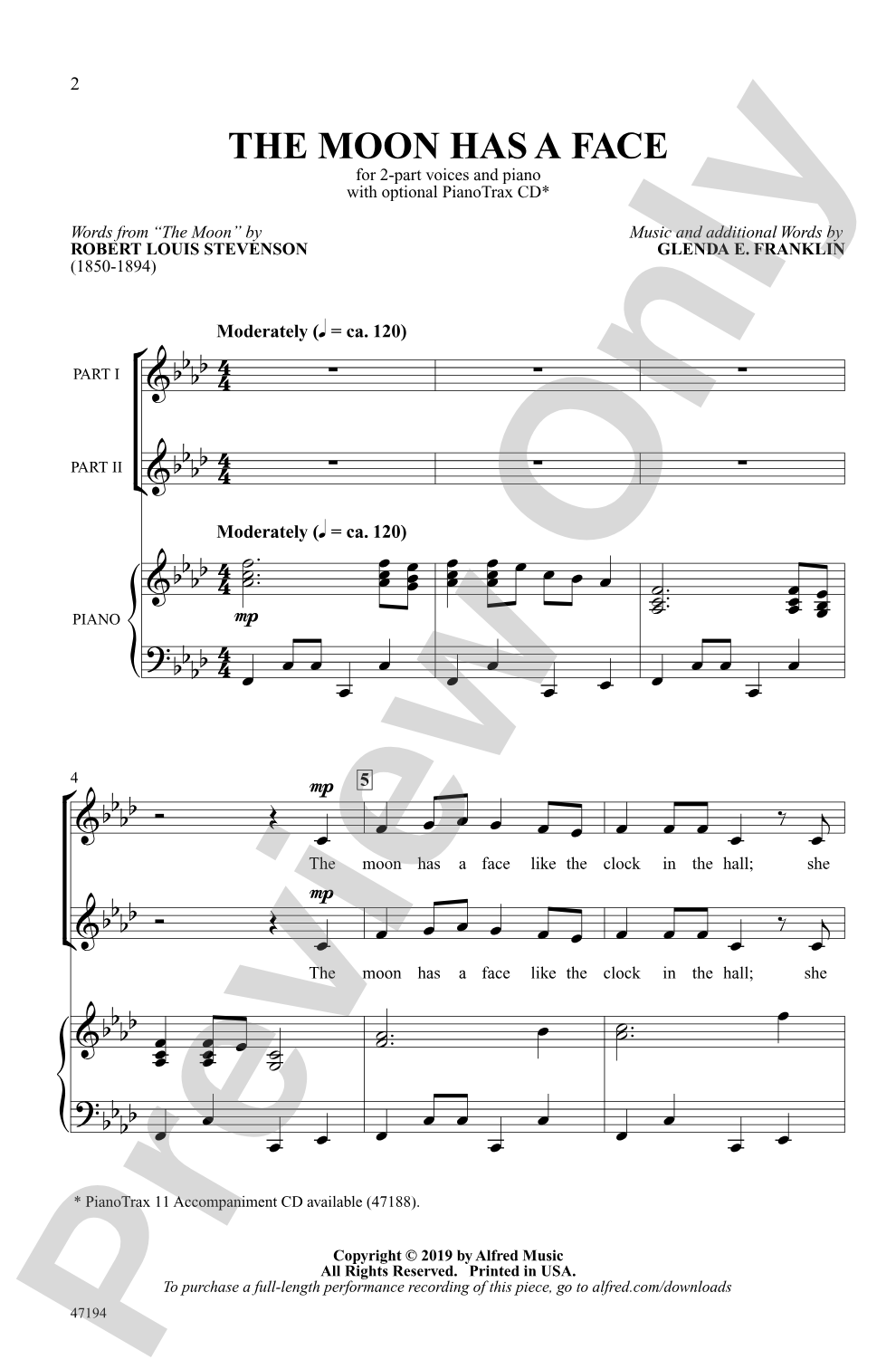
The Moon Has a Face Sheet Music Preview

The Moon Has a Face: 2-Part Choral Octavo

Words from "The Moon" by Robert Louis Stevenson, music and additional words by Glenda E. Franklin

Item: 00-PO-0005907

Digital Download
$2.05

Minimum order quantity: 20 copies

Description
Excerpts from Robert Louis Stevenson's poem "The Moon" combine with original text to create a mysterious and enchanting selection for young voices. Accessible two-part writing is ideal for choirs new to singing harmony. The haunting minor-mode and hushed dynamics are equally important to teach and captivating to hear.

The Moon Has a Face: 2-Part Choral Octavo isn't in MakeMusic Cloud just yet...but it could be. Let us know you'd like to see it, and you'll help shape what comes next. In the meantime, start a free trial and dive into thousands of interactive titles your students can play along with today.

Sample Audio
0:00
0:00
Sample Video
Additional Details
Series: Alfred Choral Designs
Publisher: Alfred Music
Page Count: 8
SKU: 00-PO-0005907

More about this title

Why we love this

Franklin's setting captures the eerie quality of Stevenson's poem without oversimplifying it for young singers. The minor mode and restrained dynamics are integral to the piece's character, not decorative, which means your singers will understand they're shaping mood through musical choices, not just hitting notes. This is the kind of repertoire that makes two-part singing feel sophisticated.

What to expect

Hushed and dreamlike, with an underlying uneasiness that keeps listeners engaged. The minor tonality and sparse texture evoke twilight and mystery, creating an intimate performance moment that feels reflective rather than grand.

Who it's for

Young choristers encountering two-part harmony for the first time will find the accessible writing manageable without sacrificing musical substance. This is ideal for middle school choirs or beginning high school treble choirs ready to move beyond unison but still developing secure part-singing skills.

How to get the most out of it

  • Shape the hushed dynamics as actively as you would a crescendo. Soft singing requires precise breath control and vowel formation, so spend rehearsal time on sustained passages at mezzo-piano and piano levels.
  • The minor mode will feel unfamiliar to singers accustomed to major-key repertoire. Isolate the melody line and have singers hear how the lower pitches create the mysterious character before adding harmonic parts.
  • Use the recorded accompaniment during early rehearsals to anchor harmonic confidence, then gradually reduce reliance on it so singers develop independence in their parts.

How to use it

Position this as a contrast piece in a concert program, especially alongside brighter or more energetic selections. Its literary foundation also makes it a strong choice for festivals emphasizing text interpretation or for programs built around poetry themes.

Skills your students will build

  • Two-part harmony with independent vocal lines
  • Sustaining soft dynamics with vocal control and supported breath
  • Interpreting text through minor-mode melody and harmonic color
  • Singing with ensemble blend in close harmonic intervals

You May Also Like