
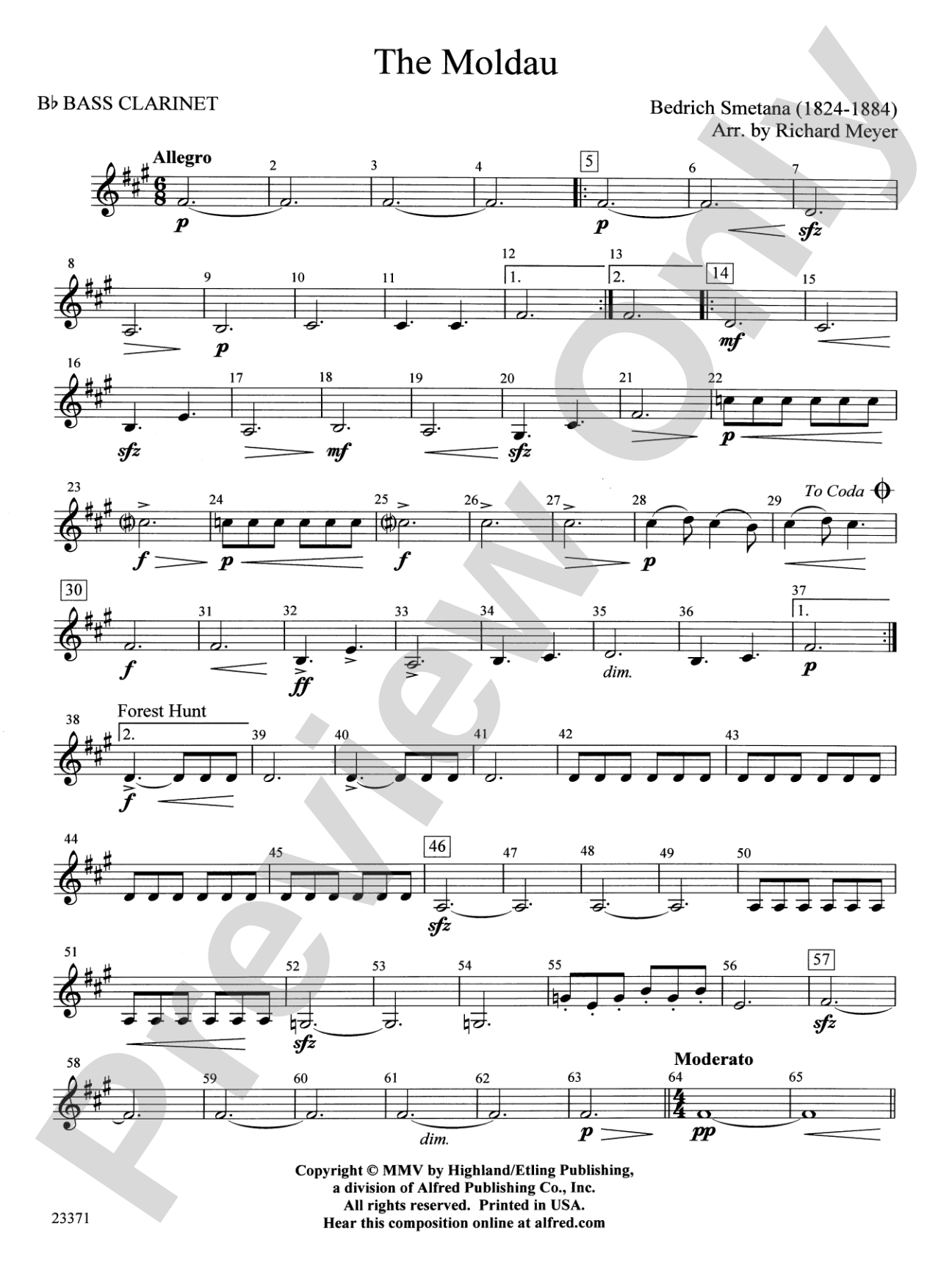

The Moldau: B-flat Bass Clarinet
By Bedrich Smetana / arr. Richard Meyer
Grade: 2.5
Item: 00-PC-0000713_CBC
$3.00
Pickup currently not available
Description
The wonderful arrangement brings Bedrich Smetana's masterpiece to your young orchestra while preserving the sound and intent of the original. All string parts are playable in first position with alternate "upper octave" opportunities included for Violin I and String Bass. As with all arrangements in the "First Philharmonic " Series, a Violin III (Viola treble clef) and Piano Accompaniment part are included. (5:00)


Don't just read it, hear it, play along with it, and watch your students grow with it. In MakeMusic Cloud, The Moldau: B-flat Bass Clarinet comes alive with professional accompaniment, adjustable tempo, and built-in practice tools that turn solo practice into real progress.
Open in the Player
Jump straight in and assign it today.
Start Your Free Trial
Open this title and explore the full library in minutes.
Sample Audio
No sample audio found.
Sample Video
No sample videos found.
Additional Details
Series:
Highland/Etling First Philharmonic
Publisher:
Alfred Music
Page Count:
108
SKU:
00-PC-0000713_CBC
More about this title
About the Composer: Bedrich Smetana
Bedrich Smetana (1824-1884) was a Czech nationalist composer whose orchestral works became the musical voice of his country during a period of political struggle under Austrian rule. His symphonic poem cycle Ma vlast (My Homeland), which includes The Moldau, stands as one of the most powerful expressions of musical nationalism in the Romantic era, each movement celebrating a different aspect of the Czech landscape and culture.
Smetana's mastery of orchestration and gift for memorable melody made his works accessible to audiences while remaining musically substantial. As a conductor, pianist, and educator, he understood how to write for young performers without sacrificing artistic integrity, a quality that makes his orchestral music enduringly valuable in the concert hall and festival circuit.
Why we love this
Richard Meyer's arrangement captures everything that makes The Moldau such a compelling work for young orchestras: the famous descending string melody that opens the piece, the rhythmic vitality of the river's journey, and the structural clarity that lets players understand the narrative arc they're creating. The thoughtful approach to violin part accessibility (first position playable with upper octave options) means your section leaders can challenge themselves without forcing less experienced players to struggle, and the inclusion of Violin III in treble clef and a functional piano part gives you genuine flexibility in rehearsal and performance.
What to expect
The Moldau takes you on a genuine journey, beginning with the gentle birth of a river in the mountains and building to a triumphant, almost heroic climax as it flows toward the sea. The piece moves between moments of delicate lyricism and vigorous, driving rhythmic passages, offering every section in the orchestra a chance to shine while maintaining a narrative coherence that even younger players can feel and convey.
Who it's for
Young orchestras at the intermediate level who are ready for a masterwork but need an arrangement that respects their developing technical skills. This works equally well for middle school orchestras aiming for festival performance or high school ensembles building their core Romantic repertoire without the burden of negotiating multiple position shifts.
How to get the most out of it
- Balance the opening string section so the iconic descending melody emerges clearly; this moment sets the entire character of the piece, so invest rehearsal time in achieving a cohesive, singing tone across all string parts.
- Use the piano accompaniment strategically during sectional rehearsals to anchor rhythm section timing and help woodwinds lock into the piece's natural pulse, then gradually wean the ensemble from it as independence grows.
- Shape the harmonic progression through the river's journey by giving the ensemble a sense of forward momentum; avoid letting the piece settle into a static tempo, and encourage slight rubato at the broader melodic gestures.
- Mark breath points and phrase endings clearly in all parts; this piece rewards musical breathing and gives players a sense of participating in a continuous narrative rather than executing isolated musical phrases.
How to use it
This arrangement sits comfortably alongside other Romantic-era works in a concert focused on nationalism or cultural music, or it can anchor a program built around water imagery and nature subjects. Its five-minute duration and immediate audience appeal make it an excellent choice for festival competitions, and its relative accessibility compared to other Smetana orchestrations means you can program it confidently even with time constraints during the concert season.
Skills your students will build
- Reading and maintaining first position across all string parts with secure intonation
- Sustaining long melodic lines while remaining aware of harmonic context
- Responding to sectional leadership and cues in a structure that spans contrasting tempos
- Collaborating as a full orchestra to shape a narrative arc across a five-minute form
- Balancing independent rhythmic patterns (river currents, flowing accompaniment) with unified ensemble sound