
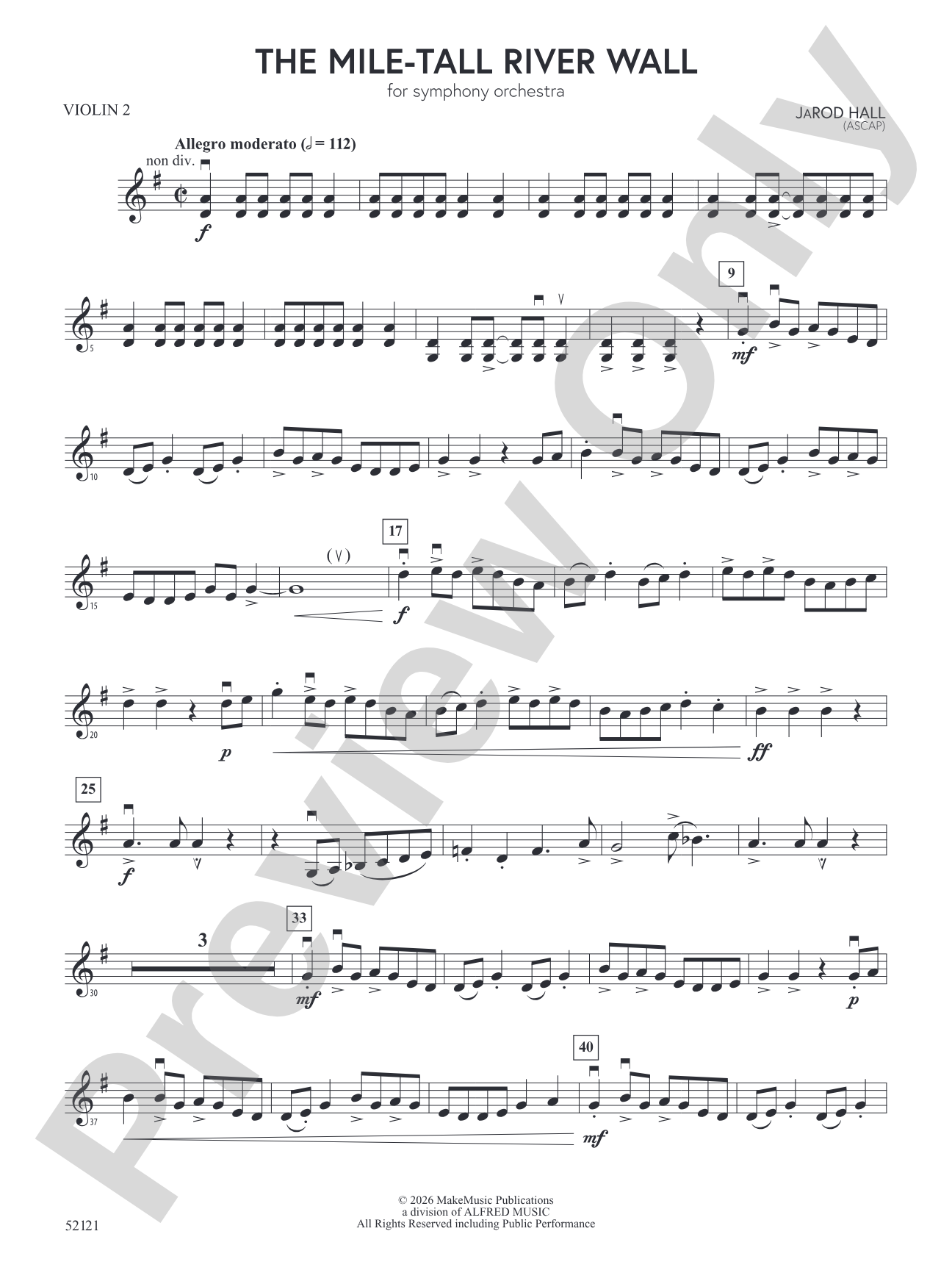

The Mile-Tall River Wall: 2nd Violin
for Symphony Orchestra
By JaRod Hall
Grade: 4
Item: 00-PC-0019847_VN2
$3.00
Pickup currently not available
Description
Inspired by an incredible view of a canyon from a mountaintop, The Mile-Tall River Wall is an energetic tour-de-force by JaRod Hall that blends open harmonies, folk melodies, and Copland-esque orchestration to capture the beauty of American landscapes. Perfect as a spirited opener or memorable closer! (2:40)


Don't just read it, hear it, play along with it, and watch your students grow with it. In MakeMusic Cloud, The Mile-Tall River Wall: 2nd Violin comes alive with professional accompaniment, adjustable tempo, and built-in practice tools that turn solo practice into real progress.
Open in the Player
Jump straight in and assign it today.
Start Your Free Trial
Open this title and explore the full library in minutes.
Sample Audio
1
Audio File
--:--
0:00
0:00
Sample Video
Additional Details
Series:
MakeMusic Symphony Orchestra
Publisher:
MakeMusic Publications
SKU:
00-PC-0019847_VN2
More about this title
About the Composer: JaRod Hall

JaRod Hall brings a distinctive voice to American orchestral writing shaped by decades of ensemble experience and classroom success. Born in Texas in 1991, he earned degrees in music education and composition from the University of North Texas and Texas State University, studying conducting with Nicholas Williams and Caroline Beatty while developing his compositional craft under Michael Ippolito and Jack Wilds. As a tubist and trombonist, he performed with the North Texas Wind Symphony, the 3 O'Clock Lab Band, and Texas State's wind ensembles, and was named a four-time Texas All-State Band member, including principal chair in jazz bass trombone.
Hall's work in the classroom has earned national recognition. During his eight years as a band director, his students won consistent sweepstakes awards at the Texas UIL Concert and Sightreading Evaluations, and in 2018 his non-varsity band at Griffin Middle School became the first in Frisco ISD to receive the Citation of Excellence. His compositions appear on the Texas Prescribed Music List, the J.W. Pepper Editor's Choice list, and the Bandworld Top 100 list. His fanfare "Silver Fanfare" won the 2020 Dallas Winds Call for Fanfares, and "Through the Storm" received the 2021 Barbara Buehlman Prize for middle school band.
Why we love this
Hall captures the grandeur of American landscape without sentimentality, grounding the work in actual folk melodic gestures and Copland-inspired orchestration that feels earned rather than borrowed. The piece moves with genuine narrative momentum, making it equally effective as a concert opener that commands attention or a closer that leaves audiences with a sense of discovery. At Grade 4, it strikes a rare balance: energetic and ambitious without overshadowing younger ensemble players, and sufficiently detailed to keep advanced orchestras engaged.
What to expect
Expansive and panoramic, like surveying a vast landscape from a high vantage point. The piece breathes with open harmonies and folk-inspired melodies that evoke the American heartland, moving forward with clear purpose and generous orchestral sweep. There's an undercurrent of discovery throughout, as if seeing familiar terrain transformed by light and perspective.
Who it's for
This work suits orchestras at the Grade 4 level ready to explore orchestral color and American compositional language with more sophistication than typical light concert fare. Ensembles preparing for festival programming or seeking a piece that balances accessibility with genuine musical substance will find strong material here.
How to get the most out of it
- Bring out the folk melodies in the principal voices (especially early woodwind and brass statements) by shaping them with gentle rubato; the surrounding open harmonies provide plenty of space for lyrical breathing.
- Balance the orchestration so that no section overwhelms the texture; Hall's writing often distributes thematic material across diverse instruments, and clarity emerges from restraint rather than volume.
- Use the conductor's score to map the harmonic shifts and key areas carefully; the Copland-esque open harmonies can blur slightly without clear tonal anchoring from the podium.
- Establish a secure tempo framework early in rehearsals, as the energetic character depends on rhythmic consistency across all sections rather than flexible rubato in the accompanimental layers.
How to use it
Program this as a concert opener to immediately establish orchestral sophistication and energy, or use it as a memorable final selection that sends audiences out with a sense of scale and accomplishment. It works well alongside other American concert works or as a stronger alternative to generic Grade 4 light concert selections in festival competition.
Skills your students will build
- Balancing independent melodic lines within a full orchestral texture
- Playing open harmonies (intervals and chords) with tonal clarity and stability
- Responding to conductor's phrasing in folk-inspired melodic passages
- Maintaining rhythmic precision through sections dominated by accompaniment patterns
- Listening to and blending with unfamiliar orchestral color combinations