
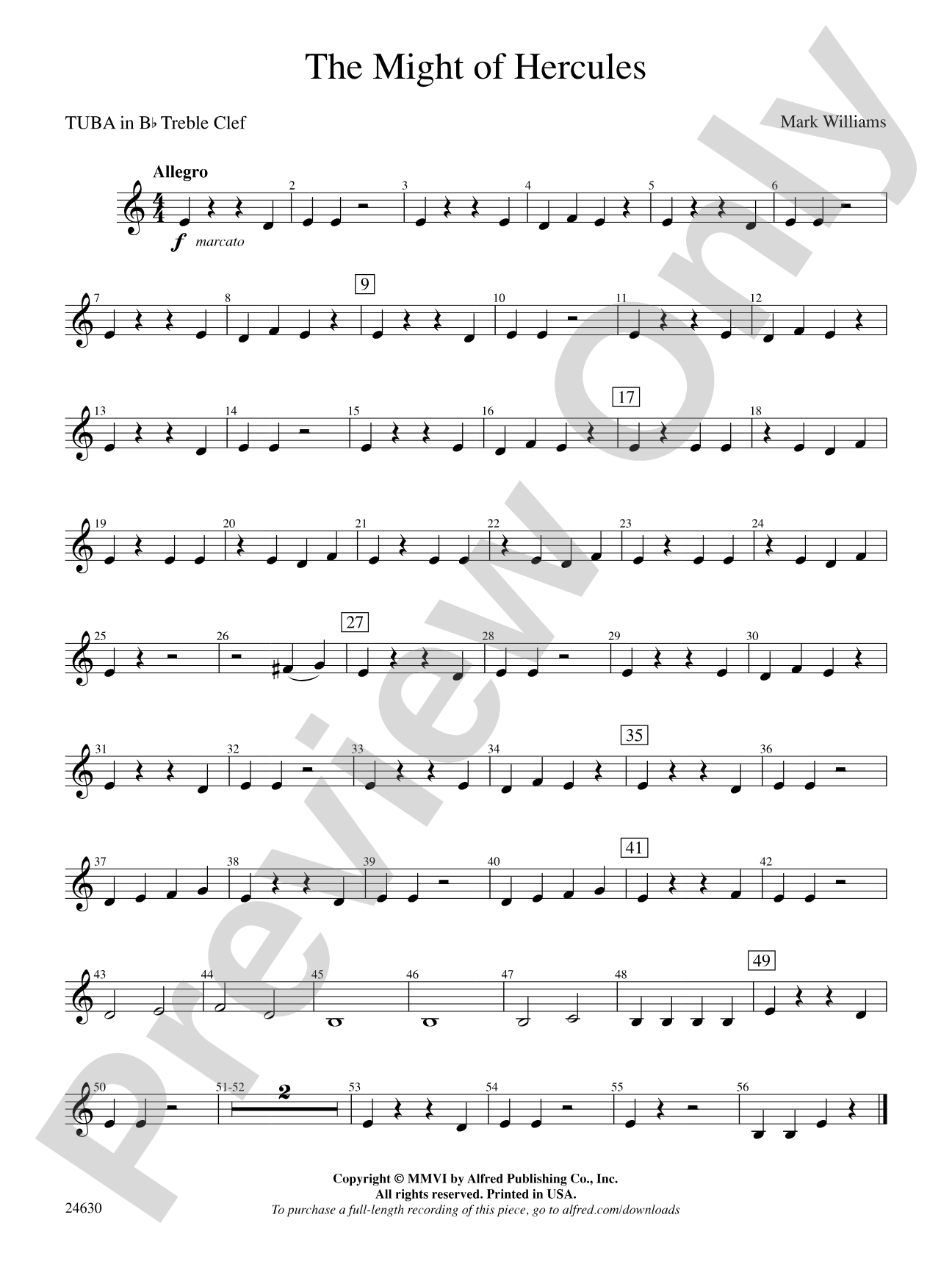

The Might of Hercules: (wp) B-flat Tuba T.C.
By Mark Williams
Grade: 0.5 (Very Easy)
Item: 00-PC-0000798_wpTBBTC
$3.00
Pickup currently not available
Description
The legendary strength of this great hero of Greek mythology is reflected in this powerful new work for first-year band. Written in the Greek modes of Phrygian and Aeolian, this impressive work combines active, driving percussion and very easy wind parts in quarter notes to produce a perfect sonic showpiece for your beginning band. Correlated with Accent on Achievement, Book 1, page 15, this is destined to be an all-time student and audience favorite. This title is available in MakeMusic Cloud.


Don't just read it, hear it, play along with it, and watch your students grow with it. In MakeMusic Cloud, The Might of Hercules: (wp) B-flat Tuba T.C. comes alive with professional accompaniment, adjustable tempo, and built-in practice tools that turn solo practice into real progress.
Open in the Player
Jump straight in and assign it today.
Start Your Free Trial
Open this title and explore the full library in minutes.
Sample Audio
1
Audio File
--:--
0:00
0:00
Sample Video
No sample videos found.
Additional Details
Series:
Accent on Achievement
Publisher:
Alfred Music
Page Count:
124
SKU:
00-PC-0000798_wpTBBTC
More about this title
About the Composer: Mark Williams

Mark Williams built his reputation as one of the most prolific and widely respected composers for school bands and orchestras, with over 200 published works spanning multiple genres and difficulty levels. A native of Chicago who spent his formative years in Spokane, Washington, he earned degrees from Eastern Washington University and spent years teaching elementary band in Washington schools while maintaining an active schedule as a clinician and guest conductor across 34 states, 5 Canadian provinces, and Australia.
Beyond composition, Williams was a skilled woodwind performer and arranger who served with the 560th Air Force Band, and he co-authored the Accent on Achievement Band Method alongside his conducting work with the Spokane British Brass Band. His contributions to music education earned him recognition including the Western International Band Clinic's Gralia Competition and multiple ASCAP Special Awards, cementing his legacy as a musician equally dedicated to writing accessible, engaging music for young players and fostering musical growth in beginning ensembles.
Why we love this
Williams understands exactly what a first-year band needs: music with real impact that doesn't demand technical wizardry. The Greek modal writing gives this piece genuine musical sophistication while the straightforward quarter-note wind writing keeps focus on tone and ensemble balance, making it an ideal anchor for your fall concert or festival entry.
What to expect
The energy of myth made manifest: propulsive and heroic, with the percussion driving forward relentlessly while winds paint bold, confident lines in ancient modal colors. There's a sense of strength and forward momentum throughout, building an exciting sonic landscape that feels far more sophisticated than the individual parts might suggest.
Who it's for
This piece is designed for beginning band students in their first year of study, offering substantial musical reward without demanding advanced technical facility. Directors seeking a showpiece that's approachable for learners but genuinely impressive for audiences will find it especially valuable.
How to get the most out of it
- Emphasize the driving pulse in the percussion section; the rhythmic energy is what makes this piece soar, so lock in the timpani and bass drum parts early in rehearsals.
- Shape the melodic lines even though the rhythms are simple; have students think about phrase direction and avoid playing quarter notes as mechanical.
- Use the Phrygian and Aeolian modal colors as a teaching moment about non-major/minor tonality; let students hear how the mode affects the overall character.
How to use it
Open your fall concert with this as a statement piece, or feature it at a festival where you want judges to hear both the musicality and accessibility of your beginning band. Its correlation with Accent on Achievement, Book 1 makes it a natural fit for students who've progressed to page 15.
Skills your students will build
- Reading and performing in Phrygian and Aeolian modes
- Maintaining steady pulse and ensemble rhythm with complex percussion accompaniment
- Producing clear, sustained tone on quarter-note lines
- Balancing individual voice with ensemble sound
- Recognizing and responding to musical character and style beyond major/minor tonality