
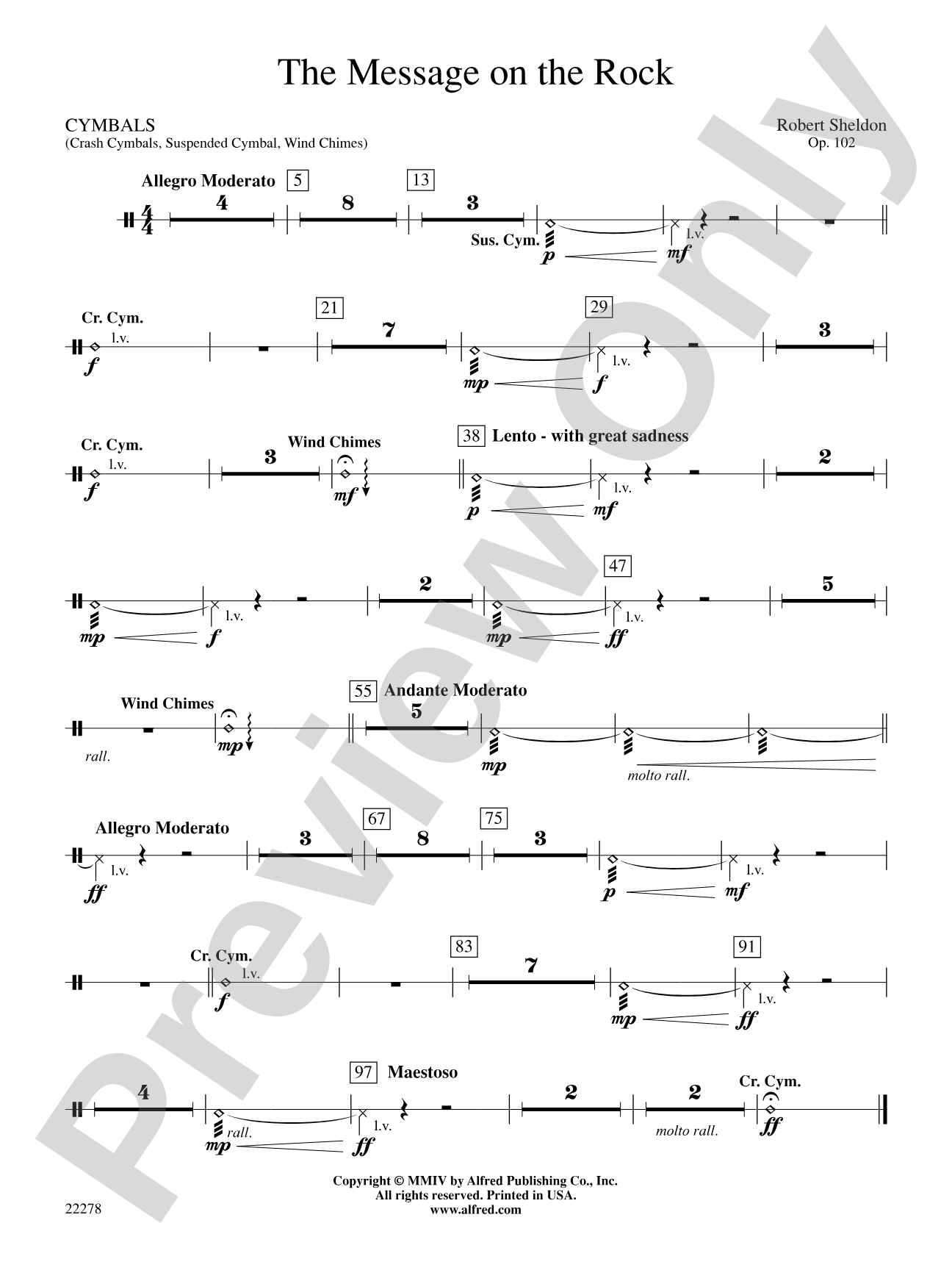

The Message on the Rock: 1st Percussion
By Robert Sheldon
Grade: 2 (Medium Easy)
Item: 00-PC-0000532_PC1
$3.00
Pickup currently not available
Description
The musical inspiration for this piece came from the scenes and speeches on a rock emblazoned with battle scenes from our nation's history. The piece opens with a military-sounding march that leads to a solemn section over which a narrator reads the speeches seen on the rock while a muted trumpet plays "Taps" in the background. The initial march then returns, with fragments of numerous patriotic melodies juxtaposed with the original melody, coming to an exciting ending. (4:45) This title is available in MakeMusic Cloud.


Don't just read it, hear it, play along with it, and watch your students grow with it. In MakeMusic Cloud, The Message on the Rock: 1st Percussion comes alive with professional accompaniment, adjustable tempo, and built-in practice tools that turn solo practice into real progress.
Open in the Player
Jump straight in and assign it today.
Start Your Free Trial
Open this title and explore the full library in minutes.
Sample Audio
1
Audio File
--:--
0:00
0:00
Sample Video
Additional Details
Series:
Young Symphonic
Publisher:
Alfred Music
Page Count:
258
SKU:
00-PC-0000532_PC1
More about this title
About the Composer: Robert Sheldon

Robert Sheldon stands among the most frequently performed composers in wind band repertoire today. His work garners consistent recognition from the American School Band Directors Association, Phi Beta Mu, and ASCAP, and his compositions appear on international contest and concert programs worldwide. Beyond his prolific output as a composer, Sheldon co-authored Sound Innovations for Concert Band, establishing himself as a significant voice in wind band pedagogy.
Sheldon's influence extends across the globe through conducting engagements, clinician appearances at state music education conferences and university campuses, and guest conducting positions with all-state and regional honor bands. His works have been performed at Carnegie Hall, Orchestra Hall in Chicago, Boston Symphony Hall, the Sydney Opera House, and the Kennedy Center. In 2020, VanderCook College of Music awarded him an honorary doctorate in recognition of his contributions to music education and composition.
Why we love this
Sheldon crafts an emotionally resonant journey that respects the patriotic subject matter without resorting to heavy-handed sentiment. The inclusion of a narrator transforms this from a purely instrumental narrative into a multimedia experience that deepens audience engagement while remaining accessible for Grade 2 ensembles. The balance between solemn reflection and triumphant march gives directors genuine dramatic architecture to shape during rehearsal.
What to expect
The piece unfolds like a memorial service set to music, opening with the measured dignity of a military march before shifting into hushed reverence. As the narrator's voice enters over muted trumpet, the mood becomes contemplative and weightedwith historical significance. The return to the march in the final section rebuilds energy, layering in patriotic themes that feel like echoes of America's past converging toward an affirmative, celebratory conclusion.
Who it's for
This piece suits concert bands at the Grade 2 level who want to program meaningful patriotic content without sacrificing musicality. It works well for bands seeking to incorporate a narrator into a concert, offering students and audiences a compelling alternative to instrumental-only patriotic selections. The accessible instrumentation and moderate technical demands make it ideal for mid-tier ensembles looking to expand their repertoire beyond standard marches.
How to get the most out of it
- Shape the opening march with crisp articulation and steady pulse; this military character anchors the piece and makes the tonal shift to the muted trumpet and narration more impactful.
- Coordinate the narrator's pacing with the muted trumpet "Taps" section during rehearsals so the dialogue feels organic rather than mechanically synchronized.
- Bring out the patriotic melody fragments in the final section with clear voicing across sections; they weave through the original theme and deserve distinct color without muddying the texture.
- Build the final excitement gradually, allowing the return of main material to accumulate intensity rather than jumping to full volume immediately.
How to use it
Program this for 4th of July or Veterans Day concerts, where it will resonate with audiences seeking substance alongside seasonal themes. Its 4:45 duration and dramatic arc make it a strong centerpiece for a patriotic set, allowing you to bookend it with lighter selections or use it as the emotional climax of your program. The multimedia element also makes it a natural fit for educational concerts designed to engage school and community audiences.
Skills your students will build
- Responding to a conductor's emotional and dramatic intent beyond basic tempo and dynamics
- Balancing ensemble blend while maintaining clarity of inner melodic lines and countermelody fragments
- Sustaining musical focus through extended sectional and full-band textures
- Performing with appropriate tone quality and articulation across contrasting characters (military march, solemn reflection, triumphant finale)
- Coordinating with non-instrumental performers and following rubato-inflected accompaniment