
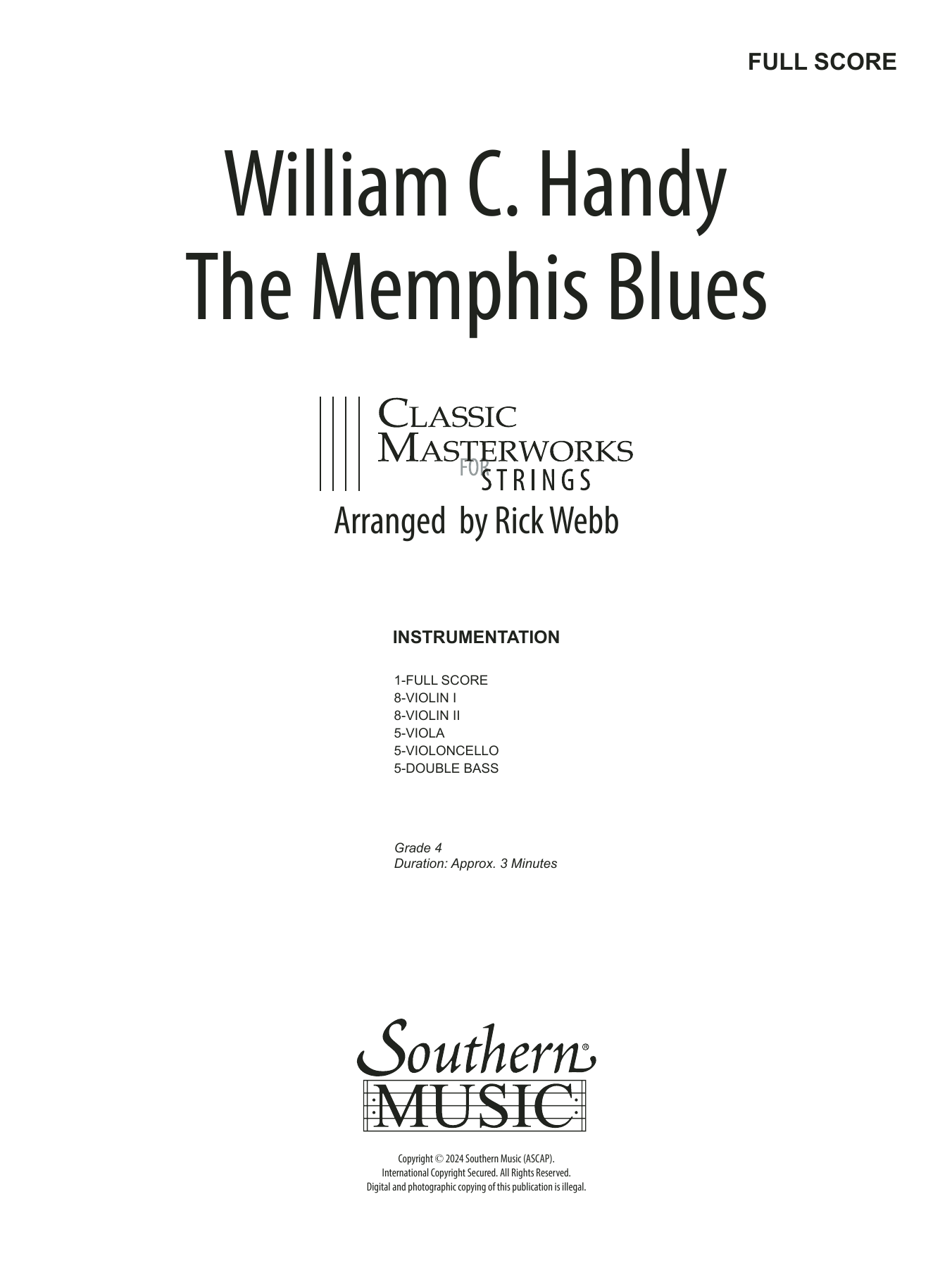

The Memphis Blues (arr. Richard Webb): String Orchestra Conductor Score & Parts
By W.C. Handy / Arranged by Richard Webb
Grade: 4
Item: 35-PK01511868
$60.00
Pickup currently not available
Buy Extra Parts (Digital PDF Download)
Parts Added to Cart!
Description
Handys THE MEMPHIS BLUES was published in 1912, and was based on a campaign song called MR. CRUMP, which the composer claimed to have written for a mayoral candidate in Memphis, Tennessee. It has been performed and recorded by many blues, jazz, and popular music artists through the years.


The Memphis Blues (arr. Richard Webb): String Orchestra Conductor Score & Parts isn't in MakeMusic Cloud just yet...but it could be. Let us know you'd like to see it, and you'll help shape what comes next. In the meantime, start a free trial and dive into thousands of interactive titles your students can play along with today.
Request This Title
Tell us you want it.
Start Your Free Trial
Explore everything that's ready to play right now.
Sample Audio
No sample audio found.
Sample Video
No sample videos found.
Additional Details
Publisher:
Hal Leonard
SKU:
35-PK01511868
More about this title
About the Composer: W.C. Handy
W.C. Handy earned the title "Father of the Blues" by codifying and publishing blues forms that emerged from African American communities in the Deep South. His work as a composer, bandleader, and music publisher transformed folk blues traditions into written arrangements that reached wide audiences through sheet music and recordings. Handy's influence on American music education extends beyond his compositions; his arrangements and publications established blues as a legitimate genre worthy of study and performance.
Handy's career spanned from his early days as a cornet player in brass bands through his emergence as a dominant force in popular music publishing. The Memphis Blues, alongside St. Louis Blues and other standards, demonstrate his gift for writing memorable melodies that capture the spirit of blues while remaining accessible to performers of varying skill levels. His legacy includes not just iconic pieces, but a model for how vernacular music can be documented and shared within formal musical structures.
Why we love this
Webb's arrangement respects the character of Handy's blues idiom while writing for the string section with remarkable clarity and color. This sits at exactly the right difficulty level for strong Grade 4 programs; it's not simplified to the point of losing its jazz-influenced harmonic movement, yet it's entirely playable by developing musicians. Adding an early American blues standard to your programming season opens conversations about where popular music and concert music intersect.
What to expect
The Memphis Blues carries the relaxed sophistication of early jazz era arranging; there's blues vocabulary in the harmonic language and a walk to the rhythm, yet everything sits comfortably under the fingers of string players. The melody unfolds with the lyrical ease of a vocalist, inviting players to think in phrases rather than note collections. Performing this piece feels like stepping into an era when popular music and orchestral writing were far closer neighbors than they are today.
Who it's for
This arrangement works beautifully for Grade 4 string orchestras looking to expand beyond standard classical repertoire into American vernacular traditions. Directors seeking repertoire that engages students' ears differently while building technical skills in a high-interest context will find this invaluable. The piece also serves ensembles preparing for pops concerts or showcases where blues and jazz standards fit naturally.
How to get the most out of it
- Shape the opening melody with subtle dynamic shaping rather than strict terraced dynamics; the blues feel depends on a conversational quality even in the straight sections.
- Balance the rhythm section awareness throughout. Even though this is arranged for strings, the implied walking pulse beneath the melody should feel like a living groove, not metronomic.
- Encourage the section playing sustained harmony to listen for and respond to the soloist's phrasing, treating harmonies as reactive rather than merely accompaniment.
How to use it
Program this as a standalone concert piece on a classical program to add color and historical context, or pair it with other early American standards to create a focused thematic concert around vernacular traditions. The Grade 4 difficulty makes it feasible as a midyear project that keeps ensembles engaged during the stretch between winter and spring concert preparation. It also works well in educational settings where you're teaching students about blues form and its impact on modern music.
Skills your students will build
- Blues harmonic vocabulary and chord changes
- Phrasing and dynamic shaping within jazz idioms
- Listening for and responding to implied rhythmic pulse in swing feel
- Balancing melody-driven writing with supporting harmonies