
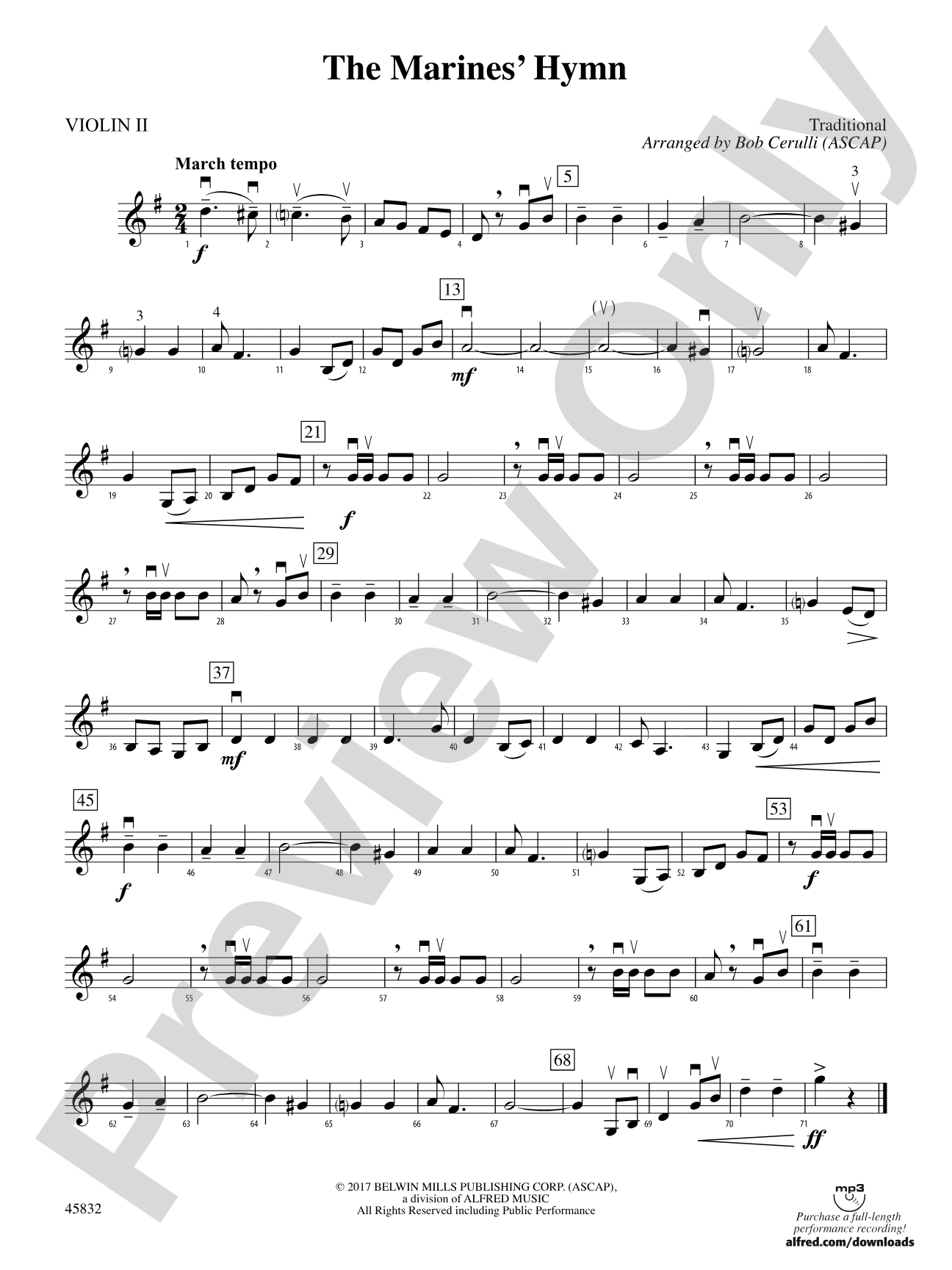

The Marines' Hymn: 2nd Violin
Traditional / arr. Bob Cerulli
Grade: 2
Item: 00-PC-0017634_VN2
$5.99
Pickup currently not available
Description
This patriotic classic is sure to become a go-to piece in your library as it introduces basic march style and provides teaching opportunities! Arranged by Bob Cerulli, this stirring piece reinforces hi 2 and lo 2 while the melody moves around the orchestra. (2:10)


Don't just read it, hear it, play along with it, and watch your students grow with it. In MakeMusic Cloud, The Marines' Hymn: 2nd Violin comes alive with professional accompaniment, adjustable tempo, and built-in practice tools that turn solo practice into real progress.
Open in the Player
Jump straight in and assign it today.
Start Your Free Trial
Open this title and explore the full library in minutes.
Sample Audio
1
Audio File
--:--
0:00
0:00
Sample Video
Additional Details
Series:
Belwin Intermediate String Orchestra
Publisher:
Alfred Music
Page Count:
72
SKU:
00-PC-0017634_VN2
More about this title
About the Arranger: Bob Cerulli

Bob Cerulli combines performance expertise with deep pedagogical experience. He studied double bass at the Curtis Institute of Music under Roger Scott, earned degrees in music education from the University of the Arts and in conducting from the College of New Jersey, and performed as Principal Bass with several regional orchestras including the Greater Trenton Symphony and Delaware Valley Philharmonic. His performance career included work with the Buffalo Philharmonic, Broadway productions, and collaborations with composers and performers ranging from Henry Mancini to Luciano Pavarotti.
For nearly three decades, Cerulli taught music in public schools, bringing his orchestral and compositional knowledge directly into the classroom. He has also conducted festivals and reading sessions for young musicians across the region. Currently, he serves as a Senior Adjunct Professor at Rowan College at Burlington County, continuing to shape music education at the university level.
Why we love this
This arrangement captures what makes the Marines' Hymn resonate with students: a melody that's instantly recognizable and deeply familiar, paired with orchestration that invites every section to shine. Cerulli's scoring reinforces fundamental string techniques (divisi writing with high 2 and low 2 positions) without overwhelming young players, making this both musically satisfying and pedagogically smart. It's the kind of patriotic standard that builds ensemble pride and sits naturally into spring concert programming.
What to expect
Dignified and ceremonial, this arrangement honors the hymn's military heritage without grandstanding. The orchestration moves the melody organically through the ensemble, creating moments of transparency and warmth that let young musicians experience what it feels like to be part of something larger than themselves. It's rousing without being bombastic.
Who it's for
This arrangement serves Grade 2 string orchestras ready to move beyond unison playing into basic divisi writing. Directors seeking patriotic repertoire with educational substance will find a piece that teaches march style and position work while remaining accessible. It works equally well for concert performance or festival competition.
How to get the most out of it
- Balance the melody across your sections as it passes through first violins, second violins, and violas. Young orchestras often over-play the melody line, so shape it with dynamic restraint and let supporting voices anchor the harmony.
- Establish a steady, dignified tempo befitting a march. Avoid rushing through the 2:10 duration; let students experience the ceremonial quality of the piece rather than racing to the finish.
- Isolate the divisi passages in rehearsal. High 2 and low 2 positions can feel unfamiliar to Grade 2 players, so practice them separately by part before running full sections together.
- Tune chord changes carefully, especially at cadences. String players at this level often slide into pitch rather than playing with intention, so emphasize vertical tuning when harmony shifts.
How to use it
Program this as a concert opener or closer on a spring concert; its patriotic character and moderate length make it ideal for creating a strong bookend. It also fits naturally into Memorial Day, Veterans Day, or citizenship-themed concerts. Consider pairing it with contrasting lighter or folk-based repertoire to give your program shape.
Skills your students will build
- Playing in high 2 and low 2 positions on strings
- Reading and executing basic divisi parts
- Maintaining steady tempo in march style
- Balancing melody and accompaniment across multiple sections
- Tuning chord changes and vertical harmony