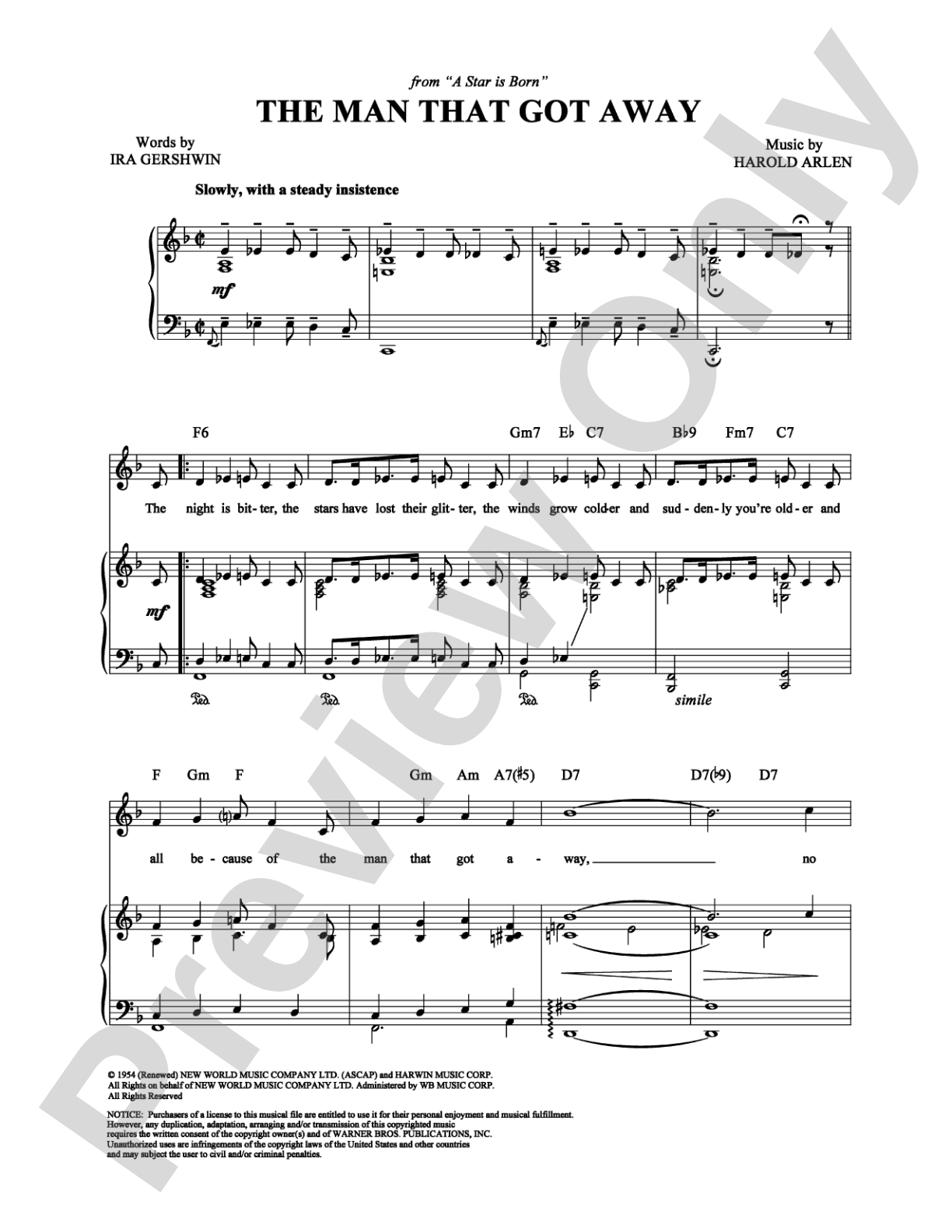
The Man That Got Away: Piano/Vocal/Chords Digital Sheet Music

The Man That Got Away: Piano/Vocal/Chords Digital Sheet Music

Harold Arlen, Judy Garland

Item: 00-PS-0002463

Digital Download
$3.99
Description

The Man That Got Away: Piano/Vocal/Chords Digital Sheet Music isn't in MakeMusic Cloud just yet...but it could be. Let us know you'd like to see it, and you'll help shape what comes next. In the meantime, start a free trial and dive into thousands of interactive titles your students can play along with today.

Sample Audio
No sample audio found.
Sample Video
Additional Details
SKU: 00-PS-0002463

More about this title

About the Artist: Judy Garland

Judy Garland (1922, 1969) redefined the American vocal standard through her emotional directness and technical command. Her interpretations of Great American Songbook material set the benchmark for generations of singers, combining jazz-inflected phrasing with classical vocal technique.

Why we love this

Garland's interpretation of this Harold Arlen and Ira Gershwin masterpiece is the definitive recording for most singers learning the song. Her phrasing and emotional openness make this digital sheet music an ideal study tool for vocalists seeking to understand how great singers approach standard repertoire. The piano/vocal/chords format supports both solo practice and collaboration, making it adaptable for voice lessons, jazz ensemble work, or recital preparation.

What to expect

The song moves through heartbreak with resilience. The melody has a torch-song quality that feels both resigned and defiant, grounded in the blues but reaching for something larger. Garland's voice brings warmth and specificity to every phrase, making abstract emotion feel immediate and personal.

Who it's for

This is essential for vocalists studying jazz standards and American popular song repertoire, whether in private voice lessons, jazz ensemble contexts, or recital preparation. Pianists accompanying vocalists will benefit from the straightforward chord symbols and melody-centered layout. Students seeking to understand how to interpret a standard authentically will find Garland's version a vital reference point.

How to get the most out of it

  • Listen to Garland's recording multiple times before learning the melody. Notice how she shapes phrases, where she breathes, and how she sits slightly behind or ahead of the beat to create emotional weight.
  • Work the lyrics as carefully as the melody. Garland's power comes from her commitment to what the words are saying; singing through text with intention will deepen your interpretation.
  • Balance the vulnerability of the verse against the soaring quality of the refrain. The contrast between these sections is what gives the song its dramatic arc.
  • Use the chord symbols to explore harmonic movement on piano or with an accompanist. Understanding the progression deepens your sense of where the melody sits within the harmony.

How to use it

Include this in a voice recital exploring standards from the golden age of American song, or use it as a study piece in a jazz ensemble or small group setting. The song works equally well as a solo feature or as part of a thematic program exploring resilience and hope through song.

Skills your students will build

  • Interpreting lyrics with emotional specificity and conviction
  • Phrasing choices within a jazz standard context
  • Working with chord symbols for harmonic awareness
  • Balancing melodic simplicity against harmonic sophistication
  • Understanding how Arlen's melody interacts with the harmonic progression

You May Also Like