
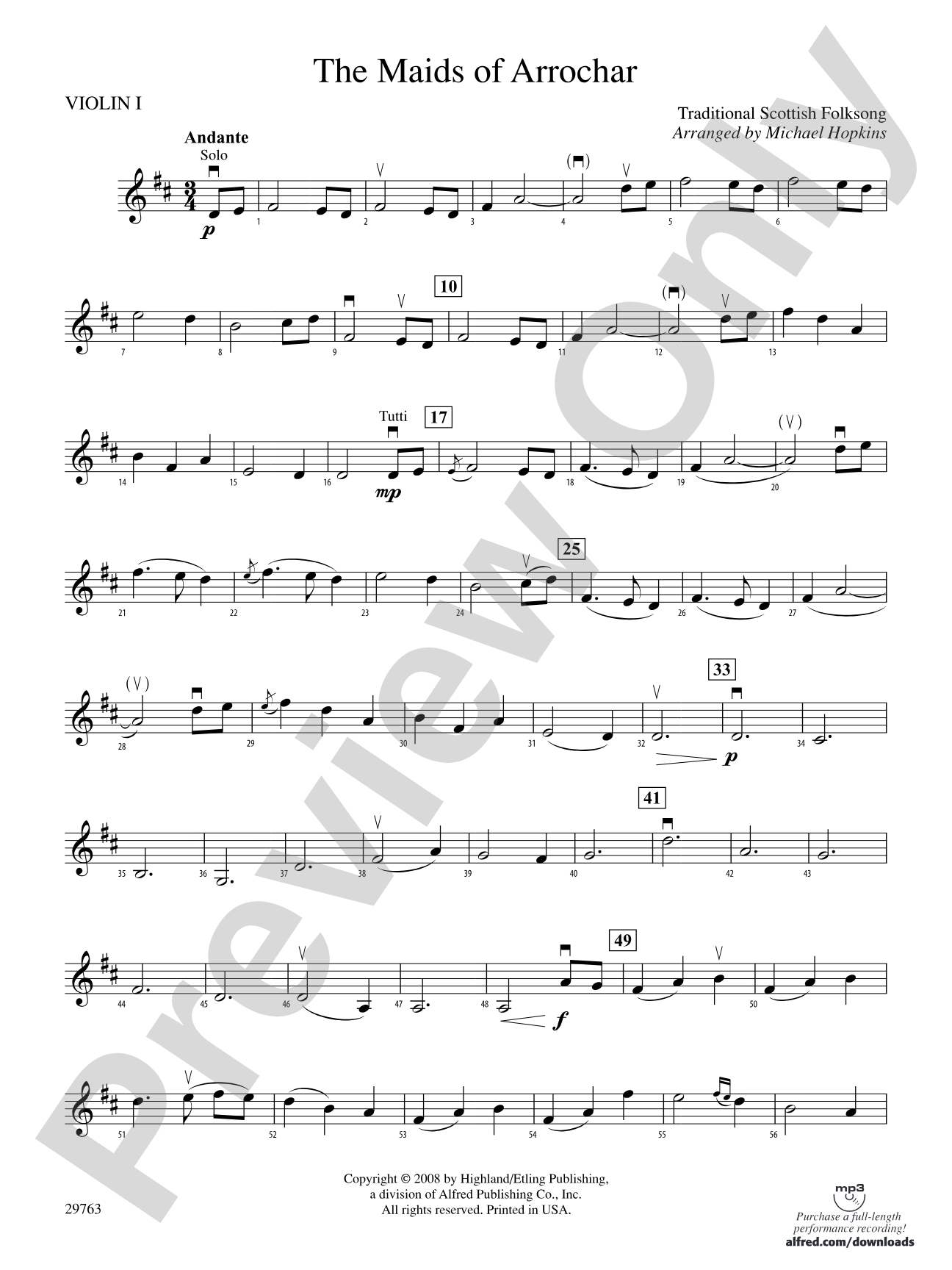

The Maids of Arrochar: 1st Violin
Traditional / arr. Michael Hopkins
Grade: 2.5
Item: 00-PC-0001609_VN1
$5.99
Pickup currently not available
Description
Your students will enjoy playing this traditional Scottish air, beautifully arranged for string orchestra by Michael Hopkins. This is a great piece for developing expression and legato bow changes. This is also a great piece for introducing students to ornamentation used in Scottish folk music. The piece begins with a violin solo, and also features short solos for violin and viola at the end. All parts are playable in first position, with some shifting to third position for double bass. Piano, guitar and flute parts are included. (4:20)


Don't just read it, hear it, play along with it, and watch your students grow with it. In MakeMusic Cloud, The Maids of Arrochar: 1st Violin comes alive with professional accompaniment, adjustable tempo, and built-in practice tools that turn solo practice into real progress.
Open in the Player
Jump straight in and assign it today.
Start Your Free Trial
Open this title and explore the full library in minutes.
Sample Audio
1
Audio File
--:--
0:00
0:00
Sample Video
No sample videos found.
Additional Details
Series:
Highland/Etling String Alternatives
Publisher:
Alfred Music
Page Count:
114
SKU:
00-PC-0001609_VN1
More about this title
About the Arranger: Michael Hopkins

Michael Hopkins has taught string techniques and orchestra methods at the University of Michigan, where he serves as Professor and Chair of Music Education. His experience spans conducting university ensembles, directing orchestra programs at the middle and high school levels across Colorado, Michigan, and Vermont, and founding the Burlington Chamber Orchestra. He has guest conducted at over 100 orchestra festivals and clinics nationwide and presented more than 60 times at national and state music education conferences on string pedagogy and music technology.
Hopkins has composed and arranged over 70 published works for orchestra and contributed articles to major music education journals including the Journal of Research in Music Education, American String Teacher, and the Music Educators' Journal. He authored The Art of String Teaching, published by GIA Publications, a comprehensive resource for pre-service teachers, conductors, group string instructors, and private studio teachers.
Why we love this
This arrangement transforms a beloved Scottish melody into a perfect vehicle for teaching legato bow changes and expression without overcomplicating rhythmic or technical demands. The solo passages for violin and viola give your ensemble members meaningful moments in the spotlight while the accessible first-position writing keeps the focus on musical phrasing and ornamentation technique.
What to expect
A lyrical journey through a Scottish landscape, intimate and reflective. The opening violin solo sets a contemplative mood, and the gentle ornamentation gives the melody an almost improvisational character that feels both folk-rooted and elegantly arranged.
Who it's for
String orchestras at the intermediate level (grades 6-10) who are developing control over legato playing and expressive techniques. This piece works well for ensembles ready to move beyond purely technical exercises into music that rewards thoughtful interpretation and sectional refinement.
How to get the most out of it
- Shape each phrase with graduated dynamics rather than rigid forte and piano markings. Let the melody breathe by pulling slightly away from the pulse before lifting into the next phrase.
- Approach the ornamentation as an integral part of the melodic line, not as decoration applied after the fact. Listen to Scottish folk recordings to hear how the grace notes and turns sit naturally within the phrasing.
- Coordinate the violin and viola solos at the end by having those players rehearse independently first, then bring the ensemble in. This ensures the soloists feel secure before adding accompaniment texture.
- Balance the optional piano and guitar parts carefully; they should support the string texture rather than dominate it. In a concert setting with these additions, place them slightly back in the ensemble.
How to use it
This pairs naturally with other folk-inspired arrangements in a concert celebrating world music traditions, or program it as a calm center section in a concert that opens and closes with more energetic works. Its moderate length (4 minutes 20 seconds) makes it ideal filler between longer competition pieces or as part of a festival performance.
Skills your students will build
- Legato bow changes with minimal audible discontinuity
- Ornamentation interpretation specific to Scottish folk idiom
- Shaping phrases with subtle dynamic contour rather than obvious forte/piano
- Intonation and balance in accompanimental texture while soloists are featured
- Third-position shifting on double bass
- Sustaining musical line through written rests and accompaniment figures