The Magnificent Five: 1st F Horn Sheet Music Preview

The Magnificent Five: 1st F Horn

By Mark Williams

Grade: 0.5 (Very Easy)

Item: 00-PC-0001393_H1

Digital Download
$3.00
Description
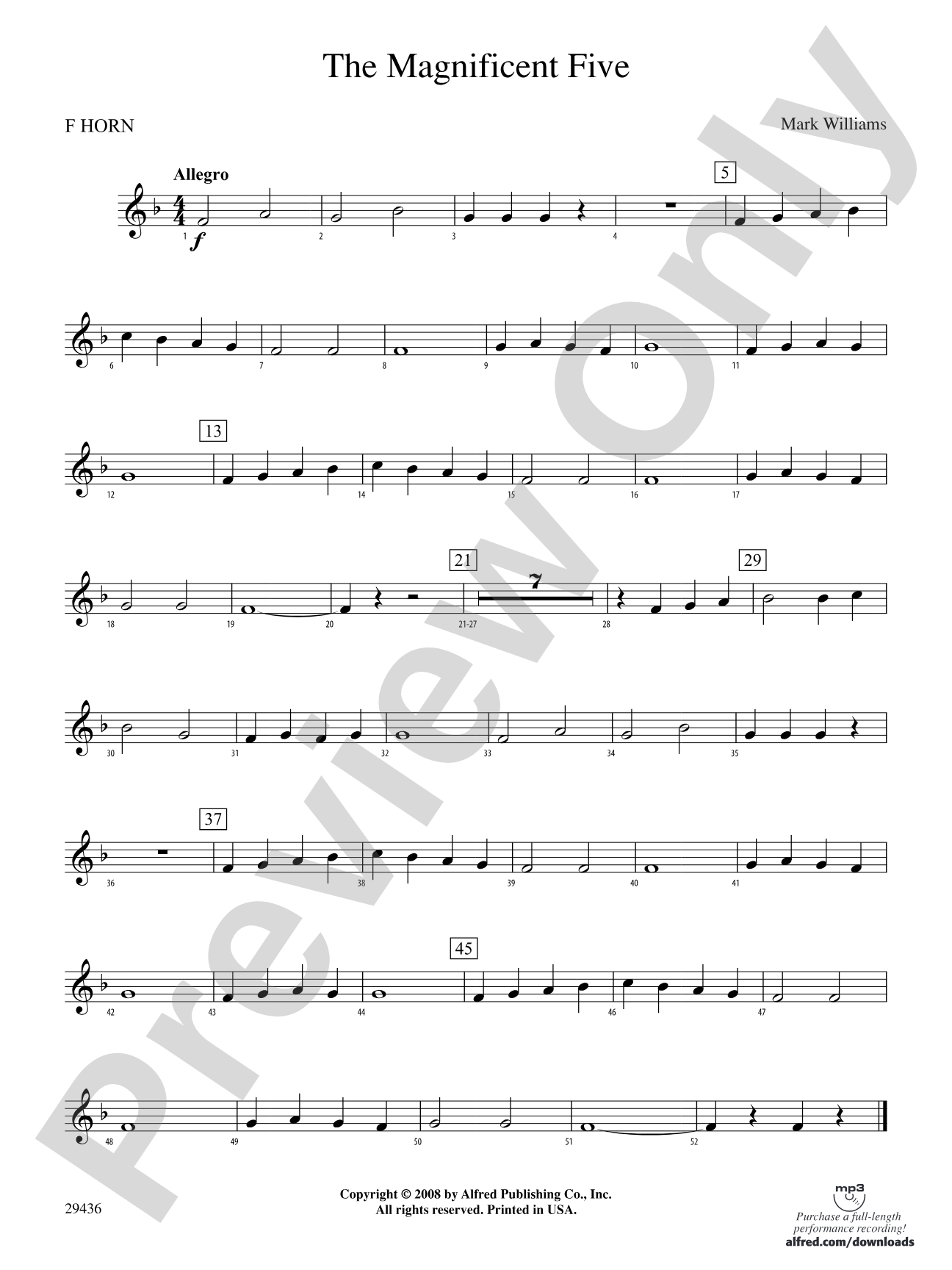
Written for the beginning band's very first concert, this playful tune uses only five notes (the first five notes learned in most band methods) with rhythms no faster than a quarter-note in scale-wise patterns that will build technique and provide a great performance experience. Your beginners will enjoy showing off their newly learned skills with this five-note showpiece. (1:45)

Correlated with Accent on Achievement, Book 1, page 8.

Don't just read it, hear it, play along with it, and watch your students grow with it. In MakeMusic Cloud, The Magnificent Five: 1st F Horn comes alive with professional accompaniment, adjustable tempo, and built-in practice tools that turn solo practice into real progress.

Sample Audio
0:00
0:00
Sample Video
Additional Details
Series: Accent on Achievement
Publisher: Alfred Music
Page Count: 120
SKU: 00-PC-0001393_H1

More about this title

About the Composer: Mark Williams

Mark Williams

Mark Williams shaped generations of young musicians through his prolific output and direct classroom experience. With over 200 published compositions for band, orchestra, and choir, he earned recognition from the Western International Band Clinic and multiple ASCAP Special Awards. His work as co-author of the Accent on Achievement Band Method reflects his deep understanding of how beginners learn and what keeps them engaged.

Williams spent his career in Washington state as an elementary band specialist, combining that teaching expertise with extensive guest conducting and clinician work across 34 states, five Canadian provinces, and Australia. A accomplished bassoon player and arranger for the 560th Air Force Band, he also served as conductor and artistic director for the Spokane British Brass Band. His ability to write music that works in real classrooms came from living and teaching in them.

Why we love this

Williams designed this piece specifically for the moment beginners need it most: their first concert. The five-note restriction isn't a limitation but a triumph of focused writing that lets young players sound genuinely musical without overwhelming them technically. A director can schedule this early in the year knowing the band will deliver a polished, confident performance that celebrates how far they've come in just weeks.

What to expect

Bright, spirited, and encouraging. The piece bounces along with genuine charm, giving young musicians permission to play with personality and enjoy showing off what they've mastered. There's real joy in the simplicity.

Who it's for

This score and parts set serves brand-new concert band students ready to perform their first public concert. Directors will use it as a confidence-builder and technical checkpoint after weeks of foundational instruction from a standard method like Accent on Achievement.

How to get the most out of it

  • Keep the tempo steady and energetic; the novelty relies on consistent pulse and clean articulation, not rushing.
  • Balance the five notes across the full band so the melody shines without drowning accompanying voices.
  • Emphasize the scale-wise patterns as an opportunity to lock in consistent fingering and tone quality across all sections.
  • Build ensemble precision on rhythmic figures during sectionals before putting parts together, since beginners often struggle with coordinating attacks across different instruments.

How to use it

Schedule this early in the season, ideally at a full-band winter or spring concert where you can lead with confidence and momentum. It pairs well with slightly more challenging pieces later on the same program, anchoring the concert in what beginners do best while proving to audiences that new musicians make compelling performers.

Skills your students will build

  • Maintaining steady tempo and ensemble pulse
  • Clean articulation and consistent tone on five foundational pitches
  • Reading scale-wise melodic and rhythmic patterns in quarter-note and longer note values
  • Balancing melody and harmony across a full band texture
  • Sight-reading confidence through repeated exposure to simple, logical patterns

You May Also Like