
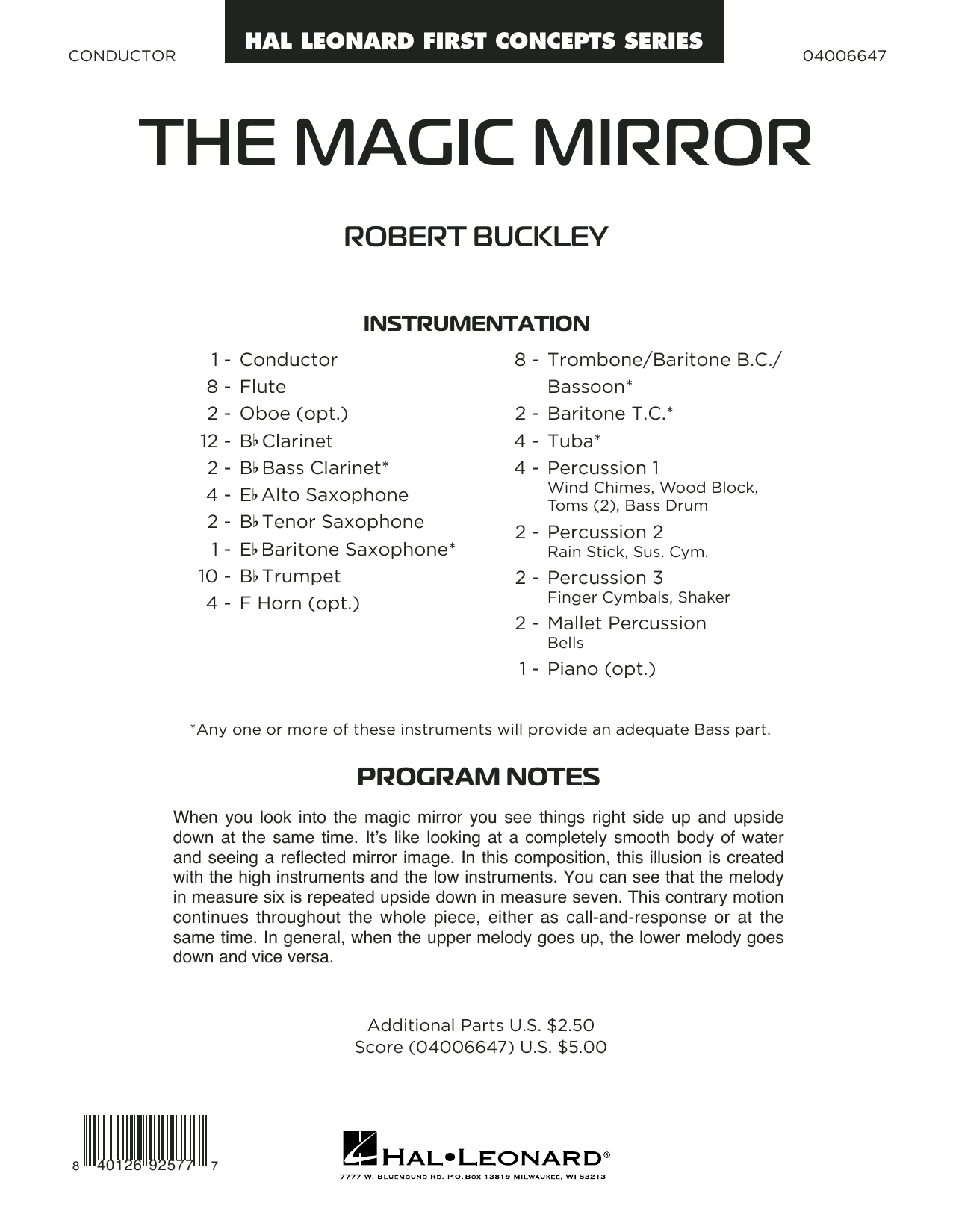

The Magic Mirror: Concert Band Conductor Score & Parts
By Robert Buckley
Grade: 0.5-1
Item: 35-PK00463482
$50.00
Pickup currently not available
Buy Extra Parts (Digital PDF Download)
| Product | Price | Quantity |
|---|---|---|
| The Magic Mirror - Conductor Score (Full Score) | $7.50 | |
| The Magic Mirror - Flute | $6.00 | |
| The Magic Mirror - Oboe | $6.00 | |
| The Magic Mirror - Bb Clarinet | $6.00 | |
| The Magic Mirror - Bb Bass Clarinet | $6.00 | |
| The Magic Mirror - Eb Alto Saxophone | $6.00 | |
| The Magic Mirror - Bb Tenor Saxophone | $6.00 | |
| The Magic Mirror - Eb Baritone Saxophone | $6.00 | |
| The Magic Mirror - Bb Trumpet | $6.00 | |
| The Magic Mirror - F Horn | $6.00 | |
| The Magic Mirror - Trombone/Baritone B.C./Bassoon | $6.00 | |
| The Magic Mirror - Baritone T.C. | $6.00 | |
| The Magic Mirror - Tuba | $6.00 | |
| The Magic Mirror - Percussion 1 | $6.00 | |
| The Magic Mirror - Percussion 2 | $6.00 | |
| The Magic Mirror - Percussion 3 | $6.00 | |
| The Magic Mirror - Mallet Percussion | $6.00 | |
| The Magic Mirror - Piano | $6.00 |
Parts Added to Cart!
Description
Looking at a perfectly still body of water, images appear right side up and upside down at the same time. "The Magic Mirror" creates this illusion with upper and lower instrument groups moving in contrary motion. Effective even for beginners, this piece sounds more advanced than it is, and everyone gets a chance to play melody! The First Concepts Series features simplified instrumentations, unison bass lines, optional advanced snare drum parts, and optional piano accompaniments.


The Magic Mirror: Concert Band Conductor Score & Parts isn't in MakeMusic Cloud just yet...but it could be. Let us know you'd like to see it, and you'll help shape what comes next. In the meantime, start a free trial and dive into thousands of interactive titles your students can play along with today.
Request This Title
Tell us you want it.
Start Your Free Trial
Explore everything that's ready to play right now.
Sample Audio
No sample audio found.
Sample Video
No sample videos found.
Additional Details
Publisher:
Hal Leonard
SKU:
35-PK00463482
More about this title
About the Composer: Robert Buckley
Robert Buckley has established himself as a composer deeply committed to the educational ensemble world. His work across concert band, jazz, and choral genres reflects a keen understanding of what students need to succeed: clear musical logic, engaging orchestration, and genuine fun to play.
Why we love this
The contrary motion writing here is genuinely clever without requiring extensive rehearsal to achieve polish. What makes this stand out is how naturally the upper and lower instruments emerge as equals; there's no hierarchy, just two equally rewarding melodic lines that create something visually and sonically impressive for an audience.
What to expect
There's something mesmerizing about hearing two distinct melodies unfold simultaneously, each one complete and satisfying on its own. The piece creates an optical illusion in sound, drawing the listener into the symmetry and precision required to make it work.
Who it's for
Beginning bands and first-year ensembles that need a piece sounding more sophisticated than the difficulty level suggests. Directors seeking repertoire where everyone gets genuine melodic material rather than filler parts will find this especially valuable.
How to get the most out of it
- Highlight the symmetry in rehearsal by having students physically see the contrary motion. Write opposite arrows above and below the parts so brass and reeds understand they're creating a musical mirror.
- Balance the two instrumental groups by checking that dynamics are truly equivalent on both sides. This piece's magic depends on neither line dominating.
- If your ensemble includes the optional advanced snare drum part, use rehearsal time to lock that percussion line early. A solid rhythmic foundation makes the contrary motion feel even more intentional.
- The simplified instrumentation means every voice matters. Take time to verify that each section hears their line as primary, not as accompaniment.
How to use it
Use this as a confidence builder early in the concert season when your ensemble is still building fundamentals. The visual novelty of contrary motion gives audiences something interesting to watch and discuss, making it ideal for family concerts or school assemblies where you want impact without extreme technical demands.
Skills your students will build
- Reading and executing contrary motion between upper and lower voices
- Maintaining independence within a section while listening across instrumental groups
- Balancing dynamics symmetrically across different timbres
- Understanding how melodic content differs from accompaniment roles
- Ensemble blend and collective intonation in counterpoint-based writing