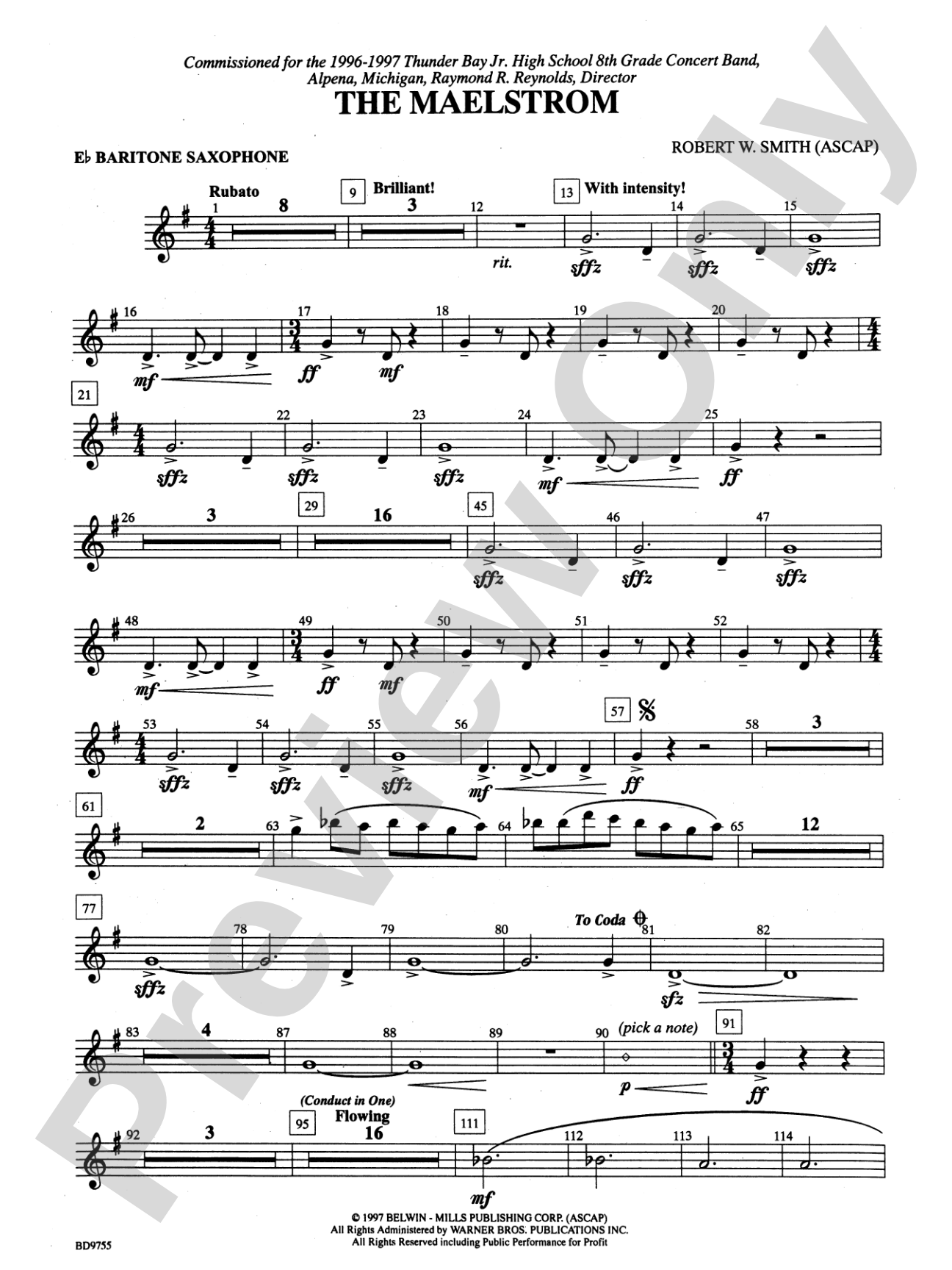
The Maelstrom: E-flat Baritone Saxophone Sheet Music Preview

The Maelstrom: E-flat Baritone Saxophone

By Robert W. Smith

Grade: 3 (Medium Easy)

Item: 00-PC-0002060_BTX

Digital Download
$3.00
Description
A maelstrom is described as 'an intense whirling mass of water circling into itself with great strength.' With this as inspiration, composer Robert W. Smith launches the resplendent new work The Maelstrom. Soaring melodic lines, punctuated with vibrant percussion, propel this driving and dramatic piece with fury and excitement. A dazzling concert statement! (duration 5:10)

Don't just read it, hear it, play along with it, and watch your students grow with it. In MakeMusic Cloud, The Maelstrom: E-flat Baritone Saxophone comes alive with professional accompaniment, adjustable tempo, and built-in practice tools that turn solo practice into real progress.

Sample Audio
0:00
0:00
Sample Video
Additional Details
Series: Belwin Concert Band
Publisher: Alfred Music
Page Count: 308
SKU: 00-PC-0002060_BTX

More about this title

About the Composer: Robert W. Smith

Robert W. Smith

Robert W. Smith stands among America's most recorded composers for concert band and orchestra, with over 400 published works performed across North America, Europe, Australia, and Asia. He holds degrees in Music Education from Troy State University and a Master's in Music from the University of Miami, and has established himself as both a composer and a clinician who conducts workshops internationally.

Smith's orchestral works, including his symphonies The Divine Comedy and The Odyssey, have earned widespread recognition, while his band compositions like The Tempest have become essential repertoire for developing ensembles. His music has appeared in major television broadcasts, Olympic ceremonies, and landmark cultural events, reflecting his ability to craft works that resonate across performance contexts.

Why we love this

Smith delivers exactly what a Grade 3 band needs: thrilling energy without overcomplicating the score. The piece builds momentum through soaring lines and colorful percussion work, giving every section moments to shine while maintaining clear narrative arc. Audiences will hear a polished, exciting concert statement that feels far more sophisticated than the difficulty level suggests.

What to expect

The piece swirls with kinetic energy, pulling the listener into a whirling mass of sound that feels both dramatic and controlled. Brilliant sectional moments emerge from waves of orchestration, creating a sense of propulsion and urgency that builds to a resplendent climax.

Who it's for

Concert bands at the Grade 3 level looking for a showpiece that combines accessibility with genuine excitement. This work rewards solid fundamentals and gives student musicians a chance to play music that feels ambitious and rewarding without excessive technical demands.

How to get the most out of it

  • Let the percussion drive the drama, especially the timpani rolls and accents that punctuate the melodic phrases. These rhythmic markers anchor the ensemble's forward motion.
  • Shape the soaring melodies with dynamic contrast rather than volume alone. Ensure the lyrical passages breathe between the intense sections to maximize impact.
  • Maintain ensemble cohesion during the whirling passages by keeping a steady conducting gesture. The circular energy demands precision in how sections lock together.
  • Balance the tutti sections so that individual voice parts remain audible within the full texture. At Grade 3, clarity prevents the sound from becoming muddy during dense moments.

How to use it

Position this as a concert centerpiece or closing selection on a festival program. Its 5:10 duration and contest-appropriate difficulty make it ideal for spring concert programming or adjudicated events, where you want the band to leave the stage with momentum and confidence.

Skills your students will build

  • Sustaining lyrical phrasing against driving rhythmic accompaniment
  • Balancing independent melodic lines within a complex texture
  • Executing precise dynamic control during rapid sectional changes
  • Building ensemble unity during sustained unison and octave passages
  • Responding to rapid meter changes and rhythmic articulation patterns

You May Also Like