
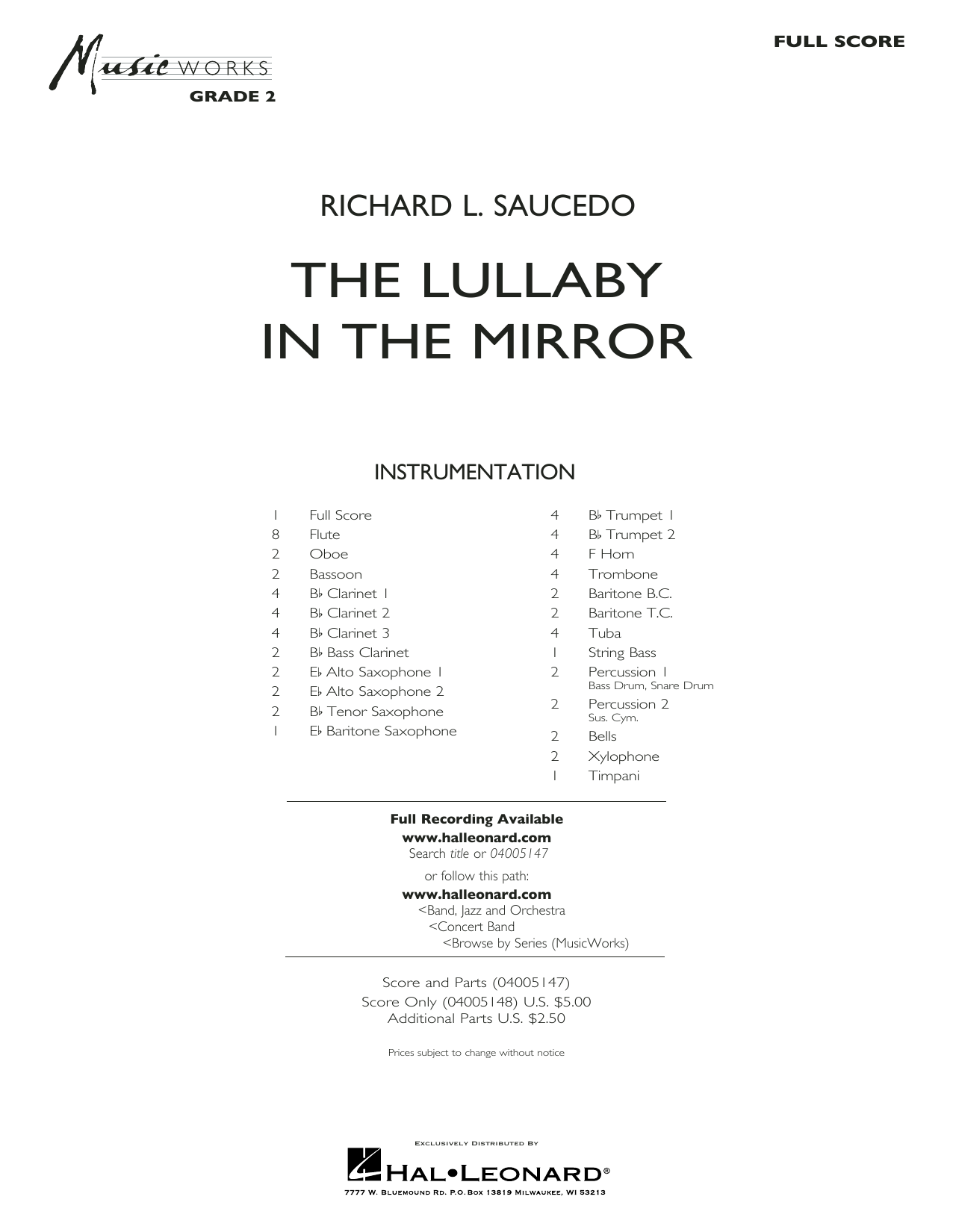

The Lullaby in the Mirror: Concert Band Conductor Score & Parts
By Richard L. Saucedo
Grade: 2
Item: 35-PK00379310
$65.00
Pickup currently not available
Buy Extra Parts (Digital PDF Download)
Parts Added to Cart!
Description
Recognizing the need for well-paced lyric pieces for young players, Richard Saucedo gives us "The Lullaby in the Mirror." This heartfelt and touching work features a mournful melody that winds its way through a variety of moods, and will stay in your memory long after the music has ended. Simply beautiful! Dur: 3:10


The Lullaby in the Mirror: Concert Band Conductor Score & Parts isn't in MakeMusic Cloud just yet...but it could be. Let us know you'd like to see it, and you'll help shape what comes next. In the meantime, start a free trial and dive into thousands of interactive titles your students can play along with today.
Request This Title
Tell us you want it.
Start Your Free Trial
Explore everything that's ready to play right now.
Sample Audio
No sample audio found.
Sample Video
No sample videos found.
Additional Details
Publisher:
Hal Leonard
SKU:
35-PK00379310
More about this title
About the Composer: Richard L. Saucedo

Richard L. Saucedo spent 31 years leading the Carmel High School bands program in Indiana, where he established one of the nation's most decorated ensemble traditions. His Wind Symphony I appeared at the Music for All National Concert Band Festival three times and earned the Indiana State Champion title; the Carmel Marching Greyhounds secured top-ten finishes at the BOA Grand National Championship for 17 consecutive years, capturing national championships in 2005 and 2012. Saucedo received Indiana's Bandmaster of the Year award in 1998-99 and was honored as Outstanding Music Educator in 2010.
Beyond his school tenure, Saucedo has shaped the field through major leadership roles at Music for All and Bands of America, where he serves as Senior Educational Consultant and Chief Judge Team Leader. As a freelance composer and arranger, he has created works across multiple ensembles and contributed arrangements to the Cavaliers Drum and Bugle Corps that earned five DCI world championships. He was inducted into the Music for All Hall of Fame in 2015 and the Drum Corps International Hall of Fame in 2022, and holds membership in the American Bandmasters Association.
Why we love this
Saucedo understands what young ensembles need: a piece that moves with intentional pacing and rewards focused listening. The central melody carries genuine emotional weight without requiring technical pyrotechnics, giving your players something meaningful to perform rather than merely execute. At Grade 2, this sits in the sweet spot where students can shape a real musical idea while building confidence in sustained playing.
What to expect
A quiet reflection captured in sound. The mournful melody unfolds without urgency, inviting players and listeners into an intimate space where each phrase matters. The emotional arc is subtle but undeniable, like watching something familiar from a new angle.
Who it's for
Grade 2 concert bands seeking a lyrical centerpiece that doesn't demand virtuosity but does demand musicianship. This works equally well for developing ensembles building technique and for established groups needing a accessible concert opener or closer.
How to get the most out of it
- Let the melody breathe. Young players often rush lyrical lines from nervousness; mark a target tempo in your score and trust it. The mournful character relies on space and restraint, not precision rushing.
- Balance the accompaniment beneath the featured voice. Even at this level, directors can shape texture by bringing the melody forward in sectional rehearsals, then rebalancing during full ensemble work.
- Commit to the mood shifts. The piece moves through several emotional territories; mark these transitions clearly in parts so students understand they're not just playing notes but traveling through a musical narrative.
How to use it
Open a concert with this piece to establish a contemplative tone, or program it mid-set as a change of pace that quiets the room. The three-minute duration and lyrical focus make it an ideal pairing with more energetic works, offering audiences genuine contrast and your musicians a chance to demonstrate expressive control.
Skills your students will build
- Sustaining lyrical lines with consistent breath support
- Balancing individual voice within ensemble texture
- Responding to subtle dynamic and tempo nuance
- Phrasing extended melodies across multiple measures
- Maintaining intonation during soft, exposed passages