
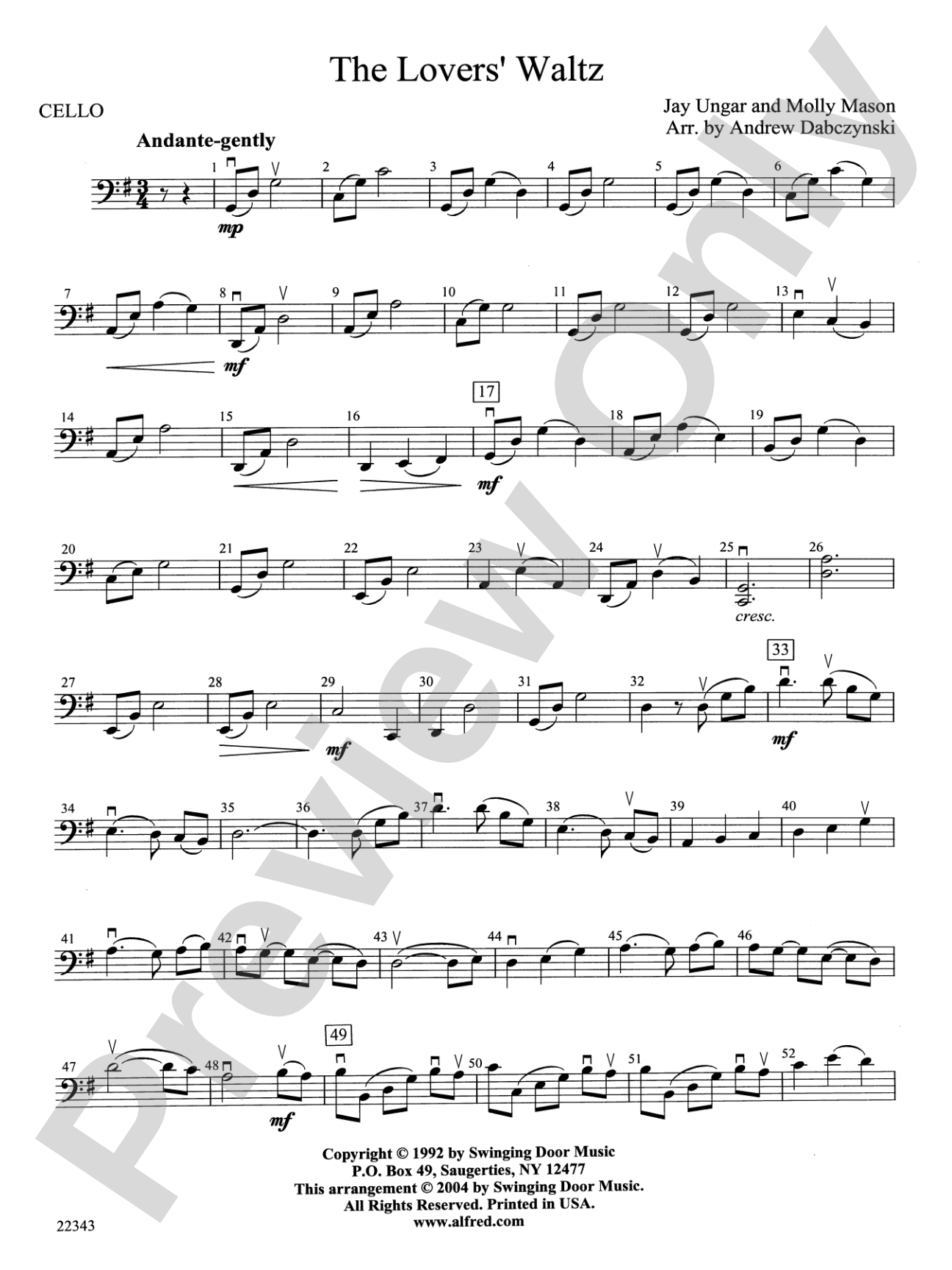

The Lover's Waltz: Cello
By Jay Ungar and Molly Mason / arr. Andrew H. Dabczynski
Grade: 2.5
Item: 00-PC-0000590_VC1
$5.99
Pickup currently not available
Description
Your audience will fall in love with this beautiful waltz arranged for your string orchestra. Perfect for teaching section independence, each part is unique and important, from the violin melody to the rich-sounding sonorities and counter-melodies in the lower strings. Ideal for teaching legato phrasing and dynamic contrast. May be performed with optional harp.


Don't just read it, hear it, play along with it, and watch your students grow with it. In MakeMusic Cloud, The Lover's Waltz: Cello comes alive with professional accompaniment, adjustable tempo, and built-in practice tools that turn solo practice into real progress.
Open in the Player
Jump straight in and assign it today.
Start Your Free Trial
Open this title and explore the full library in minutes.
Sample Audio
1
Audio File
--:--
0:00
0:00
Sample Video
No sample videos found.
Additional Details
Series:
Highland/Etling String Alternatives
Publisher:
Alfred Music
Page Count:
128
SKU:
00-PC-0000590_VC1
More about this title
About the Arranger: Andrew H. Dabczynski

Andrew H. Dabczynski has shaped string education through decades of teaching, research, and advocacy. A violist trained at the Eastman School of Music and the University of Michigan, he founded BYU's "New Horizons Orchestra" and served as Emeritus Professor of Music Education at Brigham Young University, where he received the Joseph E. White Fellowship for Teaching and Learning. His work has earned him recognition as Utah ASTA's "Higher Education Teacher of the Year" in 2005 and the organization's award for "Outstanding Contributions to Music Education" in 2014.
Beyond the university, Dabczynski has held positions at the Eastman School of Music, in public school districts across New York and Michigan, and as a performer in several regional symphonies. His pedagogical expertise is evident in the String Explorer method series, co-authored with Alfred Publishing. A scholar of folk music and fiddling traditions, he brings both technical rigor and cultural breadth to his contributions to string education.
Why we love this
Dabczynski writes with genuine pedagogical purpose. Rather than assigning parts arbitrarily, he constructs independent lines throughout the ensemble so every section has something musically substantive to play; this arrangement teaches your violins, violas, and cellos what it means to be essential. The waltz form and character of the piece create a natural platform for teaching legato phrasing and dynamic shaping without compromising the beauty your audience will hear.
What to expect
The Lover's Waltz unfolds with the grace and lilting motion of a traditional European dance, but Dabczynski's arrangement adds depth through the interplay of independent melodic lines. Your ensemble will sound fuller and more sophisticated than the Grade 2.5 designation suggests, with the harp adding an optional shimmer that transforms the piece into something genuinely elegant.
Who it's for
String orchestra directors at the Grade 2.5 level who want a piece that develops musicianship without simplifying the arrangement's compositional substance. This works equally well for a spring concert, adjudicated festival, or young orchestra that has mastered basic ensemble cohesion and is ready to tackle part independence and interpretive detail.
How to get the most out of it
- Shape the opening violin melody with clear phrasing, but resist the temptation to rush. The waltz rhythm benefits from a relaxed, singing quality that emerges when tempo remains steady and bow pressure stays consistent through longer phrases.
- Balance your lower strings carefully. Violas and cellos carry counter-melodies throughout, and bringing them forward slightly in rehearsal helps violins understand that their melody is not the only musical conversation happening on stage.
- Establish unified bow direction and articulation within each section before sectional rehearsals end. The arrangement's effectiveness depends on homogeneous attacks and releases, especially in accompaniment figures that support the main line.
- If you include the optional harp part, rehearse the entire string orchestra with it present so the ensemble adjusts to the tonal color and learns to listen around the harp's shimmer rather than covering it.
How to use it
Place this early in your concert to establish an accessible, audience-friendly tone that showcases the string sound in its most lyrical mode. It pairs well with contrasting fare such as a rhythmically driven contemporary piece or a short work for full orchestra, allowing you to highlight the range of your ensemble's capabilities within a single program.
Skills your students will build
- Reading and performing independent inner parts alongside a prominent melody
- Legato phrasing with consistent bow control across longer phrases
- Dynamic contrast and shaping within a sustained, song-like context
- Sectional balance and blend when melodies are distributed across violin, viola, and cello
- Listening and responding to other sections' musical statements