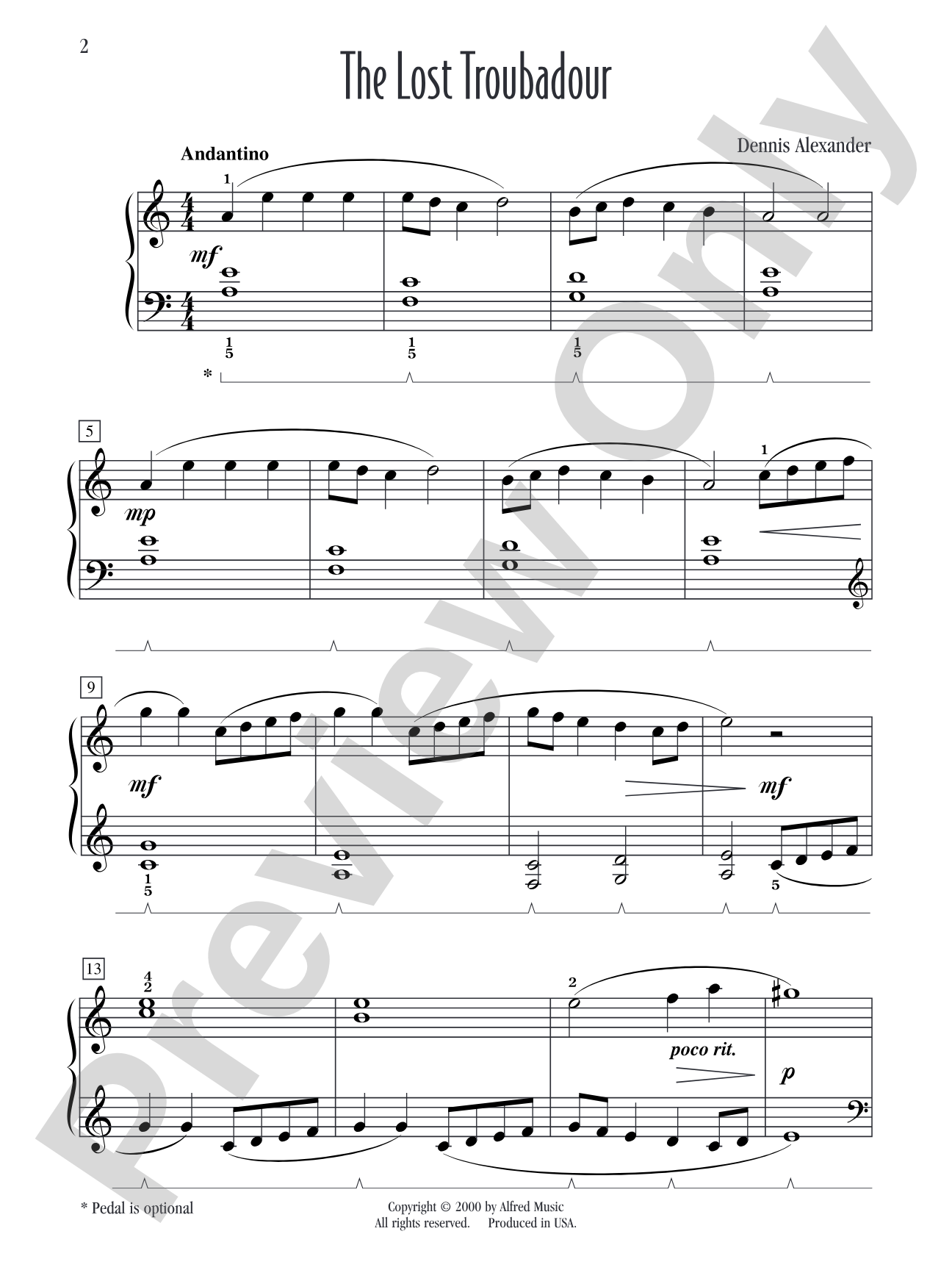
The Lost Troubador - Piano Solo Sheet Music Preview

The Lost Troubador - Piano Solo: Piano

By Dennis Alexander

Level: Late Elementary

Item: 00-PB-0000754

Digital Download
$2.99
Description
There is a medieval mood and charm in this late elementary level ballad, with modal melodic material in long sweeping phrases against simple harmonic fifth accompaniment, and both hands taking turns singing the melody. A Federation Festivals 2024-2028 selection.

The Lost Troubador - Piano Solo: Piano isn't in MakeMusic Cloud just yet...but it could be. Let us know you'd like to see it, and you'll help shape what comes next. In the meantime, start a free trial and dive into thousands of interactive titles your students can play along with today.

Sample Audio
No sample audio found.
Sample Video
Additional Details
Series: Signature Series
Publisher: Alfred Music
Page Count: 4
SKU: 00-PB-0000754

More about this title

About the Composer: Dennis Alexander

Dennis Alexander

Dennis Alexander has shaped educational piano pedagogy for over four decades. Starting at the University of Montana in 1972, where he led the piano department, he spent 24 years teaching applied piano, class piano, and piano pedagogy before relocating to California. There he continued teaching at Cal State Fullerton and Cal State Northridge while maintaining an active performance career as soloist, accompanist, and chamber musician.

Since 1986, Alexander has created more than 400 compositions and recordings published by Alfred Music, establishing himself as one of the most widely performed educational piano composers in the world. His work has been commissioned by numerous state and national music organizations. Beyond composing, he remains a sought-after clinician at music teachers conventions and has conducted master classes and adjudicated competitions internationally, including tours throughout Southeast Asia and appearances at major venues like Carnegie Recital Hall. He currently resides in Albuquerque, New Mexico, where he continues an active composing schedule.

Why we love this

Alexander captures genuine musical storytelling in a piece that doesn't oversimplify the late elementary level. The modal writing creates an authentic medieval atmosphere while the hand-switching melody technique builds independence and interpretive ownership. This is exactly the kind of music that reminds students why they practice piano in the first place.

What to expect

Medieval ballad music drifts through open harmonic space, unhurried and reflective. The modal melodic material suggests distant troubadours and long-ago tales, while the simple fifths keep the texture transparent and atmospheric. There is real beauty in the simplicity; the piece breathes with the restraint of a centuries-old tradition.

Who it's for

Late elementary pianists ready to move beyond simple accompaniment patterns and engage with more sophisticated melody. This piece appeals to students who respond to storytelling and historical mood, offering a chance to explore rubato and interpretive phrasing without dramatic technical demands.

How to get the most out of it

  • Shape the long melodic phrases with your full arm weight, letting gravity support the legato line as it passes between hands. Avoid the tendency to rush; the sweeping nature of these phrases benefits from unhurried phrasing and clear breath-like releases.
  • Keep the open fifth accompaniment resonant and supportive but never heavy. Think of it as a drone or bagpipe foundation that sits gently beneath the melody rather than dominating it.
  • Experiment with tone color as the melody moves between hands. Each hand might bring slightly different character to the same material, reflecting the "both hands singing" concept the composer describes.

How to use it

Program this as a contrasting recital or studio class piece alongside Baroque repertoire, where the modal writing and lean texture feel at home. It also works beautifully on a studio recital that explores historical styles or mood painting, and its reflective character makes it an effective program opener that sets a contemplative tone for what follows.

Skills your students will build

  • Legato phrasing across hand independence
  • Modal melodic interpretation and musical storytelling
  • Balance between melodic and accompanimental voices
  • Sustaining long phrases with appropriate pacing and rubato

You May Also Like