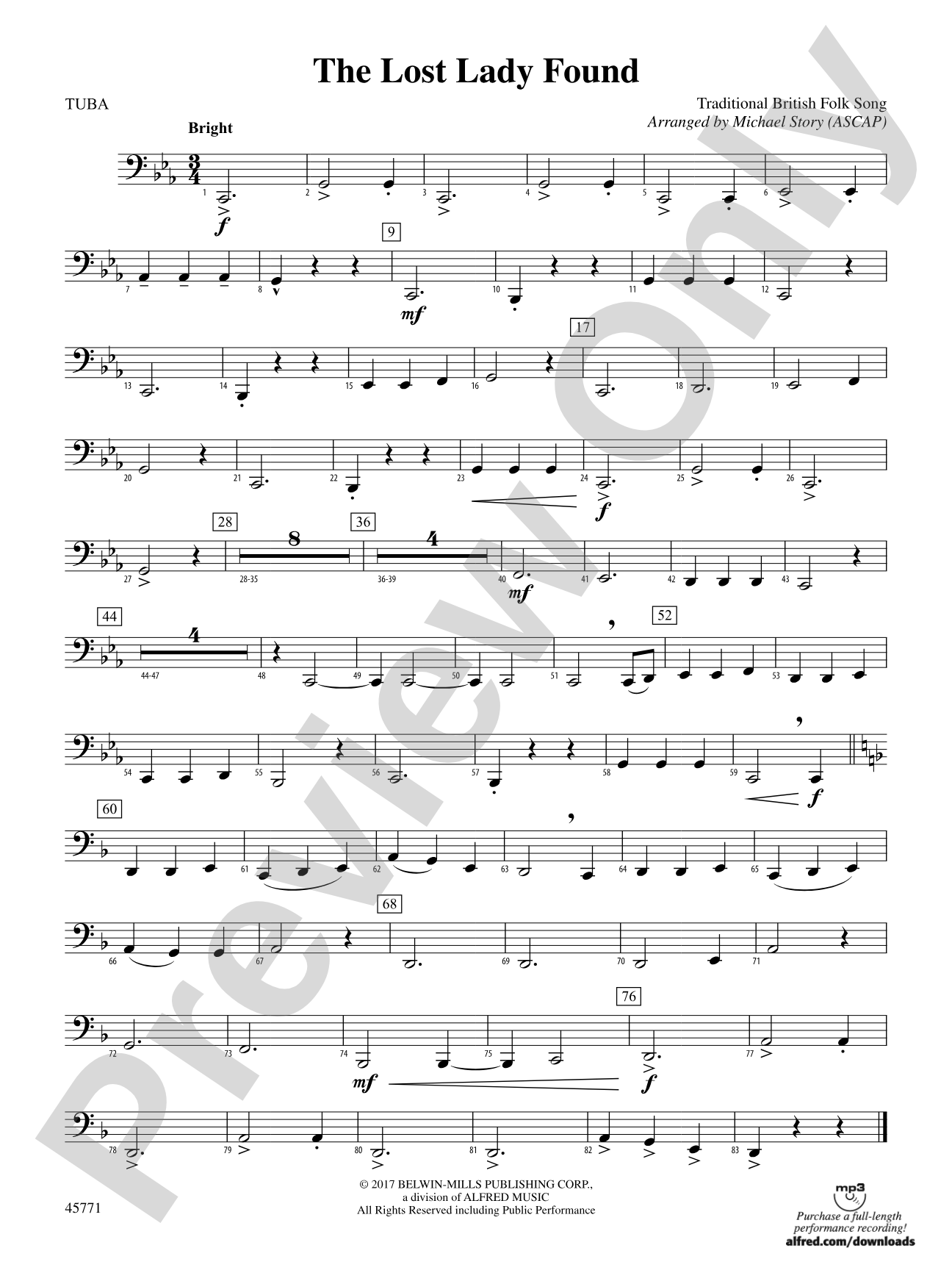
The Lost Lady Found: Tuba Sheet Music Preview

The Lost Lady Found: Tuba

Traditional British Folk Song / arr. Michael Story

Grade: 1 (Very Easy)

Item: 00-PC-0017582_TB1

Digital Download
$3.00
Description
A 19th-century British folk song found throughout England as well as Canada and the United States, the melody is most known as the basis of the last movement of Percy Grainger's masterwork, Lincolnshire Posy. In three-four time, there are a few accidentals carefully listed for the conductor that may need reviewing. Attention to the articulations, phrasing, and breath marks will make this work simply sparkle! (1:45)

Don't just read it, hear it, play along with it, and watch your students grow with it. In MakeMusic Cloud, The Lost Lady Found: Tuba comes alive with professional accompaniment, adjustable tempo, and built-in practice tools that turn solo practice into real progress.

Sample Audio
0:00
0:00
Sample Video
Additional Details
Series: Belwin Beginning Band
Publisher: Alfred Music
Page Count: 136
SKU: 00-PC-0017582_TB1

More about this title

About the Arranger: Michael Story

Michael Story has established himself as a prolific composer and arranger for beginning and intermediate bands, with a particular gift for making accessible works that never sacrifice musicality. His arrangements of folk material and original compositions have become staples in band programs across North America, known for their clarity of voice leading and attention to pedagogical detail.

Why we love this

Story captures the gentle dignity of this folk melody without overcomplicating it; the Grade 1 scoring lets every section shine through clearly while the careful attention to articulation and phrasing transforms what could be a simple tune into a concert-worthy statement. The connection to Grainger's Lincolnshire Posy gives students a meaningful bridge to more ambitious repertoire they might encounter later.

What to expect

Warm and reflective, like a melody passed down through generations and carried across oceans. The three-four meter gives it a gentle lilt, and the careful handling of accidentals suggests moments of quiet surprise within a familiar landscape.

Who it's for

Beginning band programs seeking a folk-based concert piece that builds musicianship without technical barriers. Grade 1 players will find straightforward rhythms and ranges while still engaging with real phrasing and interpretive choices.

How to get the most out of it

  • Prepare students to recognize and execute the accidentals marked throughout; take time in sectionals to identify where chromatic notes occur so they stand out intentionally rather than appearing as mistakes.
  • Shape the phrasing by honoring the breath marks; these aren't just resting places but articulation points that control the flow and prevent the melody from becoming square or mechanical.
  • Balance articulation across the ensemble; the contrasts between tongued and slurred passages are what give the melody its character, so listen for consistency within each articulation choice rather than uniform execution.

How to use it

This works beautifully as an opener or a closing concert piece for early-season performances; its brevity (1:45) and accessibility make it ideal for band festivals where you want to establish musicality and control before moving into longer works. Pair it with other British folk-based arrangements or original Grade 1 compositions for a thematic concert.

Skills your students will build

  • Reading and executing chromatic accidentals in context
  • Differentiating between tongued and slurred articulation
  • Interpreting breath marks as musical punctuation
  • Maintaining consistent intonation in three-four meter
  • Balancing sectional melody and harmony at grade 1 level

You May Also Like