
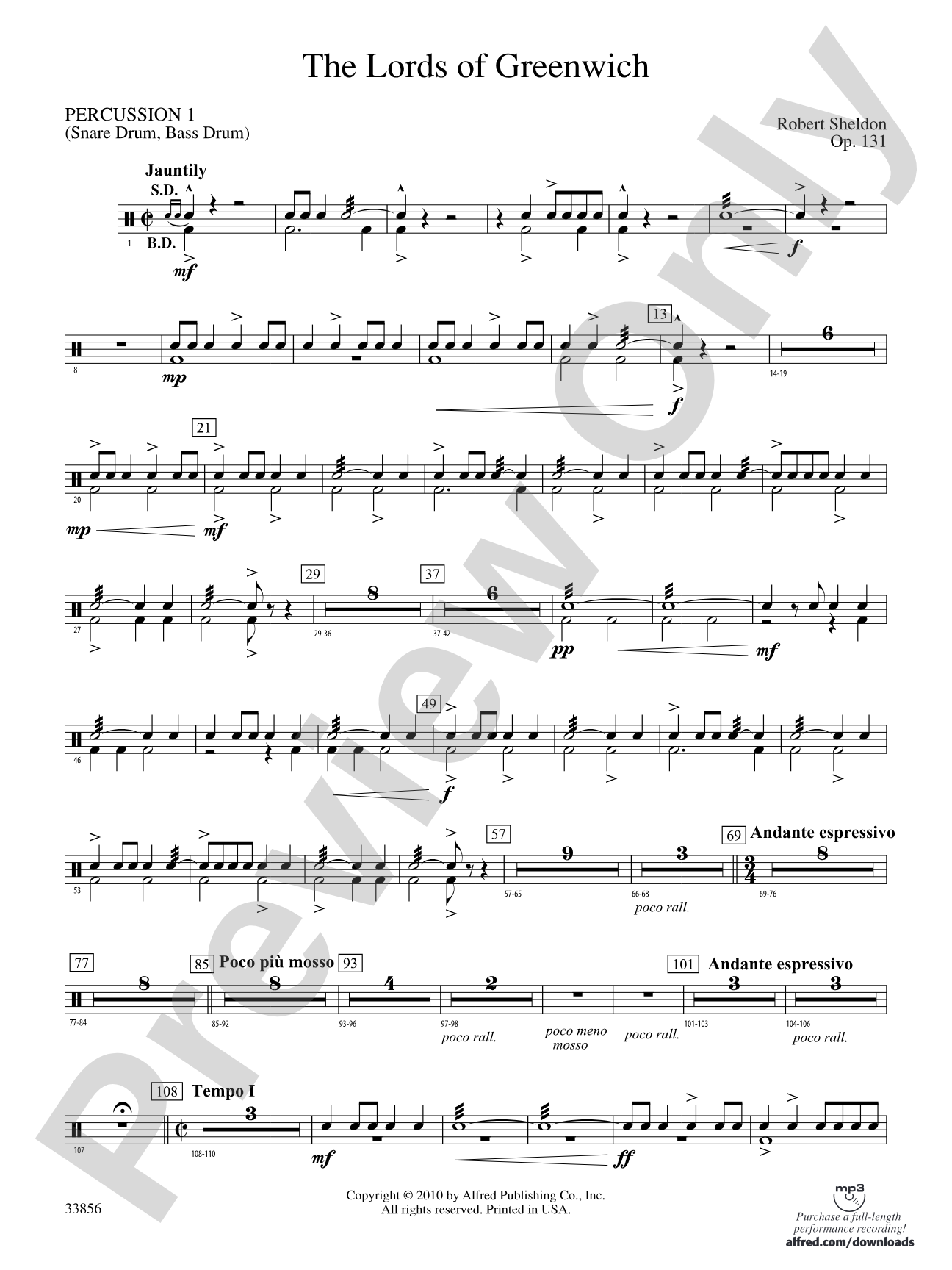

The Lords of Greenwich: 1st Percussion
By Robert Sheldon
Grade: 3.5 (Medium)
Item: 00-PC-0014587_PC1
$3.00
Pickup currently not available
Description
Written in the style of an authentic British folk tune, this is an original composition inspired by the music of Gustav Holst and Ralph Vaughan Williams. A jaunty theme greets the listener at the outset of the piece, followed by a lyrical and expressive ballade. A brief transition culminates in a musical statement that recalls the music of a British military brass band, which is then accompanied by the original thematic material bringing the piece to a definitive conclusion.
This title is available in MakeMusic Cloud.


This title is available in MakeMusic Cloud.
Don't just read it, hear it, play along with it, and watch your students grow with it. In MakeMusic Cloud, The Lords of Greenwich: 1st Percussion comes alive with professional accompaniment, adjustable tempo, and built-in practice tools that turn solo practice into real progress.
Open in the Player
Jump straight in and assign it today.
Start Your Free Trial
Open this title and explore the full library in minutes.
Sample Audio
1
Audio File
--:--
0:00
0:00
Sample Video
No sample videos found.
Additional Details
Series:
Alfred Concert Band
Publisher:
Alfred Music
Page Count:
278
SKU:
00-PC-0014587_PC1
More about this title
About the Composer: Robert Sheldon

Robert Sheldon stands among the most frequently programmed composers in wind band repertoire. His works have earned recognition from the American School Band Directors Association, Phi Beta Mu, and ASCAP, and his compositions are performed internationally across concert stages and festival competitions. Beyond composing, Sheldon serves as lead author of Sound Innovations for Concert Band and maintains an active schedule as guest conductor for All-State and Regional Honor Bands.
Sheldon has conducted and presented clinics throughout North America, Europe, Asia, and Australia, bringing his expertise to university music education programs and state association conferences. His works have been performed at venues including Carnegie Hall, Boston Symphony Hall, Sydney Opera House, and the Kennedy Center. In 2020, VanderCook College of Music awarded him an honorary doctorate in recognition of his sustained contributions to wind music education and composition.
Why we love this
Sheldon crafts a piece that feels genuinely British without resorting to pastiche, drawing inspiration from Holst and Vaughan Williams while maintaining his own compositional voice. The structure unfolds with real purpose: the opening theme lands immediately, the ballade gives your ensemble room to sing through the middle voices, and the military brass band homage provides that unmistakable moment of period style before circling back to resolution. At Grade 3.5, it sits in a sweet spot where the writing is accessible yet sophisticated enough to reward careful musical attention.
What to expect
This piece inhabits the world of British wind band tradition with charm and warmth. The opening theme bounces with character, the middle section blooms into genuine expression, and when the military brass band idiom appears, there is a moment of pageantry that feels earned. The journey back to the original theme provides satisfaction without sentimentality.
Who it's for
Concert bands at the Grade 3.5 level looking for original material with personality and substance. Directors who want a piece that programs well for both concert and festival settings while offering genuine musical growth rather than technical showmanship.
How to get the most out of it
- Shape the opening jaunty theme with clear articulation and rhythmic precision; this is the musical hook, so commit fully to its character.
- Let the ballade breathe. This section asks for genuine lyricism from your woodwinds and low brass, so allow space between phrases rather than pushing tempo forward.
- The military brass band section needs weight and presence. Balance is key here; let the brass statement sing without drowning out harmonic support from the woodwinds.
- In the final return of the thematic material, build steadily toward the conclusion. This is the payoff moment where all three sections of the piece come into focus.
How to use it
Position this as a concert opener or mid-program transition that won't weigh down your set. Its blend of accessibility and compositional craft makes it equally suited to festival competition or concert performance, and its moderate length allows room for larger or more demanding works elsewhere on the program.
Skills your students will build
- Maintaining rhythmic clarity in a jaunty, syncopated theme
- Sustaining legit melodic lines with proper phrase shaping in the ballade section
- Balancing multiple harmonic layers across the full ensemble
- Responding to stylistic shifts within a single movement
- Reading a full score layout with independent part writing across all sections