

The Lone Nightingale - Piano Duo (2 Pianos, 4 Hands): Piano Duets & Four Hands
By Beatrice A. Miller
Level: Early Advanced
Item: 00-PB-0000829
$4.95
Pickup currently not available
Related Items
The Lone Nightingale: Piano Duo (2 Pianos, 4 Hands) Sheet (2 copies included) |
$4.95
|
View |
Description
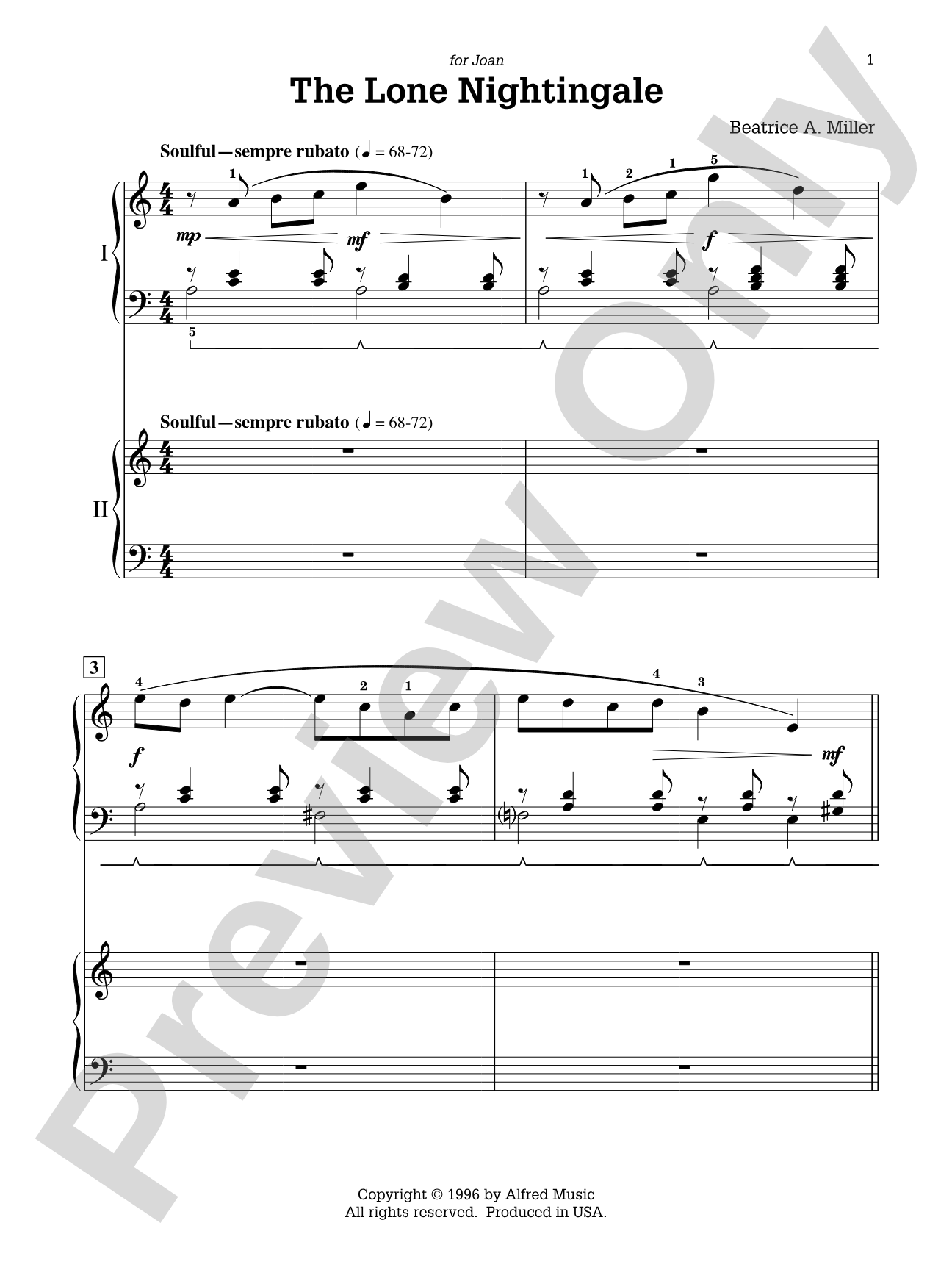
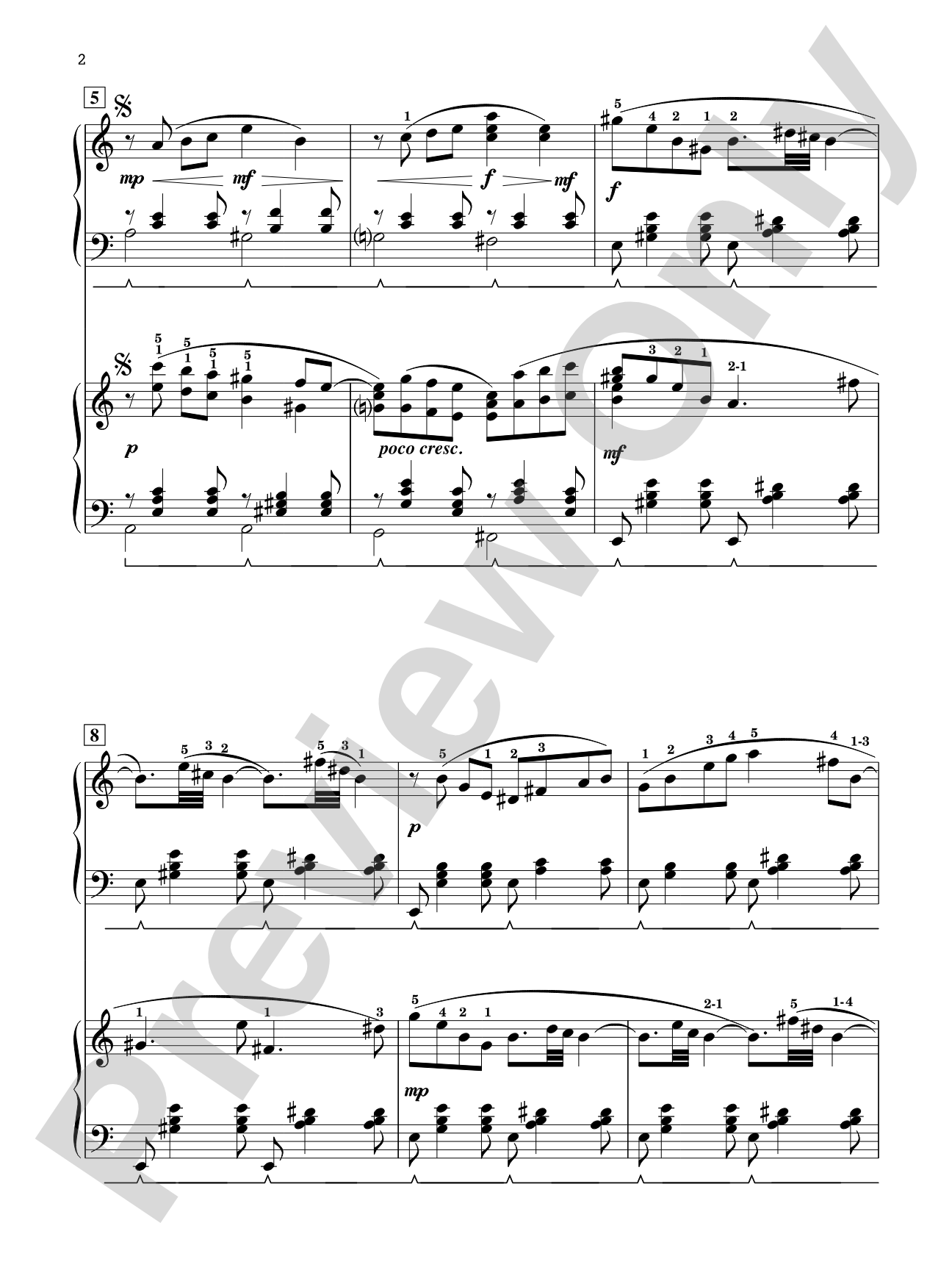
This is a soulful piece in the key of A minor for early advanced piano ensemble, two pianos, four hands. It builds broadly to an expressive middle section with the two parts exchanging melodic material in two- bar phrases. The seven-page piece ends quietly in the key of C. Two copies are included. A Federation Festivals 2024-2028 selection.


The Lone Nightingale - Piano Duo (2 Pianos, 4 Hands): Piano Duets & Four Hands isn't in MakeMusic Cloud just yet...but it could be. Let us know you'd like to see it, and you'll help shape what comes next. In the meantime, start a free trial and dive into thousands of interactive titles your students can play along with today.
Request This Title
Tell us you want it.
Start Your Free Trial
Explore everything that's ready to play right now.
Sample Audio
No sample audio found.
Sample Video
No sample videos found.
Additional Details
Publisher:
Alfred Music
Page Count:
16
SKU:
00-PB-0000829
More about this title
About the Composer: Beatrice A. Miller

Beatrice A. Miller grew up in Detroit surrounded by hymn singing led by her father, a Lutheran pastor and accomplished musician. Her family became fascinated with her precocious musical ear when, as a nine-month-old, she spontaneously matched the cadence of the hymns her family had just sung. That early musical household instilled in her a lifelong devotion to sacred music and to composing with lyrical integrity.
Miller earned her Master's degree in music composition from Northwestern University and spent decades in Corvallis, Oregon, working as a piano teacher, church organist, and choir director before dedicating herself fully to composition in 1979. She began publishing her music in 1987 and received recognition as Composer of the Year from the Oregon Music Teacher's Association in 1997.
Why we love this
The Lone Nightingale rewards the early advanced piano duo with genuine musical substance. Miller's compositional voice favors expressive lyricism over technical flash, and the exchange of melodic material between the two parts creates natural dialogue without requiring virtuosic coordination. The journey from A minor to the quiet C major ending feels earned rather than arbitrary, making this a memorable festival selection that audiences genuinely respond to.
What to expect
The Lone Nightingale unfolds like a small dramatic journey, beginning with introspection in A minor before opening into broader emotional expression. The exchange of melody between the two pianists creates moments of luminous intimacy, while the piece's architecture suggests a character study rather than mere technical display. By the time you reach the quiet C major conclusion, you feel you have witnessed something quietly profound.
Who it's for
Early advanced piano duets call for partners who have solid technique but benefit from repertoire that emphasizes musicianship over gymnastics. This piece suits studio teachers preparing students for festival play, chamber music programs in secondary schools, and recital partnerships seeking rewarding two-piano literature with genuine substance.
How to get the most out of it
- Establish the emotional tone in the opening measures by listening carefully to your partner's sound quality. The soulfulness of this piece depends on matching tone color and dynamics rather than mechanical rhythmic precision.
- When melodic phrases exchange between primo and secondo in two-bar units, think of this as conversation rather than accompaniment. Each part carries equal narrative weight during these passages.
- Shape the broad build toward the middle section as a single arc rather than a series of crescendos. Work together to identify the peak moment and support each other in the approach leading to it.
- The transition to C major and the quiet ending require discipline in voicing. Ensure the lower register voices remain clear and supported throughout the final section so the change of key registers musically rather than disappearing.
How to use it
Program this at a student recital to showcase collaborative musicianship in a duo format, or include it on a chamber music concert alongside other intimate two-piano works. Its selection for Federation Festivals 2024-2028 makes it an excellent choice for preparing students in that competitive season while also standing on its own as festival-quality repertoire.
Skills your students will build
- Listening and responding to a partner's dynamic shaping in real time
- Managing two-part dialogue where both parts carry equal melodic importance
- Coordinating broad structural arcs across a seven-page work
- Navigating key changes (A minor to C major) with musical intention
- Balancing ensemble blend while maintaining individual voice clarity in the lower register