
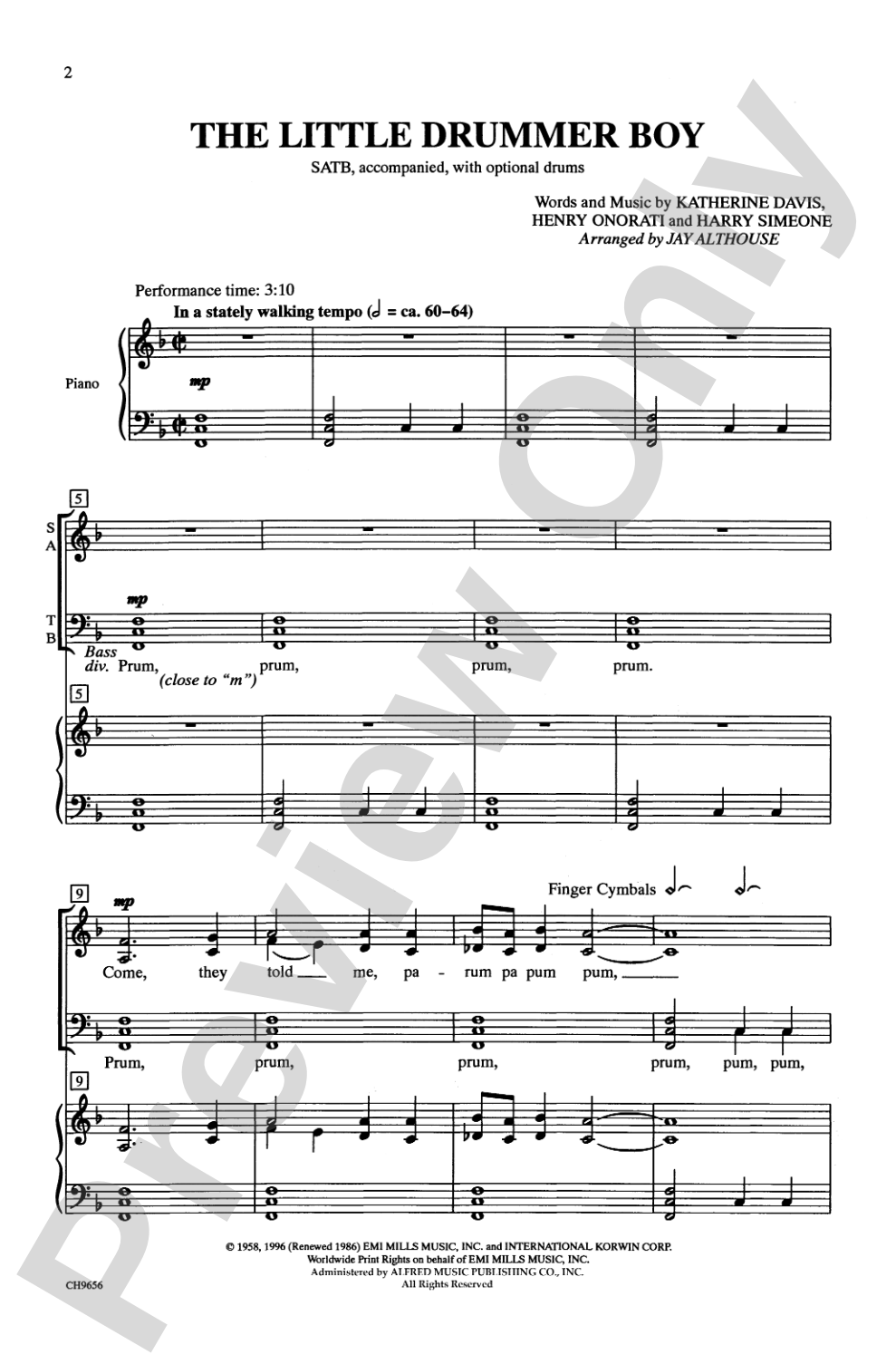
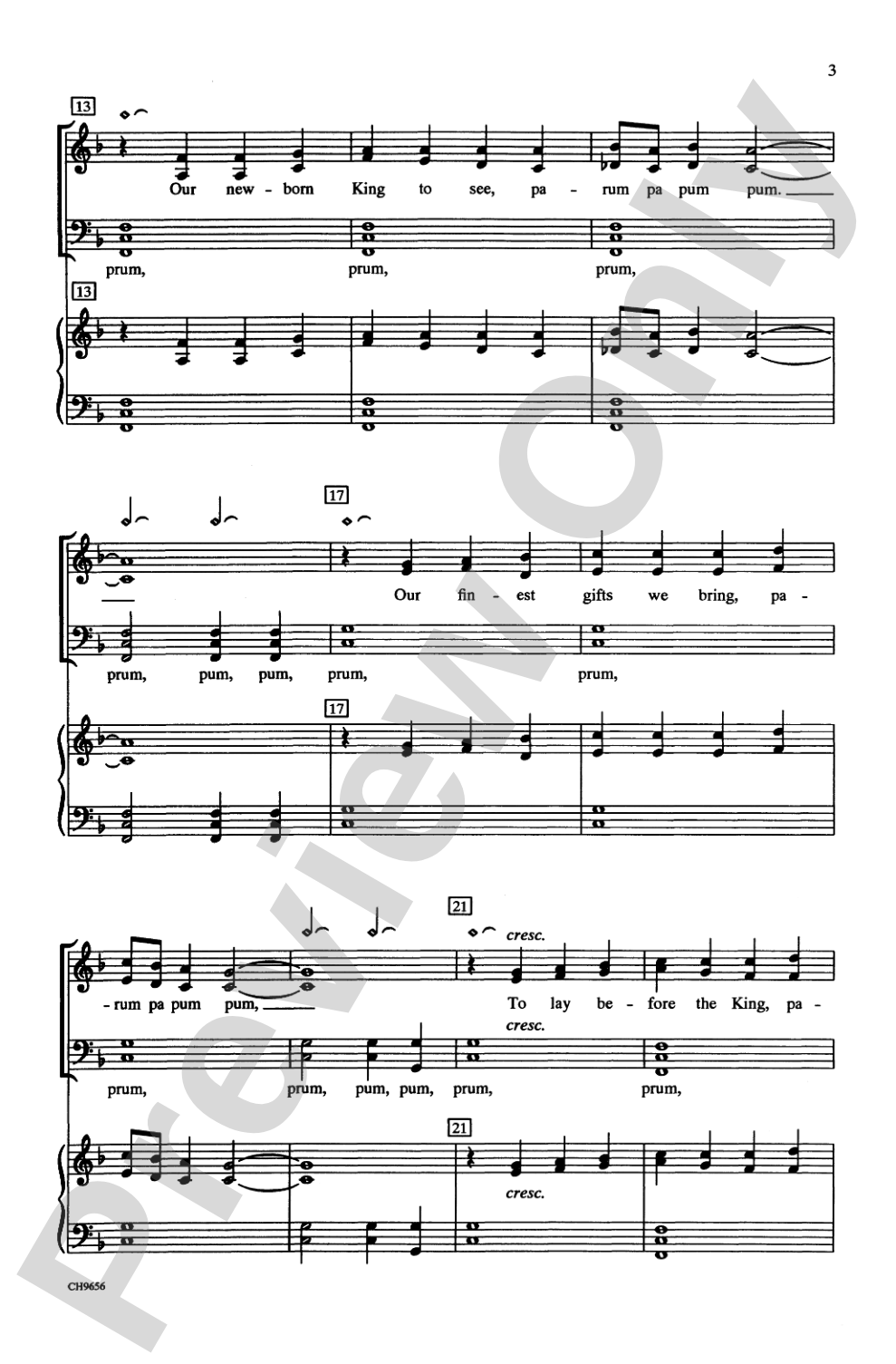

The Little Drummer Boy: SATB Choral Octavo
Arr. Jay Althouse
Level: Moderate
Item: 00-PO-0004709
$2.25
Minimum order quantity: 20 copies
Pickup currently not available
Related Items
The Little Drummer Boy: 3-Part Mixed Choral Octavo |
$2.25
|
View | |
The Little Drummer Boy: 2-Part Choral Octavo |
$2.25
|
View | |
The Little Drummer Boy: SATB Choral Octavo |
$2.25
|
View | |
The Little Drummer Boy: 3-Part Mixed Choral Octavo |
$2.25
|
View | |
The Little Drummer Boy: 2-Part Choral Octavo |
$2.25
|
View |
Description
The classic K.K. Davis song combined with the arranging talents of Jay Althouse has created a fresh new edition of this long-time favorite. Simple, yet elegant could describe the approach that Jay has taken with this new arrangement, and it will surely be the new standard in settings of this great holiday song. A must for every choir!


The Little Drummer Boy: SATB Choral Octavo isn't in MakeMusic Cloud just yet...but it could be. Let us know you'd like to see it, and you'll help shape what comes next. In the meantime, start a free trial and dive into thousands of interactive titles your students can play along with today.
Request This Title
Tell us you want it.
Start Your Free Trial
Explore everything that's ready to play right now.
Sample Audio
No sample audio found.
Sample Video
No sample videos found.
Additional Details
Series:
Alfred Archive Edition: Alfred Pop Choral Series
Publisher:
Alfred Music
Page Count:
12
SKU:
00-PO-0004709
More about this title
About the Arranger: Jay Althouse

Jay Althouse holds degrees in Music Education and Music from Indiana University of Pennsylvania, where he was honored as a Distinguished Alumnus. His career spans both the publishing side of music education and active composition; he spent eight years in rights and licensing administration for a major educational music publisher and served on the Executive Board of the Music Publishers Association of America. With over 800 choral works in print across all levels, his compositions are performed widely throughout English-speaking countries.
Althouse is a prolific writer across multiple formats. He holds ASCAP membership and is a regular recipient of the ASCAP Special Award for standard music compositions. His collaborative works with his wife Sally K. Albrecht include several children's musicals, and together they wrote the choral work I Hear America Singing, performed at President Obama's inauguration by the San Francisco Girls and Boys Choirs. His instructional publications include The Complete Choral Warm-up Book and Accent on Composers, along with classroom resources like Ready to Read Music and One-Page Composer Bios. He currently serves on the National Advisory Board of the Folk Art Society of America.
Why we love this
Althouse brings both warmth and sophistication to this holiday standard without overcomplicating it. The arrangement balances accessibility with musical substance, making it genuinely satisfying to teach and perform regardless of your choir's experience level. It's earned its reputation as the go-to modern setting of this beloved song.
What to expect
There's a quiet dignity in this setting that honors the song's tender story while letting the arrangement step back rather than imposing unnecessary flourishes. The writing feels conversational and human, with enough harmonic color to stay interesting without becoming overly complex.
Who it's for
This arrangement works for choirs at the intermediate level who want a respectful, musically substantive treatment of the song without excessive technical demands. It suits community choirs, church choirs, and school ensembles looking for a holiday staple that feels both fresh and true to the original's spirit.
How to get the most out of it
- Balance the melody carefully between soprano and alto in measures where the parts move independently; the tune should sing through without drowning out the harmonic support.
- Shape the dynamic arc around the emotional peaks rather than building steadily throughout; let phrase endings breathe and fall naturally.
- Keep the rhythm section grounded and steady, especially if using the recorded accompaniment; this clarity supports the singers' ensemble.
- Pay attention to vowel consistency across all four parts during the homophonic sections to ensure blend while maintaining clear diction.
How to use it
This pairs naturally into any holiday concert, standing equally well as a moment of reflection in a mixed program or as part of a longer Christmas sequence. Its moderate difficulty makes it a solid middle anchor in a concert that ranges from lighter pieces to more challenging repertoire.
Skills your students will build
- Balancing SATB texture with independent part movement
- Shaping musical phrases through dynamic control rather than constant crescendo
- Maintaining rhythmic precision against accompaniment
- Singing sustained notes with consistent vowel color across multiple voices