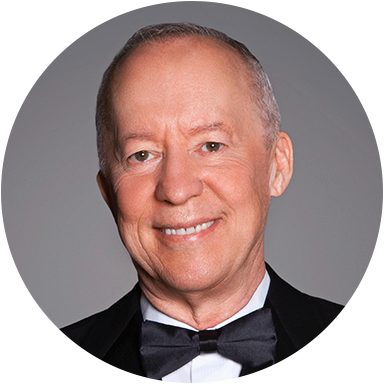
Mark Hayes brings the credentials of a world-class pianist and conductor to his work as a prolific composer and arranger. Since earning his summa cum laude degree in Piano Performance from Baylor University in 1975, he has amassed a catalog of over 1,750 published compositions across every genre. His sacred works have premiered at Lincoln Center, Carnegie Hall, and the National Cathedral, and he conducted his Requiem at St. Ignatius Basilica in Rome as part of a Vatican-sponsored festival in 2014. Baylor University recognized his sustained leadership in Christian music with a special award in 2010.
Beyond the concert hall, Hayes has shaped musical theater scores, orchestrated hit musicals, and produced recordings. His particular gift lies in writing for the piano, with more than 100 books in print spanning gospel, classical, jazz, and Broadway idioms. Whether commissioned for international celebrations or composing at his Kansas City home, Hayes consistently creates music that serves both the performer and the listener with clarity, warmth, and craft.
Why we love this
Hayes understands how to write for voices in a way that feels both singable and spiritually substantial. This octavo sits in that sweet spot where the harmonic language is sophisticated enough to reward a mature choir, yet the vocal lines remain accessible and expressive rather than technically showy.
What to expect
The piece unfolds with an unhurried sense of devotion. Warm harmonic progressions and a lyrical soprano melody create intimacy without sentimentality, while the full four-part texture deepens the emotional resonance in moments of fuller sonority.
Who it's for
This arrangement serves choirs with solid fundamentals and singers who can sustain tone and blend across four parts with confidence. It works equally well for church choirs preparing for a major service and concert choirs looking to include a reverent sacred work on a mixed program.
How to get the most out of it
Balance the soprano line carefully in the upper register; it carries much of the lyrical content but should never overshadow the inner voices where Hayes often places crucial harmonic movement.
Attend to the text setting throughout. Hayes' word painting is subtle and earned; letting the natural phrasing of the text guide your conducting will reveal the shape of each phrase.
Rehearse the alto and tenor parts with particular care early on. These voices often function as the harmonic foundation, and locking them in place gives the sopranos and basses freedom to sing with expression.
How to use it
Place this as a centerpiece on a sacred or seasonal concert, or use it to anchor the emotional arc of a program that includes both lighter contemporary works and heavier choral fare. It also functions beautifully as a closing piece for a worship service or concert.
Skills your students will build
Sustaining legato tone across phrase lengths in a sacred style
Blending four independent parts while maintaining clarity of individual lines
Responding to subtle text-painting and emotional gesture in harmonic writing
Singing with stylistic unity in sacred choral music
You May Also Like
Scan to Complete Your Purchase
Use your phone's camera to scan the code below
You'll log in on your phone and the order will be added to your account