
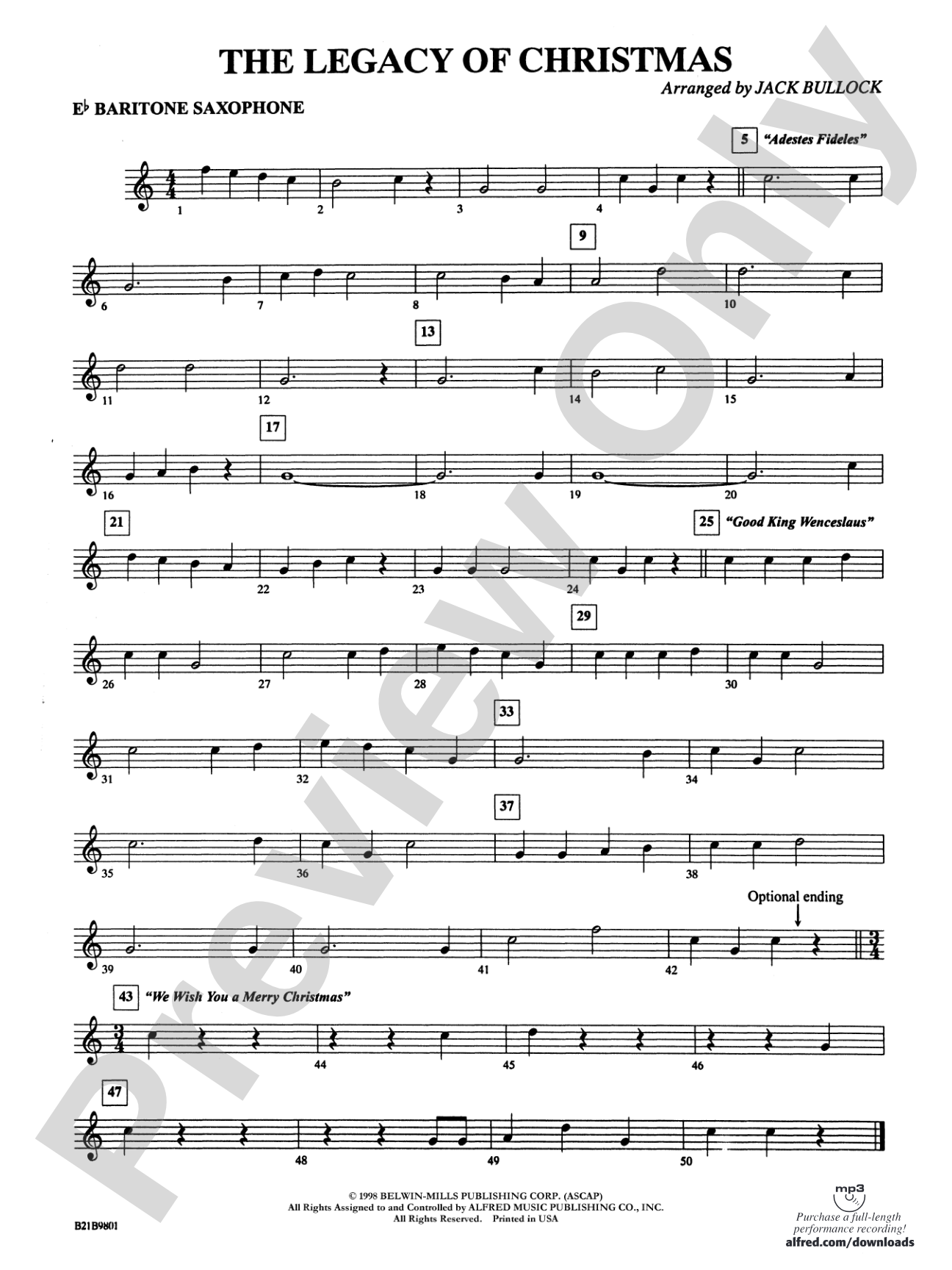

The Legacy of Christmas: E-flat Baritone Saxophone
Arr. Jack Bullock
Grade: 1 (Very Easy)
Item: 00-PC-0015176_BTX
$3.00
Pickup currently not available
Description
Although written as supplemental material to the Belwin 21st Century Band Method (for use after lesson 8 of Level One), this piece for the holidays can be utilized with any beginning method. The grade level is 1/2-1, the pitch ranges are within an octave from concert low B-flat to A-flat, and the rhythm patterns are limited to whole, dotted half, half, and quarter notes and rests. Three well-known Christmas songs are included in this mini-medley: Adeste Fidelis, Good King Wenceslas, and We Wish You A Merry Christmas. There is an optional ending after the first two selections, and all three pieces can be played independently as short individual pieces if the director desires. (2:06)


Don't just read it, hear it, play along with it, and watch your students grow with it. In MakeMusic Cloud, The Legacy of Christmas: E-flat Baritone Saxophone comes alive with professional accompaniment, adjustable tempo, and built-in practice tools that turn solo practice into real progress.
Open in the Player
Jump straight in and assign it today.
Start Your Free Trial
Open this title and explore the full library in minutes.
Sample Audio
1
Audio File
--:--
0:00
0:00
Sample Video
No sample videos found.
Additional Details
Series:
Belwin Very Beginning Band
Publisher:
Alfred Music
Page Count:
128
SKU:
00-PC-0015176_BTX
More about this title
About the Arranger: Jack Bullock

Jack Bullock brings decades of practical experience from both the performer's chair and the conductor's podium. A trumpet player trained under respected artists including Harry Glantz and James Ode, he performed with the Miami Philharmonic Orchestra, Miami Opera Company, and touring ensembles across the country. He earned undergraduate, graduate, and doctoral degrees in Music Education and served 20 years teaching instrumental music in classroom settings.
Bullock's compositional output spans more than 600 works across concert band, orchestra, jazz ensemble, and marching band. He co-authored the Belwin 21st Century Band Method and contributed arrangements to Music Expressions, Alfred Music's comprehensive school music curriculum. His academic leadership includes seven years as assistant band director at Ithaca College's School of Music and a four-year tenure as chair of the Music Education Department. His contributions to music education have earned recognition in Marquis Who's Who publications, and he has conducted clinics throughout North America and internationally since 1980.
Why we love this
This medley arrives exactly when you need it: after lesson 8 in Level One, when students have just enough technical foundation to handle something genuinely musical. The flexibility to perform all three carols together or separately, plus an optional ending after two pieces, means you can shape the performance around your ensemble's readiness and your concert schedule. The instrumental writing is transparent and idiomatic for young band, letting everyone participate meaningfully without frustration.
What to expect
Three beloved carols rendered with clarity and warmth, shaped in a way that respects young musicians' technical limitations while preserving the songs' character. The writing feels open and transparent; each voice part has room to breathe and contribute. There's genuine satisfaction in hearing your beginning band play recognizable repertoire that audiences celebrate instantly.
Who it's for
Grades 1 and 2 concert bands who are ready for their first real performance repertoire. This works perfectly for ensembles completing the Belwin 21st Century Band Method at Level One, though any beginning band method provides sufficient preparation. Directors looking for accessible, recognizable, and genuinely rewarding holiday programming will find a reliable solution here.
How to get the most out of it
- Balance the melody between sections by rehearsing each carol with different lead voices; rotate which instruments carry the tune so younger players understand the architecture of each song.
- Keep the tempo steady but unhurried through whole notes and dotted halves; young ensembles tend to rush at these longer values, so tap a confident pulse and hold your gesture.
- If you use the optional ending, rehearse the transition carefully so it feels intentional, not like the performance stopped mid-piece.
- Emphasize the text memory of each carol; when students hear the implied lyrics, they'll shape phrases musically rather than metronomically.
How to use it
Open a winter concert with this medley to build confidence and audience goodwill, or close the program as a send-off that engages families in the caroling tradition. You can also feature it in a holiday assembly or pep rally where recognition matters as much as technical polish. The short runtime (2:06) fits neatly into mixed concerts or school celebrations without consuming a large rehearsal investment.
Skills your students will build
- Reading rhythms limited to whole, dotted half, half, and quarter notes and their rests
- Sustaining tone on longer note values without rushing or fading
- Balancing melodic lines across multiple instruments
- Maintaining ensemble precision within a narrow pitch range (concert B-flat to A-flat)
- Performing recognizable melodies with intentional phrasing rather than mechanical note-reading