
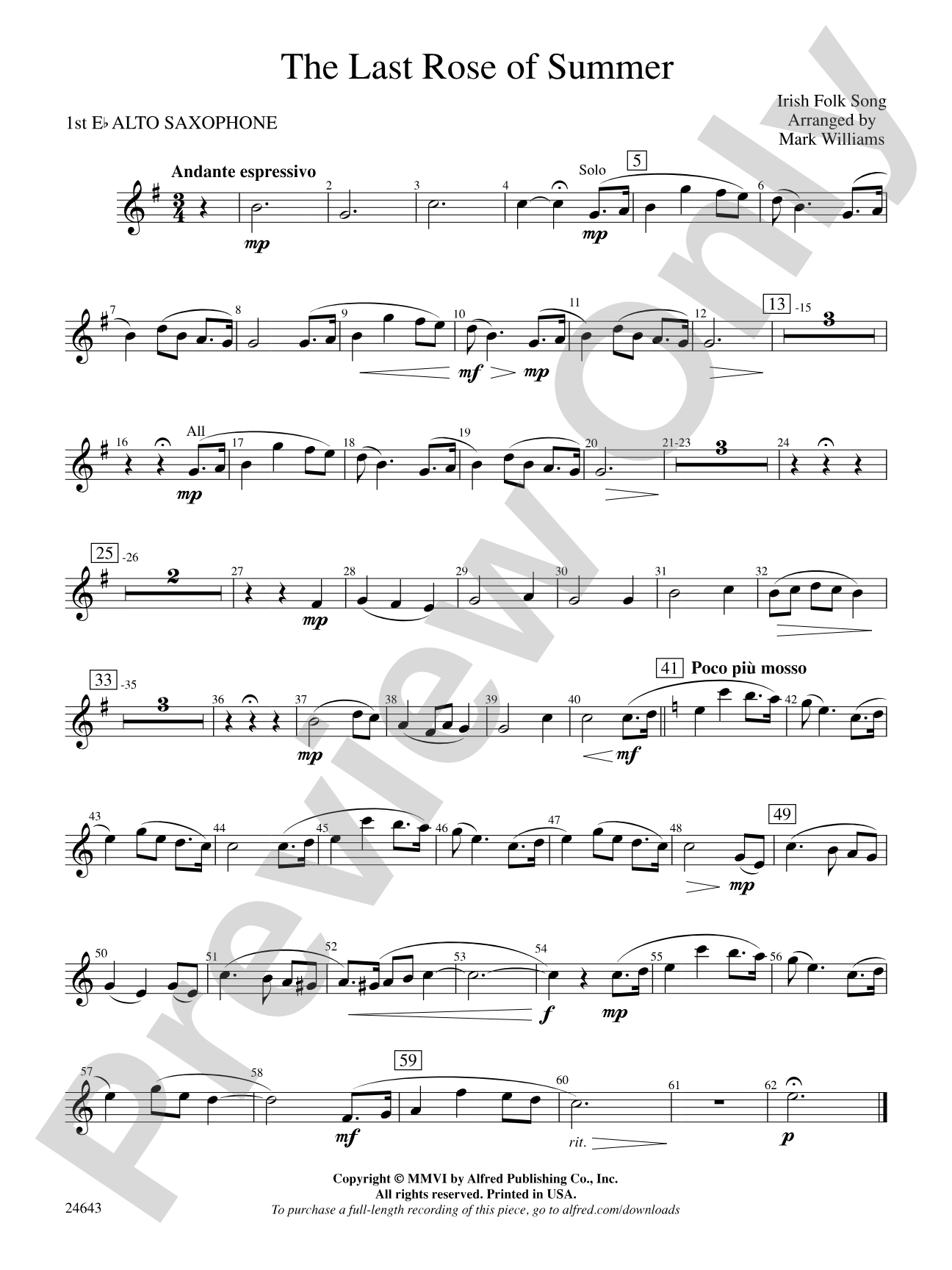

The Last Rose of Summer: E-flat Alto Saxophone
Alto Saxophone, Flute, and Trumpet Solos
Arr. Mark Williams
Grade: 2 (Medium Easy)
Item: 00-PC-0000811_AX1
$3.00
Pickup currently not available
Description
This beautiful arrangement of a favorite Irish folk song utilizes colorful scoring and features solos for alto saxophone, flute and trumpet. This gorgeous melody is also known (with a different set of words) as "The Groves of Blarney", and was featured in a popular 19th-century opera, "Martha", by German composer Friedrick von Flotow. Great for developing tone quality, blend, balance and independence, this work will be a treasured addition to your young band library for years to come. This title is available in MakeMusic Cloud.


Don't just read it, hear it, play along with it, and watch your students grow with it. In MakeMusic Cloud, The Last Rose of Summer: E-flat Alto Saxophone comes alive with professional accompaniment, adjustable tempo, and built-in practice tools that turn solo practice into real progress.
Open in the Player
Jump straight in and assign it today.
Start Your Free Trial
Open this title and explore the full library in minutes.
Sample Audio
1
Audio File
--:--
0:00
0:00
Sample Video
No sample videos found.
Additional Details
Series:
Challenger Band Series
Publisher:
Alfred Music
Page Count:
124
SKU:
00-PC-0000811_AX1
More about this title
About the Arranger: Mark Williams

Mark Williams built his reputation as a composer and arranger by writing music that works in real school band rooms. His catalog of over 200 published works, combined with his direct classroom experience teaching elementary band in Washington state, gave him insight into what students need to play and what conductors need to teach. Williams served as a woodwind performer and arranger for the 560th Air Force Band and held degrees from Eastern Washington University in education and music.
Beyond his prolific output, Williams was a dedicated clinician and guest conductor who worked across 34 states, five Canadian provinces, and Australia, sharing his expertise with student musicians everywhere. His contributions earned recognition from the Western International Band Clinic's Gralia Competition and multiple ASCAP Special Awards. He also brought his musicianship to the Spokane British Brass Band, where he served as conductor and artistic director alongside his work as a bassoon performer.
Why we love this
Williams's arrangement captures the lyrical beauty of this Irish melody while building genuine musical independence among your ensemble sections. The strategic use of solos for alto saxophone, flute, and trumpet gives young players meaningful featured moments without overwhelming them, and the scoring demands careful listening from the full band. This is the kind of piece that teaches tone and balance naturally through musicality rather than through drill.
What to expect
This arrangement honors the timeless grace of a melody that has endured through centuries and continents. The warm, singing quality invites players to focus on beautiful tone production and thoughtful phrasing, creating a performance space where young musicians genuinely connect with the music they're making.
Who it's for
Concert bands at the Grade 2 level will find this arrangement accessible and immediately rewarding. The piece works equally well for groups building foundational musicianship and those looking to add a beloved standard to their repertoire with manageable technical demands.
How to get the most out of it
- Shape the melody with dynamic clarity; the opening statement sets the emotional tone for the entire performance, so ensure your featured soloists begin with a warm, centered sound that invites the ensemble to listen.
- Balance the inner voices with the main melodic line. Young bands often rush to support the solo, so use rehearsal time to strengthen the independence of the accompaniment figures so they sit beneath rather than compete with the featured voice.
- Use the rests between phrases to reset breath support and clarify the sectional boundaries. This prevents the piece from becoming one continuous exhale and allows each section to respond with purpose.
- Attend to blend across the transition points where the melody moves from instrument to instrument. Coordinate tone quality between the flute and trumpet passages especially, so the audience hears one continuous story rather than a handoff.
How to use it
Slot this into a concert as a moment of lyrical contrast, especially alongside more energetic works. The solo writing makes it ideal for showcasing individual players while keeping the full ensemble engaged, and the accessible difficulty level lets you program it confidently even in a diverse band.
Skills your students will build
- Tone quality and sustained singing tone across phrase lengths
- Sectional balance and independent accompaniment lines
- Melodic continuity across instrument transitions
- Solo performance within an ensemble context
- Listening and blend adjustment in mixed instrumental colors