The Last Night Of The World (from Miss Saigon) (arr. Francis Shaw) Sheet Music Preview

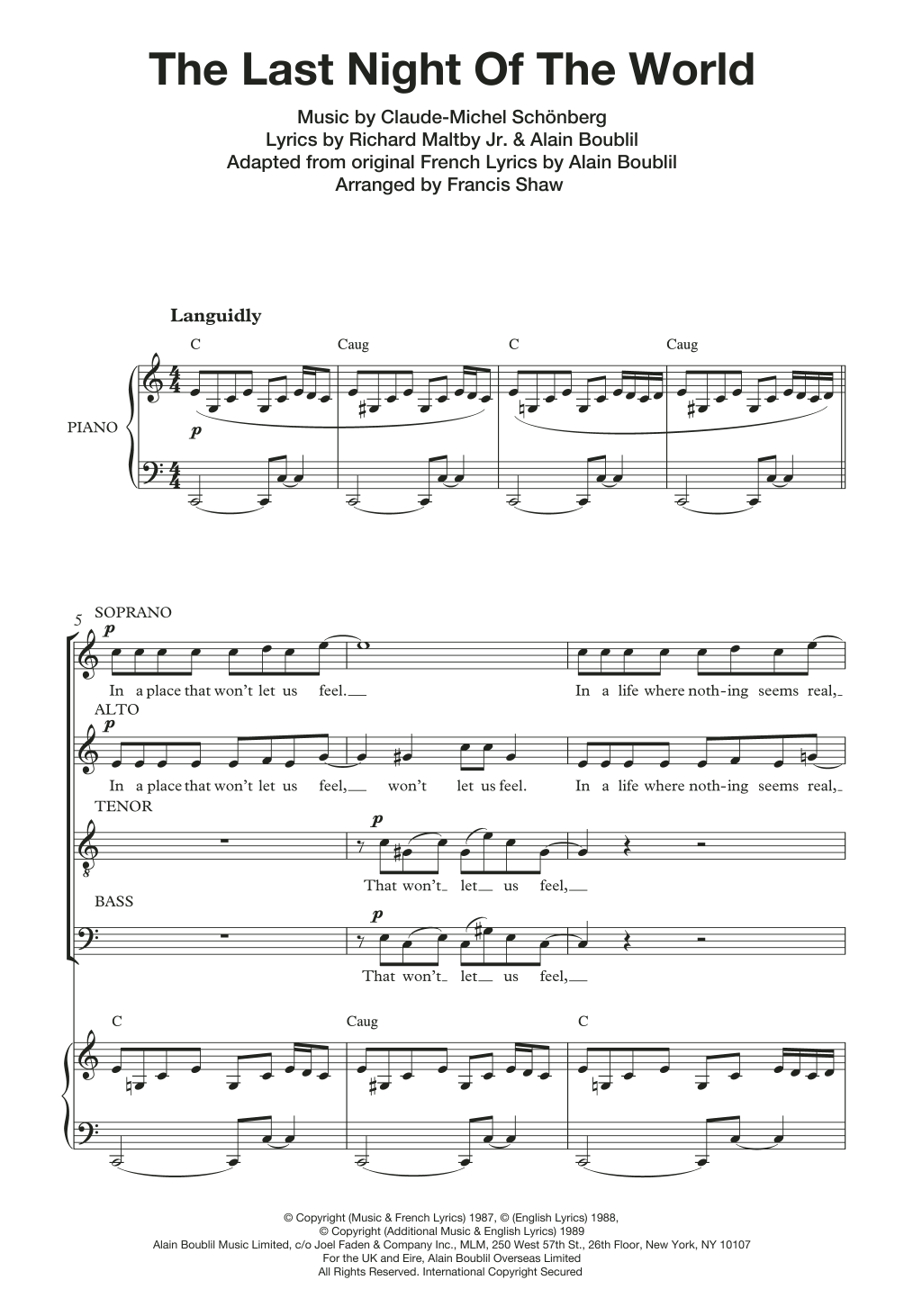
The Last Night Of The World (from Miss Saigon) (arr. Francis Shaw): SATB Choral Octavo

By Claude-Michel Schonberg / As performed by Boublil and Schonberg

Item: 35-DS00338206

Digital Download
$2.99
Description

The Last Night Of The World (from Miss Saigon) (arr. Francis Shaw): SATB Choral Octavo isn't in MakeMusic Cloud just yet...but it could be. Let us know you'd like to see it, and you'll help shape what comes next. In the meantime, start a free trial and dive into thousands of interactive titles your students can play along with today.

Sample Audio
No sample audio found.
Sample Video
Additional Details
Publisher: Hal Leonard
Page Count: 17
SKU: 35-DS00338206

More about this title

About the Composer: Claude-Michel Schonberg

Claude-Michel Schönberg is a French composer best known for his work with lyricist Alain Boublil on some of musical theatre's most ambitious scores. His gift for melody and harmonic sophistication brought emotional depth to large-scale theatrical narratives, making complex emotional moments accessible to audiences across genres and languages.

Schönberg's approach to composition emphasizes singability within richly orchestrated contexts. For educators, his work offers students the chance to engage with contemporary musical theatre writing that demands both vocal control and dramatic commitment, bridging classical choral traditions with modern theatrical storytelling.

Why we love this

This arrangement transforms a genuinely moving theatrical moment into something your choir can own completely. Francis Shaw's SATB voicing respects the melody's shape while creating real harmonic interest; the parts work logically without sacrificing emotional impact. Programming this gives singers the rare pleasure of connecting to music they likely know and love while encountering sophisticated arrangement choices they have to actually think about.

What to expect

Tender and aching. The melody carries the specific gravity of two people trying to hold onto a moment they know will dissolve. There is no bombast here, only the quiet desperation of connection, framed in harmony that swells and retreats like breathing. The arrangement lets the emotional arc breathe; it doesn't oversell the sentiment.

Who it's for

Intermediate to advanced choirs seeking meaningful Broadway literature that challenges singers musically while connecting them to repertoire they recognize and care about. Works equally well for high school show choirs, community choruses, and college ensembles looking to expand beyond traditional classical fare without compromising musical standards.

How to get the most out of it

  • Balance the soloists or solo sections carefully against the harmonic background. The vulnerability of this moment depends on hearing the emotional line clearly without the chords overwhelming it.
  • Shape the phrase endings with restraint. Resist the impulse to push into each climactic moment; let the melody's own contour generate the drama.
  • Work the vowel consistency across the sustained passages. Uniformity in tone color matters more than volume here, since the piece's power lives in its lyricism rather than its force.
  • Honor the pauses. If the arrangement includes them, treat silence as compositional material, not as a gap to fill with breath noise or anxiety.

How to use it

Pair this with other contemporary musical theatre selections to build a Broadway-focused concert, or use it as a solo number within a longer program to provide textural and stylistic contrast. Its moderate length and emotional specificity make it ideal for showcasing ensemble maturity at a spring concert or as a signature piece for a chamber choir within a larger group.

Skills your students will build

  • Legit vocal production across extended phrase lines
  • Sustaining focus through lyrics that require emotional authenticity
  • Ensemble blend when moving between unison and four-part writing
  • Understanding arrangement choices and how voicing affects harmonic color
  • Approaching contemporary musical theatre with the same musicianship standards applied to classical works

You May Also Like